🔍 ASP In-plant Recycling Pelletizing System
👉 The ASP In-plant Recycling Pelletizing System is an inline recycling solution designed for direct integration into production lines. It converts plastic scrap and edge trim into high-quality recycled pellets in real-time, allowing them to be immediately fed back into the production process.
👉 Key Advantages:
Eliminates the need for manual handling
Automated, closed-loop recycling
Significantly reduces raw material costs
Enhances production continuity
👉 Typical Application Industries:
Blown Film (PE / PP Film)
Sheet Extrusion
Packaging Manufacturing
Injection Molding
I. Why Consider In-plant Recycling?
In traditional plastic manufacturing models, waste management typically relies on the following sequence:
Collection → Storage → Transportation → Outsourced Recycling / Secondary Processing
This approach is not only procedurally complex but also incurs hidden costs and results in efficiency losses. As the global manufacturing sector faces the following challenges:
Continuous fluctuation in raw material prices
Rising labor costs
Increasingly stringent environmental regulations
👉 In-plant recycling is rapidly emerging as a key industry trend.
🔻 Core Issues with Traditional Recycling Methods
1️⃣ High Labor Costs: Waste requires manual collection, sorting, and handling.
2️⃣ Increased Logistics & Time Costs: Waste must be transported to centralized processing centers or external recycling facilities.
3️⃣ Reduced Production Efficiency: Waste accumulation occupies valuable floor space and hinders effective site management.
4️⃣ Loss of Material Value: Inability to reuse materials immediately leads to increased costs for purchasing virgin raw materials.
🚀 The Core Value of In-plant Recycling
1️⃣ Instant Recycling, Direct Cost Reduction: Scrap and edge trim are converted into recycled pellets in real-time, reducing the need to purchase virgin raw materials.
2️⃣ Enhanced Production Continuity: Eliminates the need to halt production to handle waste, resulting in a more stable and consistent manufacturing process.
3️⃣ Automation & Lean Manufacturing: Minimizes manual intervention, thereby boosting overall operational efficiency.
4️⃣ Establishes a Closed-Loop Production System: Enables the internal circulation and reuse of resources within the facility.
5️⃣ Aligns with Sustainability Trends: Reduces waste generation and improves the company's ESG (Environmental, Social, and Governance) performance.
II. What is the ASP In-plant Recycling Pelletizing System?
The ASP In-Plant Recycling and Granulation System is an integrated single-screw shredding and pelletizing system developed by ACERETECH, designed specifically for the recovery of in-house production waste.
👉 Unlike Traditional Recycling Methods:
ASP = In-line Recycling + Immediate Pelletizing + Direct Reuse
✅ Key Features
Directly connectable to production lines (In-line System)
Eliminates the need for waste accumulation or intermediate handling
Integrated design (Shredding + Extrusion + Pelletizing)
Automated operation
🔄 Typical Workflow
Production → Scrap Generation → In-line Pelletizing → Direct Reuse
👉 Enabling Truly: Near-Zero Waste Production
III. ASP System Working Principle
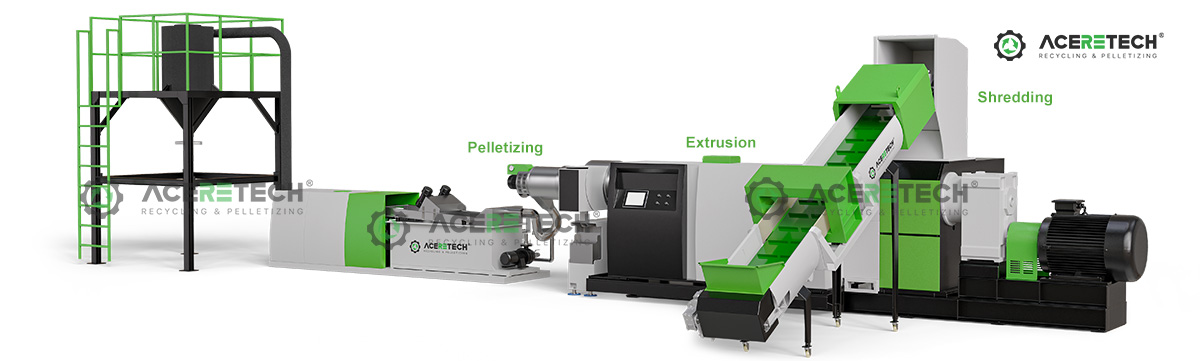
The ASP system employs a highly integrated, all-in-one process workflow:
1️⃣ Online Feeding
Edge trims, off-cuts, and defective products are fed directly into the system
Automated transport is achieved via conveyor belts or pneumatic conveying systems
2️⃣ Shredding / Size Reduction
Irregular waste materials are processed into uniform sizes
Ensures stable and continuous feeding
3️⃣ Extrusion & Plasticization
A single-screw extruder melts and homogenizes the material
Removes certain volatile substances (e.g., moisture)
4️⃣ Pelletizing
The molten plastic is cut into uniform pellets
Available with a choice of air-cooled or water-cooled pelletizing methods
👉 The entire system operates continuously and automatically, synchronized with the main production line.
IV. Typical Application Scenarios for the ASP System
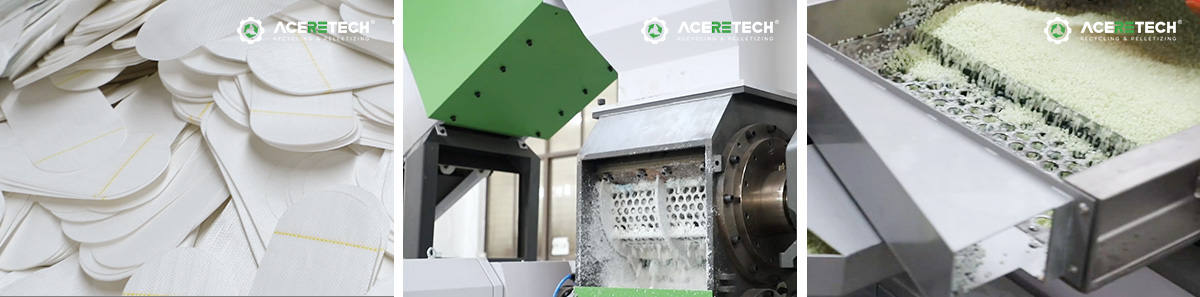
The ASP system is particularly well-suited for production environments where waste is generated continuously:
✔ Film Blowing Industry (PE / PP Film)
Real-time recovery of edge trims and start-up waste
Reduces material loss costs in film production
✔ Sheet Extrusion
Continuous edge trims are ideally suited for online processing
Improves material utilization efficiency
✔ Packaging Manufacturing
Scenarios involving high-frequency waste generation
Offers significant advantages through automation
✔ Injection Molding Industry
Instant recovery of sprues and runners
Minimizes raw material waste
👉 Real-World Case Studies:
👉 PP Woven Bag Recycling Case Study
👉 PE Film Online Recycling Case Study
V. Is the ASP System Right for Your Factory?
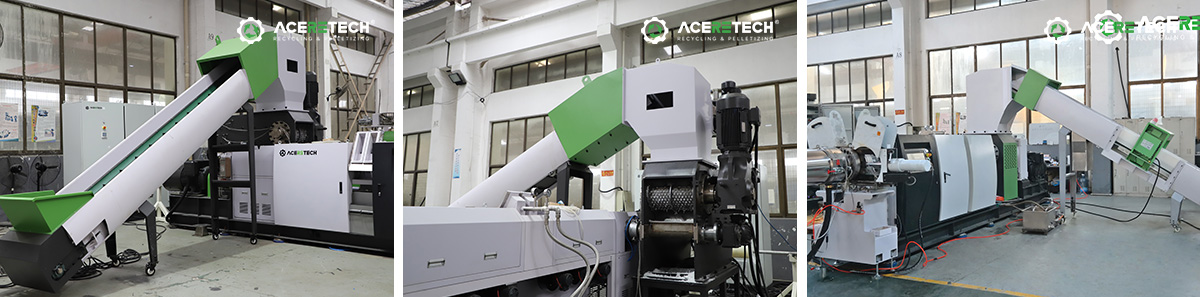
✅ Recommended for:
Consistent and steady generation of scrap/offcuts
High proportion of waste material (recommended: ≥ 5%)
Clear need for cost reduction
Desire to enhance automation levels
❌ Not Recommended for:
Heavily contaminated waste (requiring cleaning)
Non-continuous production (batch-based)
Insufficiently small volume of waste material
VI. Summary
The ASP system is redefining the landscape of plastics manufacturing:
👉 Upgrading from mere "waste disposal" to an integral "part of the production process"
By deploying the ASP system, enterprises can achieve:
Reduced raw material costs (direct profit enhancement)
Increased production efficiency (reduced downtime)
Stable product quality (high pellet consistency)
Realization of green manufacturing (alignment with environmental trends)
FAQ
Q1: Does the ASP system support the recycling of mixed materials?
A: Generally, it is recommended that a single system process only one type of material or materials of similar composition (e.g., PE or PP). Mixing different materials may compromise pellet quality and the performance of the final product; however, if there is a specific requirement to do so, a certain proportion of mixing can be achieved through formula and process optimization.
Q2: Does the system have specific requirements regarding the size and shape of the waste material?
A: The ASP system is equipped with a shredding unit capable of processing irregular materials such as films, edge trims, and lumps. However, for exceptionally large or extremely thick materials, it is recommended to install pre-crushing equipment upstream to enhance overall processing efficiency.
Q3: How is the stability of the recycled pellets guaranteed?
A: Through a stable feeding system, optimized screw design, and precise temperature control (e.g., ceramic heating elements combined with a cooling system), we ensure uniform melting and consistent pellet size, thereby guaranteeing stability when the material is reused.
Q4: Can the ASP system be integrated with existing production lines? Is the modification process complex?
A: Yes, it can. The ASP system supports flexible integration with film blowing, sheet extrusion, or injection molding production lines. Typically, this only requires the installation of conveying equipment (such as conveyor belts or pneumatic transport systems); the modification costs are low, and the impact on the original production line is minimal.
Q5: What is the system's energy consumption? Will it increase production costs?
A: Compared to the transportation, labor, and time costs associated with outsourcing recycling, the ASP system offers lower overall energy consumption costs. Through optimized design—such as the use of high-efficiency motors and energy-saving control systems—the system delivers significant overall cost reductions and efficiency gains.