1. Introduction to PP woven bags
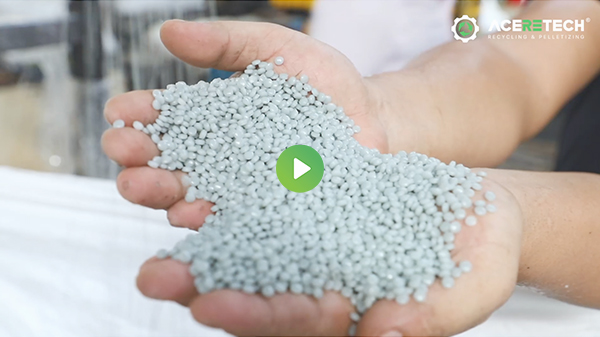
Processing PP woven bags requires a recycling line that can handle high tensile strength and contaminants. Aceretech’s specialized PP woven bag recycling line, powered by the ACSS-H Double Stage system, integrates crushing, compacting, and dual-stage extrusion. This ensures 99% impurity removal and stable pelletizing for materials with heavy ink and high moisture, making it the ideal solution for raffia, jumbo bags, and cement bags.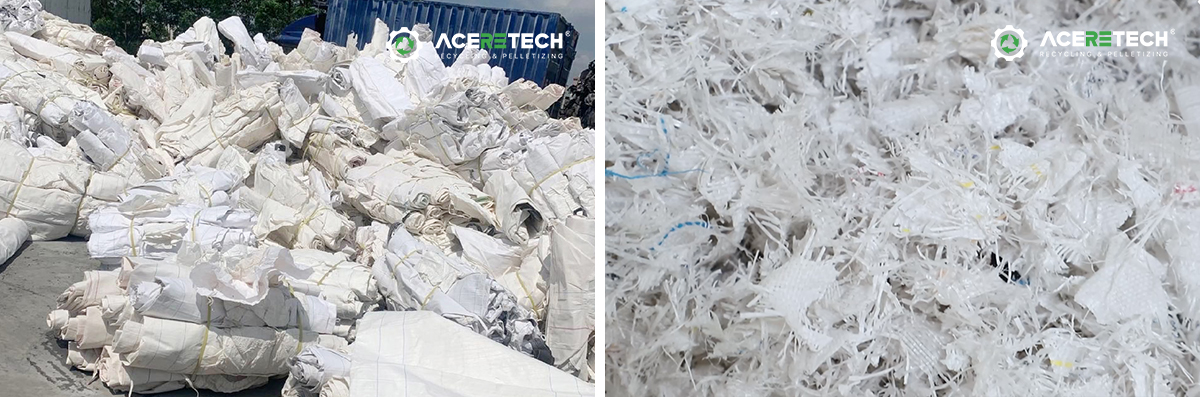
PP woven bags, that is, polypropylene woven bags, are a common packaging material, widely used in packaging in grain, chemical, building materials, feed and other industries. Due to its lightness, toughness, corrosion resistance, and not easy to break, PP woven bags occupy an important position in the market. However, with the increase in the number of uses, PP woven bags will gradually age and break, generating a large amount of waste. Recycling and granulating these wastes can not only save resources, but also reduce environmental pollution.
The "Triple Threat" of Woven Bag Recycling: Why Double Stage is Essential
For procurement managers and plant owners, PP woven bags and raffia present a "Triple Threat" that standard machines cannot handle:
- High Impurity & Ink: Heavy printing and surface debris contaminate the mel
- Moisture & Volatiles: Residual water in bags leads to porous, low-quality pellets.
- Temperature Sensitivity: PP can degrade if held at high heat for too long without precise control.
Aceretech’s ACSS-H™ Double Stage system is specifically engineered to neutralize these threats through a "divide and conquer" extrusion logic.
Engineering Excellence: Inside the ACSS-H™ Dual-Extrusion Process
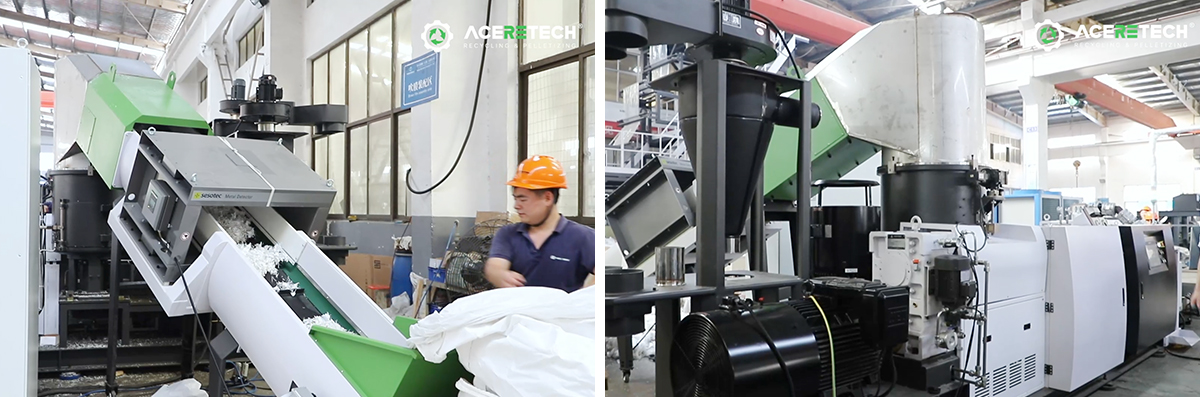
In order to recycle PP woven bag waste efficiently and environmentally friendly, ACERETECH recommended the ACSS two-stage pelletizer to customers. The equipment has the following features:
Pellet barrel capacity: The pellet barrel capacity of the ACSS two-stage granulator is 300L. The larger capacity design enables the equipment to operate continuously and improve production efficiency.
Screw diameter: The equipment adopts a screw diameter design of 80+120mm. The two-stage screw can better achieve plasticization and granulation to ensure the quality of particles.
Dust removal device: Equipped with an efficient dust removal device, it can effectively remove the dust generated during the granulation process and ensure the cleanliness of the working environment.
None-Stop Piston Type filter: The unique None-Stop Piston Type filter design realizes the non-stop network replacement, greatly improves production efficiency, and ensures the purity of particles.
3. PP woven bag recycling granulation process
1. 4-in-1 Integration: One Step to Success
The ACSS-H™ integrated Cutter Compactor handles crushing, compacting, plasticization, and pelletizing in a seamless, automated flow. This ensures a consistent bulk density and pre-heated material feed, regardless of the material's original shape (films, raffias, or woven bags).
2. Two-Stage Extrusion & Double Filtration
This is where the ACSS-H™ outperforms single-stage rivals.
- Stage 1: Focuses on initial melting and the first round of filtration to remove bulk contaminants.
- Stage 2: The melt enters a secondary single-screw extruder for fine homogenization.
- The Benefit: This "Double Filtration" logic ensures that by the time the melt reaches the pelletizer, it is of the highest purity, protecting your downstream injection or blown film equipment.
3. Multiple Exhaust Zones for Gas-Free Pellets
Given the poor fluidity and moisture often found in woven bags, the ACSS-H™ features multiple exhaust/degassing ports. This removes trapped gases and ink volatiles, ensuring the final pellets are dense, uniform, and "bubble-free."
Technical Performance Data: ACSS-H™ Series
The ACSS-H™ provides the technical resilience required for industrial-scale upcycling:
| Technical Metric |
ACSS-H™ Double Stage Advantage |
Strategic Impact |
| System Architecture |
Two sets of Single-Screw Extruders |
Handles high-impurity & sensitive materials |
| Filtration System | Dual Filtration Logic | Protects final product quality (PCR grade) |
| Degassing | Multiple Vacuum Exhaust Ports | Ideal for heavy ink and high moisture bags |
| Applications | PP/PE Woven Bags, Raffia, Filaments, Foam | Maximum Feedstock Versatility |

4. Conclusion
Why Global Recyclers Trust the ACSS-H™ System
Plant owners choose the ACSS-H™ when failure is not an option. It is the "workhorse" for materials with poor fluidity and high temperature sensitivity:
- 🛡️ Superior Homogenization: The dual-stage process ensures a more stable melt temperature, preserving the physical properties of the PP/PE.
- 📈 Direct Re-use: Pellets produced can go directly into production lines for blown film, tube extrusion, or injection molding.
- 🚀 One-Stop Reliability: As a one-stop waste recycling solution provider, Aceretech ensures every component of the ACSS-H™ is optimized for long-term operational stability.
Ready to Transform Challenging Waste into Premium PCR?
Don't let contaminated material hold back your production. The ACSS-H™ Double Stage system is the reliable, high-efficiency solution your facility needs for complex woven bag and film recycling.
Learn more about PP Woven Bag Shredding Case Studies
Learn more about PP Woven Bag Washing Case Studies
👉 [Consult with Aceretech Engineers for a Technical Layout]
Explore the full capabilities of the ACSS-H Double Stage Compacting Pelletizing Line and secure your competitive edge.
Click the link below to watch the factory test video