I. Challenges and Solutions in Lithium-Ion Battery Separator Recycling
With the rapid development of the new energy vehicle, energy storage system, and lithium-ion battery industries, the effective management of plastic waste generated during battery manufacturing has become essential. Lithium-ion battery separators represent a specific category of polymer waste that warrants particular attention.
As critical internal components of batteries, separators are typically made from polyethylene (PE), polypropylene (PP), or related polyolefin materials, characterized by their microporous structure, thinness, and high strength. During production, waste—such as offcuts, rejected units, and other clean manufacturing scraps—may appear in the form of films, rolls, or sheets. Processing these materials requires equipment that ensures stable feeding, optimized cutter design, and reliable continuous operation.
Unlike standard rigid plastics, lithium-ion battery separators are lightweight, flexible, and prone to deformation. Mismatches between feeding mechanisms and cutting methods can lead to issues such as material wrapping, bridging, unstable feeding, or inconsistent output sizes, all of which hinder downstream conveying, sorting, and resource recovery processes.
For clean production waste suitable for mechanical shredding, the ACERETECH HS series single-shaft shredder offers an effective pre-processing solution. By utilizing a hydraulic ram feeder, a low-speed, high-torque drive system, and a shearing action between rotating and stationary blades, the machine shreds separator waste into smaller fragments, facilitating subsequent processing steps.
It is important to note that production waste differs from separators recovered during the dismantling of end-of-life batteries. Materials from used batteries that may contain residual electrolyte or other hazardous components require professional assessment and appropriate safety pre-treatment before a mechanical processing strategy is determined.
II. Why Recycle Lithium-Ion Battery Separators?
Recycling lithium-ion battery separators is not only a matter of reducing plastic waste but is also closely linked to resource utilization efficiency and the overall effectiveness of the recycling process.
1. Reducing Plastic Waste Accumulation
The production of separators can generate trimming scraps, off-spec products, and other waste film. Proper collection, sorting, and pre-treatment can reduce waste accumulation, alleviate storage and handling pressures, and create conditions for subsequent resource recovery.
2. Improving Resource Utilization of Production Waste
For PE or PP separator production waste with known composition, cleanliness, and suitability for recycling, mechanical shredding helps convert large-sized film into material that is easier to transport and process further. Depending on the material's specific composition and the recycling process, subsequent methods such as washing, sorting, or other regeneration treatments can be evaluated.
3. Improving Downstream Processing
Large film sheets, rolls, and scraps may not be suitable for direct entry into downstream equipment. Appropriate shredding pre-treatment can improve material morphology, facilitating the transition to subsequent conveying, sorting, and regeneration stages. However, the final processing outcome depends on the separator structure, material condition, target size, and the configuration of the entire production line.
4. Supporting Plastic Recycling
Provided the material composition is clear, contamination levels are controllable, and downstream processes are compatible, the feasibility of mechanical recycling and regeneration for certain separator production waste can be further evaluated. By properly configuring recycling equipment, enterprises can manage production waste more systematically and enhance material utilization efficiency.
III. Key Technical Challenges in Shredding Lithium-Ion Battery Separators
The unique physical structure of lithium-ion battery separators presents the following challenges during mechanical shredding:
1. Risk of Film Wrapping
Separators typically possess high flexibility and tensile strength. Under unsuitable cutter configurations or operating conditions, the film may wrap around the cutter shafts or form clumps, disrupting continuous equipment operation. Therefore, cutter layout, cutting clearance, rotational speed, and feeding methods must be tailored to the specific material.
2. Insufficient Feeding Stability
Separators have low density and minimal thickness; sheet-like materials are prone to stacking, slipping, or bridging. For rolls and large film sheets, relying solely on the material's own weight may not ensure stable feeding. An effective forced-feeding mechanism helps continuously convey material into the cutting zone, thereby improving feeding stability.
3. Output Size Control
The flexibility of the separator film can result in shredded material taking the form of strips, flakes, or clumps. Actual output size is influenced by factors such as cutter configuration, screen setup (if applicable), material thickness, and operating parameters. Therefore, target sizes must be determined based on downstream process requirements and verified through trial runs.
4. Continuous Operation and Equipment Protection
The load imposed by film-like materials can fluctuate depending on feed volume and material morphology. The equipment requires appropriate load monitoring, overload protection, and control functions to minimize the risk of unplanned downtime and enhance production stability.
IV. ACERETECH HS Series Single-Shaft Shredder: Pre-processing Solution for Lithium Battery Separators
The ACERETECH HS series single-shaft shredder features a hydraulic ram feeding system, a shearing mechanism utilizing moving and stationary blades, and a low-speed, high-torque drive design, making it suitable for the pre-processing shredding of various plastic waste materials.
When processing production waste from lithium battery separators, equipment selection must be evaluated based on factors such as separator material, thickness, feeding method, throughput requirements, and target output size. The key technical features of this series are outlined below.
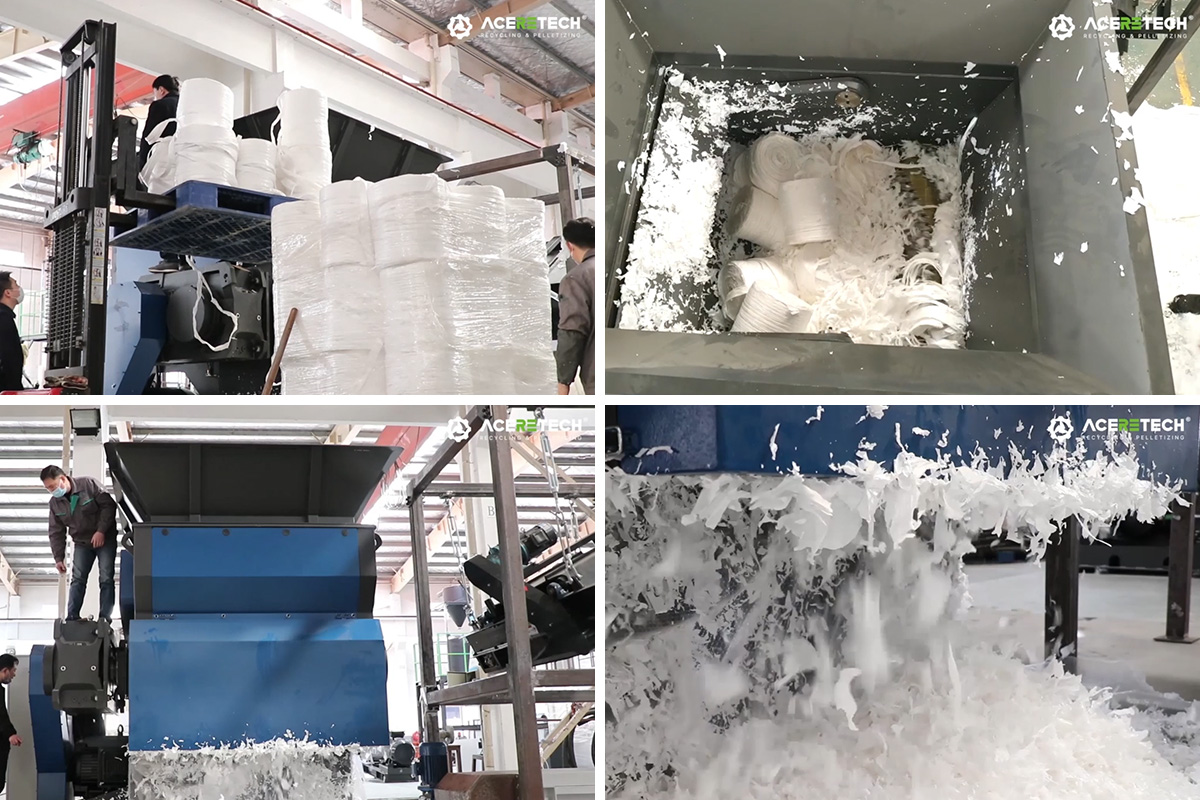
1. Hydraulic Ram Feeding System: Improving Film Feeding Stability
The HS series utilizes a hydraulic ram mechanism to push material from the feed hopper toward the rotating cutter shaft, ensuring a continuous flow of material into the cutting zone.
For separator waste that is lightweight, flexible, and prone to slipping, the ram feeding system helps mitigate the instability often associated with gravity-based feeding. Properly adjusting the ram speed relative to the cutting load improves the continuity of material supply.
Actual feeding performance depends on the separator's thickness, width, stacking characteristics, and equipment operating parameters; it is recommended to determine the optimal configuration through trial runs using representative material samples.
2. V-shaped Rotor Blade Arrangement: Enabling Cooperative Shearing
The HS series utilizes a V-shaped rotor blade arrangement, achieving material cutting through the cooperative action between the rotating blades and the stationary blades.
Compared to processing methods that rely solely on pulling or tearing, this optimized shearing structure enhances control over the cutting process and improves the quality of the shredded material.
For flexible materials like lithium-ion battery separators, the blade configuration must align with the material's specific properties. When dealing with separators of varying thicknesses, strengths, and feed forms, it is essential to evaluate blade configuration, cutting clearance, and output quality through actual testing, rather than relying solely on equipment model specifications to judge processing capability.
3. Low-Speed, High-Torque Drive: Balancing Cutting Power and Operational Stability
The HS series operates at low speeds with high torque, utilizing substantial driving force to shred plastic materials.
This design is well-suited for processing plastic waste that requires consistent cutting force. For separator offcuts with significant tensile strength, low-speed cutting helps maintain control over the process and minimizes the unnecessary loads associated with high-speed rotation.
It is important to note that low-speed, high-torque operation does not guarantee the complete elimination of film wrapping issues. Actual performance remains closely tied to separator characteristics, blade configuration, feed rates, and control parameters.
4. PLC Control System: Providing Overload Protection and Operational Monitoring
The HS series is equipped with a PLC control system that manages equipment operation and provides protection against abnormal loads, depending on the specific configuration.
In the event of an overload, the control system executes protective actions—such as stopping or reversing the machine—based on preset logic to alleviate the abnormal load and reduce the risk of equipment damage. Specific protective functions and automatic control logic depend on the actual machine configuration.
While effective automatic control reduces the need for manual intervention and helps maintain stable operation, it cannot replace necessary operational monitoring, routine maintenance, and safety management.
V. Conclusion: Reliable Shredding Pre-treatment for Lithium-Ion Battery Separator Production Waste
Recycling lithium-ion battery separators places specific demands on equipment regarding feed stability, blade configuration, cutting capability, and automatic control systems. Selecting the appropriate shredding equipment requires a comprehensive assessment of material characteristics, processing objectives, and downstream recycling processes, rather than relying solely on motor power or equipment model specifications.
The ACERETECH HS series single-shaft shredder features a hydraulic ram pusher, a V-shaped rotor knife configuration, a low-speed high-torque drive system, and PLC control; it offers a mechanical shredding pre-treatment solution for production waste from lithium-ion battery separators.
Through proper equipment selection and practical material testing, enterprises can more effectively evaluate processing efficiency, operational stability, and downstream resource recovery pathways for separator waste, thereby supporting the management and recycling of plastic production waste.
FAQ
Q1: What materials can be processed by a lithium battery separator shredder?
A: A lithium battery separator shredder may be suitable for certain PE or PP separator production scrap, including clean edge trim, rejected film, and selected film offcuts. Material composition, thickness, feeding format, and processing requirements should be evaluated before equipment selection.
Q2: Why is lithium battery separator film difficult to shred?
A: Lithium battery separator film is thin, flexible, and mechanically strong. These properties can cause unstable feeding, material wrapping around the rotor, and inconsistent output when the shredder configuration is unsuitable.
Q3: How does a hydraulic pusher improve separator film shredding?
A: A hydraulic pusher feeds material toward the cutting rotor, helping reduce feeding interruptions caused by lightweight or flexible film. Its effectiveness depends on the material dimensions, feeding method, and machine settings.
Q4: Can an HS single shaft shredder process all types of lithium battery separators?
A: Not necessarily. Separator materials vary in polymer composition, thickness, structure, and physical properties. Representative material testing is recommended to confirm shredding performance, throughput, and output size for a specific application.
Q5: Can shredded lithium battery separator film be recycled into plastic pellets?
A: Potentially, depending on the material composition, contamination level, and downstream recycling process. Shredding is a size-reduction step and does not itself produce recycled pellets. Additional sorting, cleaning, drying, and suitable extrusion or pelletizing processes may be required.