I. Efficient Shredding and Crushing of TPU Waste
TPU (Thermoplastic Polyurethane) is prized for its excellent elasticity, as well as its resistance to abrasion, tearing, and oil. It is widely used in applications such as footwear, wire and cable, automotive parts, electronics, industrial products, and more.
Due to the high toughness and elasticity of TPU, processing waste material can present challenges—such as feeding difficulties, material wrapping, reduced processing efficiency, and accelerated blade wear. Consequently, selecting the right shredding and crushing equipment tailored to the material's characteristics is a crucial step in establishing a stable TPU recycling process.
ACERETECH offers a TPU recycling solution combining the HS Series single-shaft shredder and the GF Series high-output plastic granulator. Through a two-stage process—coarse shredding followed by fine granulation—large TPU waste is progressively transformed into uniformly sized TPU flakes, providing ideal feedstock for subsequent washing, sorting, extrusion pelletizing, or direct reuse.
II. TPU Waste and Recycling Challenges

TPU is a thermoplastic polyurethane material with properties that can be tailored to specific applications; consequently, the resulting waste comes in various forms.
Common types of TPU waste include:
TPU production scrap
TPU edge trim
TPU injection molding waste
TPU rejected products
TPU sprues and runners
TPU shoe soles
TPU protective cases
TPU automotive components
Other post-industrial TPU waste
Processing large-sized TPU waste directly in a standard high-speed crusher can make feeding and size reduction difficult. Therefore, practical recycling workflows often employ a low-speed, high-torque shredder for pre-processing, followed by a high-speed crusher for fine crushing.
This staged processing approach optimizes equipment load distribution based on material size and characteristics, thereby enhancing the stability of the entire TPU recycling system.
III. TPU Shredding and Crushing Process
ACERETECH’s TPU shredding and crushing solution primarily consists of two processing stages:
TPU Waste → HS Single-Shaft Shredder → GF Plastic Crusher → TPU Flakes
Stage 1: Primary Shredding with HS Single-Shaft Shredder
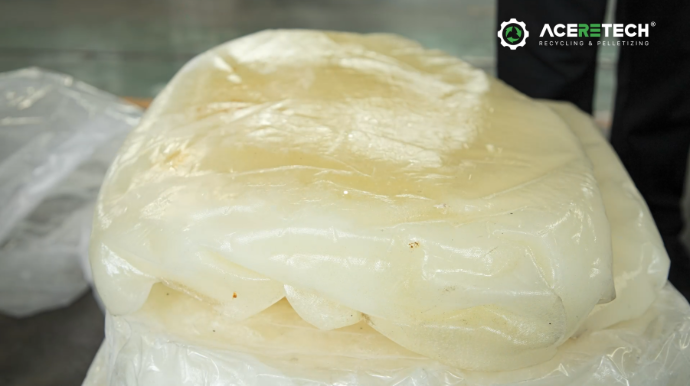
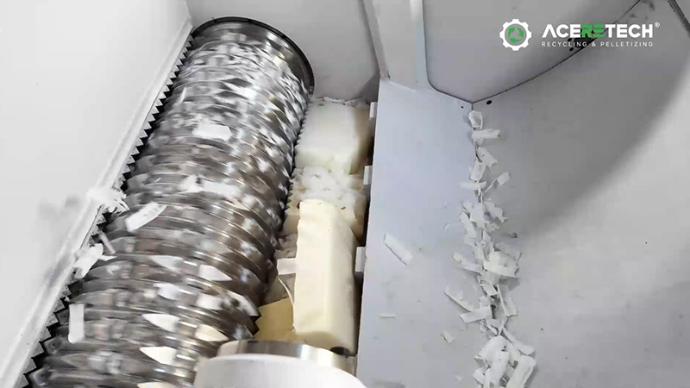
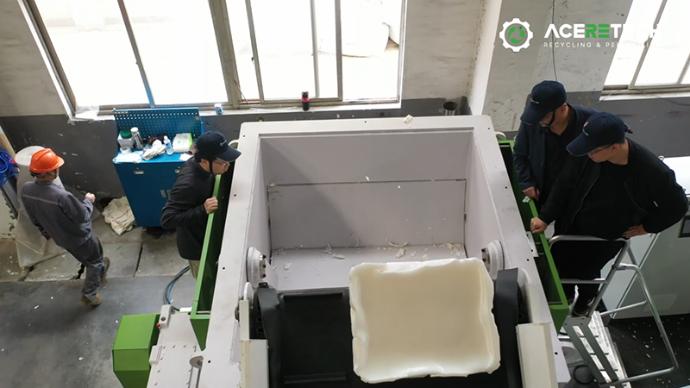
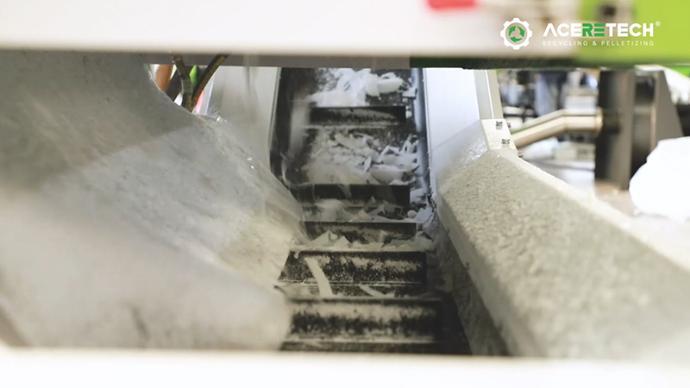
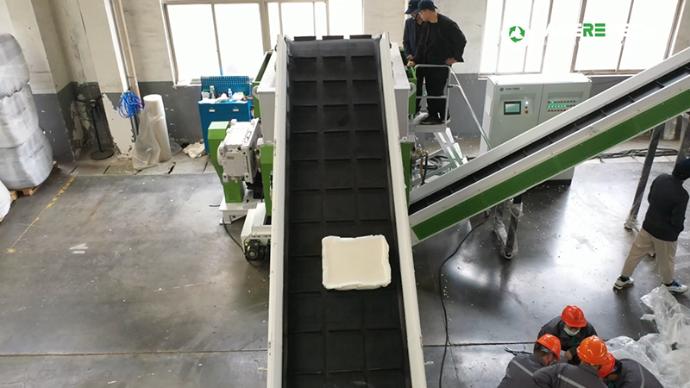
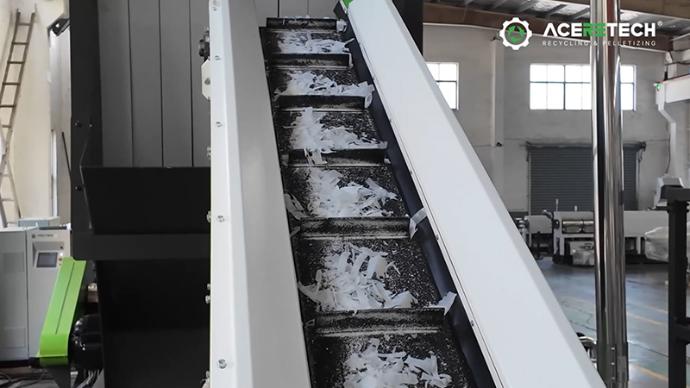
Large pieces of TPU waste first enter the HS series single-shaft shredder.
The HS series utilizes a low-speed, high-torque shredding method. It achieves initial volume and size reduction of large, tough TPU waste through the shearing action between the rotating cutter shaft and the fixed blades.
For TPU blocks, production offcuts, and thick waste products, pre-shredding reduces the feed size for downstream crushing equipment, making the material better suited for the next stage.
The HS series is equipped with a hydraulic ram system that adjusts the pushing speed based on material load, ensuring a continuous feed into the shredding chamber.
Its primary functions include:
Reducing the size of large TPU waste
Improving feeding stability
Reducing feed size for downstream crushing
Handling thick and tough plastic waste
Providing consistent material for the next processing stage
Stage 2: Fine Crushing with GF Plastic Crusher
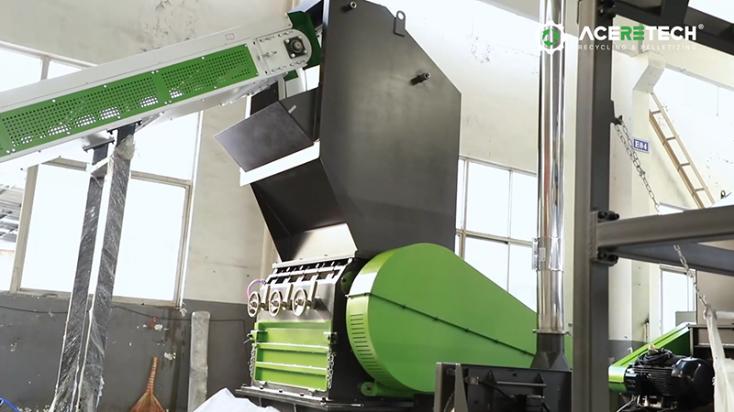
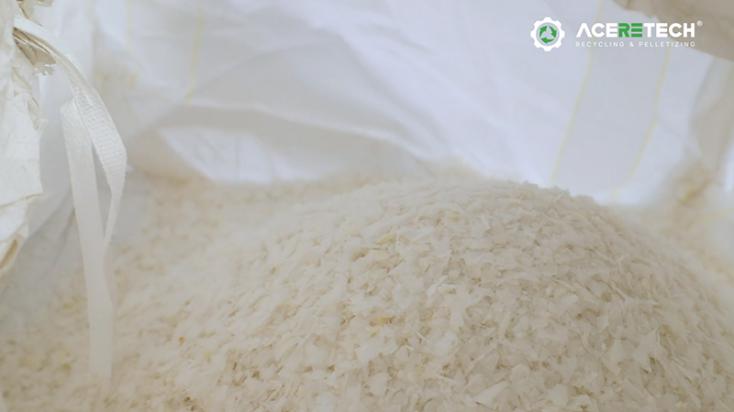
TPU material processed by the HS single-shaft shredder is conveyed into the GF series high-output plastic crusher.
The GF series employs a high-speed rotating cutter rotor to further crush the pre-processed TPU material, using a screen to control the output size.
By changing screens with different aperture sizes, the size of the TPU flakes can be adjusted to meet specific downstream application requirements.
Compared to processing large TPU waste directly, the combination of shredding followed by crushing optimizes feed conditions for the GF crusher, thereby enhancing the stability of continuous operation.
The resulting TPU flakes can proceed to subsequent processes—such as washing, drying, pelletizing, or reuse—depending on specific production requirements.
IV. Why Use a Shredder + Crusher Combination for TPU?
TPU waste possesses inherent toughness and elasticity; therefore, different processing methods are required for waste of varying sizes. The combination of HS and GF units achieves two-stage size reduction through a process of "low-speed, high-torque pre-shredding" followed by "high-speed fine crushing."
HS Single Shaft Shredder: Primary Size Reduction
The HS series is primarily designed to handle large-sized TPU waste.
Its low-speed, high-torque operation makes it ideal for processing thick, large, and tough plastic waste. A hydraulic ram assists in feeding material into the shredding chamber, ensuring consistent intake of bulky items.
The HS series serves as the front-end pre-processing unit in a TPU recycling line, preparing material at an optimal size for the subsequent crushing stage.
GF Plastic Crusher: Secondary Size Reduction
The GF series crusher is primarily responsible for the further size reduction of pre-shredded TPU.
A high-speed rotor works in conjunction with the cutting blades to further reduce the size of the pre-processed material. By using a discharge screen to control particle size, the system produces highly uniform TPU flakes.
Consequently, the GF unit is ideally suited as the secondary crushing stage in the TPU recycling process.
V. Typical TPU Recycling Applications
TPU recycling equipment can be used to process a variety of post-industrial TPU waste streams.
Typical applications include:
1. TPU Production Scrap
Trimmings, defective products, and process waste generated during TPU production can be size-reduced through shredding and granulation, then reintroduced into the material processing workflow.
2. TPU Injection Molding Waste
Runners, sprues, and rejected parts from injection molding can undergo appropriate pre-treatment based on their size before entering the granulation system.
3. TPU Shoe Soles
Large TPU shoe soles and similar products can be coarsely shredded using a single-shaft shredder before undergoing further size reduction in a granulator.
4. TPU Industrial Components
TPU waste parts from automotive, electronic, and industrial products can also be processed using tailored shredding and granulation solutions, depending on material composition, size, and contamination levels.
VI. From TPU Waste to Reusable Recycled Material
TPU recycling is not merely about reducing waste size; it involves establishing a comprehensive material recycling process tailored to the final application. A typical process flow can be designed according to customer requirements as follows:
TPU Waste → Shredding → Crushing → Washing → Drying → Extrusion & Filtration → Pelletizing → Recycled TPU Pellets
For relatively clean production scrap, the pre-processing stage can be simplified based on the material's actual condition, provided the subsequent application allows for it.
Therefore, ACERETECH can tailor the equipment configuration based on factors such as the TPU material type, feed size, contamination level, required output size, and production capacity.
Related Articles
In-house TPU Recycling and Pelletizing Solutions
VII. Advantages of the ACERETECH TPU Recycling Solution
Stable Two-Stage Size Reduction
By utilizing a division of labor between the HS and GF units to progressively reduce the size of large TPU waste, the stability of the entire crushing process is enhanced.
1. Better Handling of Tough TPU Waste
The HS single-shaft shredder features a low-speed, high-torque design, making it ideal for processing large, thick, and tough TPU waste.
2. Adjustable Output Size
The GF granulator controls output dimensions via interchangeable screens, allowing the particle size of the TPU flakes to be adjusted to suit downstream recycling processes.
3. Suitable for Further Recycling
The shredded and granulated TPU flakes serve as feedstock for subsequent stages, including washing, drying, extrusion/filtration, and pelletizing.
4. Flexible System Configuration
ACERETECH can configure the shredding, granulating, and downstream recycling equipment to meet specific customer needs regarding TPU waste type, processing capacity, feed size, and final product specifications.
VIII. TPU Recycling Solution from ACERETECH
When selecting equipment for TPU waste recycling, it is essential to consider the material's toughness, elasticity, size, contamination level, and final product requirements.
ACERETECH’s combination of the HS single-shaft shredder and GF plastic crusher provides a practical two-stage size reduction solution for TPU waste.
Through the synergistic operation of primary shredding and secondary crushing, large TPU waste is processed into uniform TPU flakes, establishing a stable raw material foundation for subsequent recycling and reuse.
If the customer wishes to proceed with the production of recycled TPU pellets, ACERETECH can also configure downstream extrusion, melt filtration, and pelletizing systems based on material characteristics and production capacity requirements, thereby enabling a complete recycling process that transforms TPU waste into recycled material.
FAQ
A: Yes. TPU is a thermoplastic material that can be mechanically recycled, provided the material composition and contamination levels are suitable. TPU waste can be shredded and crushed, then reprocessed through steps such as washing, drying, extrusion, filtration, and pelletizing.
A: TPU shredders are suitable for various types of TPU waste, including production offcuts, edge trims, rejected parts, injection molding waste, shoe soles, protective cases, and other industrial TPU waste. Specific equipment configuration depends on the material's size, thickness, and physical properties.
A: Bulky and tough TPU waste is often difficult to feed directly into a high-speed granulator (crusher). Using a single-shaft shredder reduces the volume of large pieces first, allowing the subsequent granulator to operate with an optimal feed size, thereby enhancing the stability of the overall process.
A: Yes. A complete TPU recycling line can be configured with process stages such as shredding, crushing, washing, drying, extrusion, melt filtration, and pelletizing. The final equipment configuration depends on the type of TPU waste, contamination level, required output, and end-application requirements.
A: Yes. ACERETECH provides plastic recycling equipment and customized recycling system solutions. Based on material characteristics and end-application needs, the system can be configured to cover the entire process flow, from material size reduction to downstream extrusion and pelletizing.