I. Turning Waste Fishing Nets into Recyclable Resources
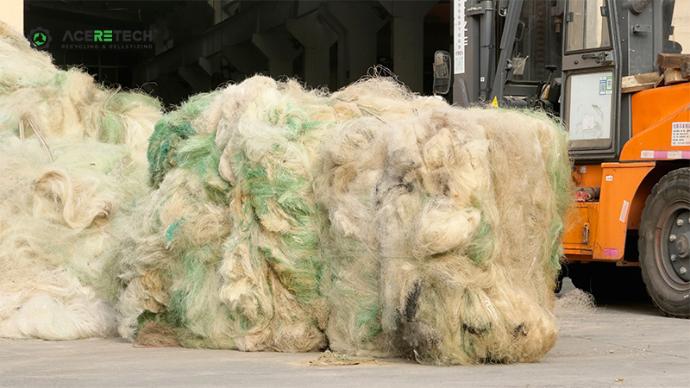
Fishing nets are widely used in commercial fishing, aquaculture, and marine industries. After extended use, damaged, worn-out, or discarded fishing nets can become difficult-to-handle waste due to their flexible structure, high tensile strength, and tendency to become tangled.
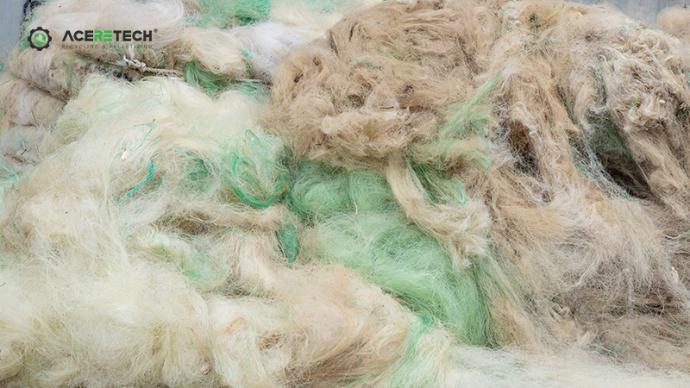
Unlike conventional rigid plastic waste, fishing nets are typically made from long, interwoven polymer fibers. Their flexible structure and resistance to tearing can make size reduction challenging, particularly when conventional shredding equipment is used.
Effective fishing net recycling therefore requires a suitable industrial shredder capable of processing flexible, high-strength materials while maintaining stable operation and consistent output.
In this application test, ACERETECH uses its DTS Series Single Shaft Shredder to process waste fishing nets. Equipped with a specialized disk-type cutting system, forged wear-resistant blades, and an adjustable discharge screen, the DTS shredder provides an integrated size-reduction solution for flexible plastic waste.
The system is designed to reduce fishing nets into smaller pieces for subsequent washing, separation, or other recycling processes, depending on the material composition and recycling requirements.
II. Key Challenges in Waste Fishing Net Shredding
Processing waste fishing nets requires more than simply reducing their physical dimensions. Their material characteristics place specific demands on the shredding system.
1. Flexible Structures and Entanglement Risks
Fishing nets consist of interconnected fibers and mesh structures. During processing, loose netting and long strands may become entangled around rotating components, potentially affecting feeding stability and operational efficiency.
A dedicated cutting structure and appropriate blade arrangement are important for maintaining effective material engagement and reducing the risk of material winding.
2. High Tensile Strength and Cutting Resistance
Many fishing nets are manufactured from durable synthetic polymers, such as nylon (PA), polyethylene (PE), or polypropylene (PP). These materials are designed to withstand demanding working conditions, making them relatively difficult to cut and reduce in size.
The shredder therefore requires durable cutting tools, sufficient mechanical strength, and a reliable drive system.
3. Different Material Conditions and Contamination Levels
Discarded fishing nets may contain sand, mud, salt, marine growth, ropes, metal weights, or other foreign materials.
Before shredding, appropriate sorting and inspection are recommended to remove unsuitable contaminants and identify the material composition. This helps protect cutting components and supports more effective downstream recycling.

III. ACERETECH DTS Single Shaft Shredder for Fishing Net Recycling
The ACERETECH DTS Series is specifically designed for flexible plastic materials, including films, woven bags, fibers, filaments, fabrics, and yarns.
Unlike conventional two-step shredding and crushing arrangements, the DTS integrates shredding and crushing functions into one machine. Its disk-type blade configuration reduces material size through a coordinated cutting arrangement, providing a practical preprocessing solution for flexible plastic recycling.
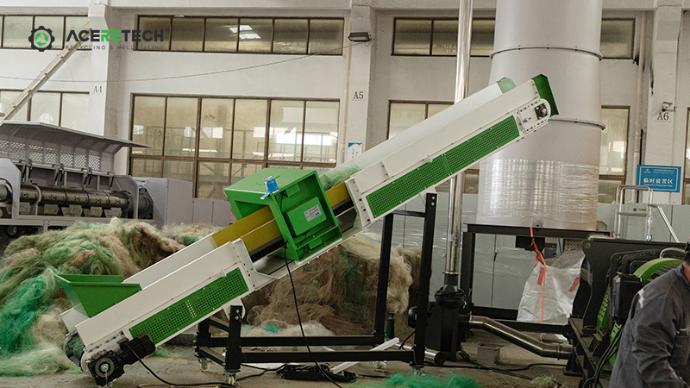
During this fishing net recycling test, the DTS shredder is equipped with a belt conveyor feeding system and a single-shaft cutting structure.
1. Specialized Disk-Type Cutting System
The DTS shredder adopts a single-shaft rotor equipped with specially arranged disk-type blades. The cutting configuration is designed to engage flexible materials and progressively reduce their size.
For fishing net applications, the blade arrangement helps cut interconnected net structures into smaller sections, making the material easier to collect and handle for subsequent processing.
The rotor operates at 54.5 rpm in this test configuration, providing controlled mechanical cutting for the tested material.
2. Forged Wear-Resistant Blades
The rotating blades are manufactured from forged, high-strength wear-resistant materials to withstand repeated cutting forces and demanding operating conditions.
The stationary knife is made of forged H13 tool steel, with a Rockwell hardness of 54–57 HRC.
The combination of durable rotating blades and hardened stationary knives provides a reliable cutting interface, helping maintain cutting performance and reduce premature wear during continuous operation.
3. High-Strength Shredder Shaft
The DTS shredder shaft is forged from alloy structural steel and precision-machined using CNC equipment to meet high manufacturing accuracy requirements.
A standard spline connection is used between the main shaft and the knife disks, providing reliable torque transmission and structural stability under demanding cutting conditions.
The shaft material is equivalent to materials used by leading European brands and undergoes quenching and tempering heat treatment, achieving a hardness of HB250–280.
This robust shaft design supports the machine's ability to handle demanding flexible plastic shredding applications.
4. Reliable Drive System and Branded Motor
The main motor adopts the WEG brand, offering reliable power output and high transmission efficiency.
Between the main machine and the gearbox, a drum-shaped gear coupling is installed to provide strong torque transmission capacity.
The gearbox features a high-strength ductile iron housing and a durable internal gear structure, supporting stable power transmission under heavy-duty operating conditions.
Together, these components provide a dependable drive system for continuous plastic shredding operations.
5. Heavy-Duty Cutting Chamber and NSK Bearings
The DTS cutting chamber adopts a welded 16Mn steel structure, providing the mechanical strength required for demanding industrial applications.
The machine is equipped with NSK bearings, including thrust ball bearings, tapered roller bearings, angular contact ball bearings with locking outer rings, and spherical roller bearings.
These bearing configurations support stable shaft operation and accommodate different radial and axial loads during machine operation.
6. Adjustable Discharge Screen for Flexible Output Control
The DTS shredder features an adjustable screen mechanism at the discharge outlet, allowing the output particle size to be configured according to specific processing requirements.
For this fishing net test, the specified output particle size is approximately 20–100 mm, with customized sizes available depending on the application.
The discharge system also incorporates a scraper manufactured from forged hot-work die steel and precision-machined for improved wear resistance.
This design helps reduce material loss caused by continuous friction and supports reliable discharge performance.
7. Intelligent Control System
The DTS shredder is equipped with a PLC-based intelligent control system.
The control system can monitor the shredder's operating current and coordinate the start and stop signals of the feeding conveyor according to machine operating conditions.
This coordinated feeding arrangement helps regulate material input, reduce unnecessary feeding pressure, and support stable equipment operation.
IV. Fishing Net Shredding Test: DTS Machine Configuration and Performance
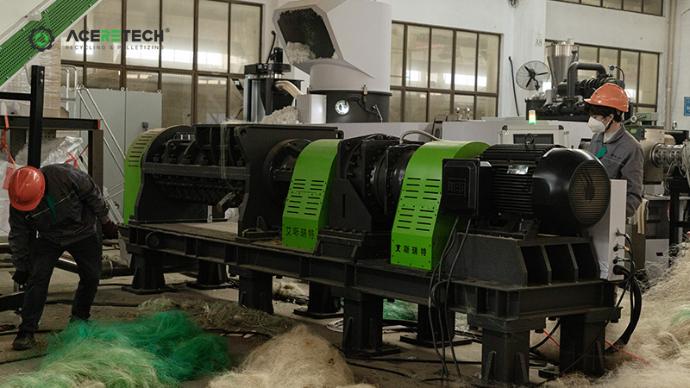
During the ACERETECH factory test, the DTS Series Single Shaft Shredder was configured to process waste fishing nets.
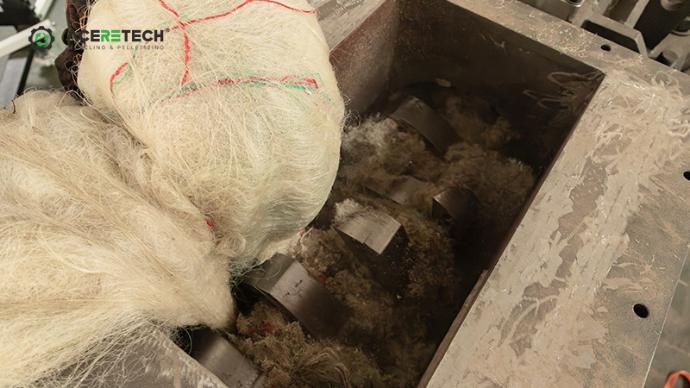
A belt conveyor was used to deliver the material into the shredding chamber, where the single-shaft disk-type cutting system reduced the netting into smaller pieces.
The following table summarizes the main configuration and technical specifications used in this test.
| Parameter |
Specification |
| Equipment Model |
DTS Series Plastic Shredder |
| Test Material | Waste Fishing Nets |
| Feeding System | Belt Conveyor |
| Effective Cutting Area | 1800 × 400 mm |
| Feeding Opening | 750 × 600 mm |
| Number of Shafts | 1 |
| Rotor Speed | 54.5 rpm |
| Rotor Diameter | 400 mm |
| Blade Material | Forged Wear-Resistant High-Strength Material |
| Control System | Intelligent PLC Control |
| Processing Capacity | 1,000–2,000 kg/h |
| Output Particle Size | 20–100 mm |
Note: The stated processing capacity is a reference range. Actual throughput depends on the fishing net material, feeding conditions, mesh structure, bulk density, and other physical characteristics. The discharge size can be customized according to specific requirements.
Test Results and Processing Considerations
The DTS shredder combines feeding, cutting, and discharge functions in one integrated machine.
For waste fishing net recycling, the resulting shredded material can serve as a preprocessing feedstock for subsequent recycling operations.
The actual downstream process depends on the polymer composition, contamination level, moisture content, and required recycled product specifications.
V. From Fishing Net Shredding to Further Recycling
Shredding is an important preliminary stage in a complete waste fishing net recycling process. However, it is not necessarily the final treatment step.
Depending on the material condition and recycling objectives, the subsequent process may include:
1. Washing and Contaminant Removal
Discarded fishing nets may contain sand, salt, mud, algae, and other surface contaminants. A suitable washing system can help remove these impurities and improve the quality of the recovered plastic material.
2. Plastic Pelletizing
After appropriate pretreatment, compatible plastic materials can be processed through an extrusion and pelletizing system to produce recycled plastic pellets.
For example, nylon (PA), PE, and PP fishing nets may require different processing conditions and recycling configurations. Material identification and testing are therefore important before selecting a complete recycling line.
ACERETECH can provide corresponding shredding, washing, and pelletizing equipment according to the customer's raw materials and production requirements.
Related Recycling Applications
PA Fiber Recycling & Pelletizing Solution
Explore a dedicated recycling and pelletizing solution for waste PA fibers.
Read More: PA Fiber Recycling and Pelletizing
PET Fiber Shredding and Pelletizing
To learn more about the PET fiber recycling process, including shredding and pelletizing solutions, explore our detailed application case study.
Read More: PET Fiber Recycling Solution
VI. Why Choose ACERETECH DTS for Flexible Plastic Shredding?
The DTS Series is designed for applications where flexible plastic materials require effective size reduction before further recycling.
Its key technical features include:
Integrated Shredding and Crushing: Combines two size-reduction functions in one machine, reducing the need for a separate conventional shredding and crushing arrangement.
Specialized Disk-Type Blades: Designed for processing flexible materials such as fishing nets, films, fibers, and woven bags.
Heavy-Duty Mechanical Structure: Alloy steel forged shaft, 16Mn cutting chamber, and durable cutting components support demanding industrial applications.
Reliable Drive Components: WEG main motor, robust gearbox, and NSK bearings support stable mechanical operation.
Adjustable Discharge Size: Screen configuration can be adapted to different downstream processing requirements.
Intelligent Feeding Control: PLC-based control coordinates conveyor feeding with shredder operating conditions.
For customers processing waste fishing nets and other flexible plastic materials, selecting an appropriate shredder is an important step toward establishing an efficient recycling process.
VII. Conclusion: A Practical Fishing Net Shredding Solution
Effective fishing net recycling starts with suitable size-reduction equipment. Due to their flexible structure, high tensile strength, and potential contamination, discarded fishing nets require a shredder with a reliable cutting system and durable mechanical components.
The ACERETECH DTS Series Single Shaft Shredder integrates shredding and crushing functions, featuring forged wear-resistant blades, a high-strength alloy steel shaft, an adjustable discharge screen, and intelligent PLC control.
With a reference processing capacity of 1,000–2,000 kg/h and an adjustable output particle size of 20–100 mm, the DTS provides a practical fishing net shredding solution for flexible plastic waste preprocessing.
Whether processing waste fishing nets, plastic fibers, films, woven bags, or other flexible materials, ACERETECH can help customers evaluate suitable shredding configurations based on their material characteristics and recycling requirements.
Looking for an industrial fishing net shredder or a customized plastic recycling solution? Contact ACERETECH to discuss your application and arrange a material test.
FAQ
A: Fishing nets are flexible and may become entangled during shredding. The DTS Series uses a specialized disk-type blade arrangement designed for flexible material processing. Proper blade configuration, feeding conditions, and material preparation are important for maintaining stable operation.
A: The reference processing capacity of the DTS configuration is 1,000–2,000 kg/h. Actual output depends on material composition, mesh structure, feeding conditions, bulk density, and physical characteristics.
A: The specified output particle size is approximately 20–100 mm. The discharge screen can be adjusted or customized according to the customer's downstream processing requirements.
A: The DTS Series is designed for various flexible plastic materials, including agricultural films, packaging films, PE films, PP woven bags, bulk bags (FIBCs), fibers, filaments, fabrics, and yarns.
A: ACERETECH provides plastic shredding, washing, and pelletizing equipment. A suitable recycling line can be configured according to the fishing net material, contamination level, required processing capacity, and final product specifications.