I. Stable Size Reduction of Thin and High-Toughness LCP Film
LCP (Liquid Crystal Polymer) film is a high-performance engineering material used in demanding applications where heat resistance, electrical performance, and dimensional stability are important.
During LCP film manufacturing and converting, production scrap such as edge trims, off-spec film, and defective film can be generated.
Compared with conventional rigid plastic scrap, LCP film is thin, lightweight, flexible, and relatively difficult to grip during size reduction. The material can also become tangled during feeding and shredding.
For this application, ACERETECH uses an HS Series Single-Shaft Shredder with a belt conveyor feeding system to process LCP film waste.
The application focuses specifically on the front-end shredding and size reduction of LCP film.
The processed material can then be transferred to subsequent processes according to the customer's requirements.
II. Application Background
LCP film is used in applications such as:
• Flexible Printed Circuits (FPC)
• High-frequency and high-performance electronic components
• 5G communication components
• Precision industrial applications
• Other high-performance applications
Because LCP is a high-value engineering plastic, production scrap represents a significant amount of recoverable material.
Typical waste generated during film production or converting may include:
• Edge trims
• Film offcuts
• Defective film
• Off-spec film
• Production scrap
Instead of treating this material as conventional plastic waste, the customer can recover the material through controlled size reduction and subsequent recycling processes.
III. Why Is LCP Film Difficult to Shred?
LCP film has several physical characteristics that make it more challenging to process than rigid plastic scrap.
1. Thin and Lightweight
The film has a low bulk density and can be difficult for conventional cutting equipment to grip effectively.
2. Flexible
Instead of breaking like rigid plastic, flexible film can deform and move with the rotor.
3. Smooth Surface
The smooth surface makes it more difficult for the cutting system to maintain stable contact with the material.
4. Tendency to Entangle
If feeding and rotor design are not properly matched to the material, film can wrap around the rotor and cause unstable operation.
5. Sensitivity to Heat
Excessive friction during shredding can generate heat. For high-value LCP material, minimizing unnecessary thermal impact is important.
These characteristics make stable feeding and controlled shearing particularly important in this application.
IV. Application Process
The actual application presented here is intentionally simple:
LCP Film Waste → Belt Conveyor → HS Single-Shaft Shredder → Shredded LCP Film → Subsequent Processing
The scope of this case study ends at the shredding stage.
The downstream process can be selected according to the customer's final application and material requirements.
1. Belt Conveyor Feeding
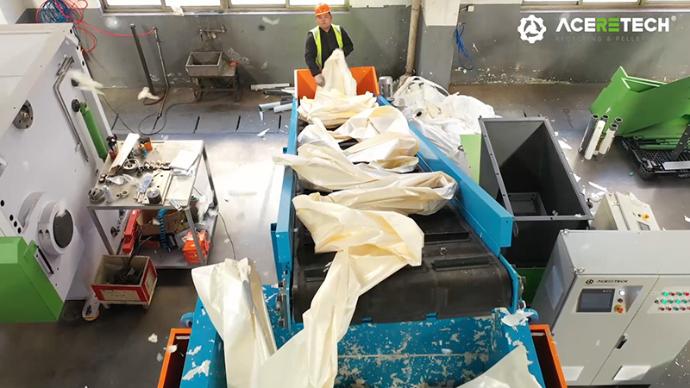
The LCP film is first loaded onto the belt conveyor.
Because the material is lightweight and flexible, controlled continuous feeding is important.
The belt conveyor provides a more stable material flow compared with manually feeding large quantities of loose film directly into the shredder.
It helps:
• Maintain continuous feeding
• Distribute material more evenly
• Reduce sudden material loading
• Improve the stability of the shredding process
For this application, the belt conveyor is part of the actual project configuration.
2. HS Single-Shaft Shredding
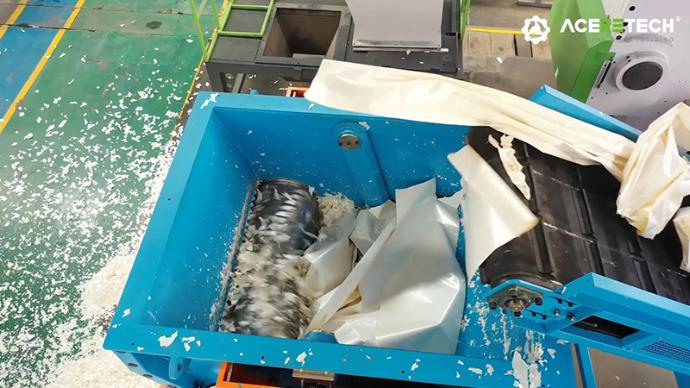
After conveying, the LCP film enters the HS Series Single-Shaft Shredder.
The main purpose of the HS shredder in this application is to reduce the size of the LCP film while maintaining stable material feeding and avoiding excessive entanglement.
The HS series uses a low-speed, high-torque shredding principle combined with a hydraulic feeding system and V-type rotor arrangement.
This configuration is particularly suitable for flexible film materials.
3. Hydraulic Forced Feeding
One of the important challenges when processing LCP film is maintaining continuous contact between the material and the cutting rotor.
The HS shredder uses a hydraulic forced feeding system to push the film toward the rotor.
The hydraulic ram helps:
• Maintain pressure on the material
• Reduce material slippage
• Improve contact between film and cutting blades
• Reduce idle rotor operation
• Maintain more stable shredding
This is particularly useful for thin and flexible film that would otherwise tend to move away from the cutting area.
4. V-Type Rotor for Controlled Shearing
The HS shredder uses a V-type rotor blade arrangement.
For film applications, the rotor design provides progressive cutting rather than relying primarily on impact.
The cutting action helps the machine:
• Grip flexible film
• Reduce material slippage
• Control the cutting process
• Reduce unnecessary impact
• Improve output consistency
For LCP film, controlled shearing is particularly valuable because excessive friction and uncontrolled material movement should be minimized.
5. Low-Speed Shredding and Heat Control
LCP is a high-value engineering plastic, so maintaining material quality during processing is important.
The HS shredder uses a low-speed, high-torque cutting principle.
Compared with high-speed impact-type size reduction, the cutting process is designed to reduce unnecessary frictional heat generation.
The objective is not to claim that shredding produces zero heat.
Rather, the machine is designed to minimize unnecessary thermal impact during size reduction.
This helps protect the value of the LCP material for subsequent recycling processes.
6. Shredded LCP Film
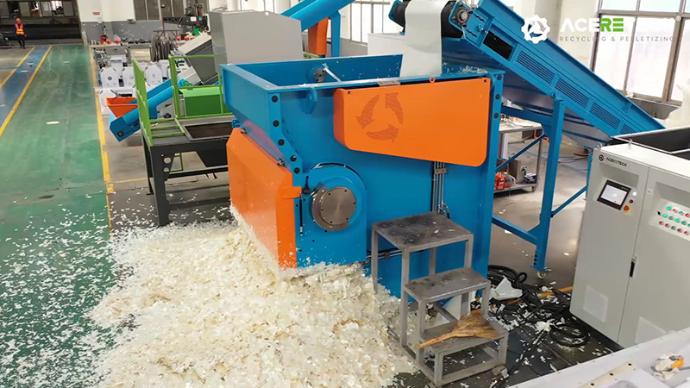
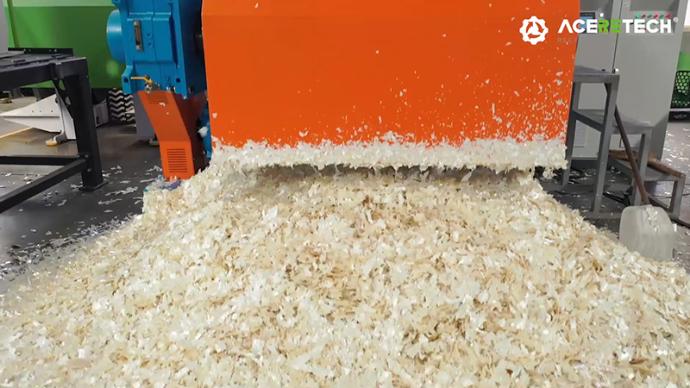
After passing through the HS shredder, the LCP film is converted into smaller shredded pieces.
The shredded material provides a more manageable feedstock for subsequent processing.
Compared with the original large rolls, trims, or film scrap, the shredded material is:
• Smaller
• Easier to convey
• Easier to handle
• More suitable for downstream processing
The final particle size can be selected according to the actual application requirements through the appropriate screen configuration.
The purpose of this case is therefore controlled size reduction, rather than defining a specific final pellet size.
V. Application Configuration
| Item |
Application Configuration |
| Feedstock |
LCP film production scrap |
| Material | LCP film |
| Application | Film shredding / size reduction |
| Feeding | Belt conveyor |
| Main Equipment | HS single-shaft shredder |
| Feeding System | Hydraulic forced feeding |
| Rotor | V-type rotor |
| Shredding Principle | Low-speed, high-torque shearing |
| Output | Shredded LCP film |
| Downstream | According to customer's requirements |
The configuration above reflects the application presented in this case study. The original website content also identifies the HS series' belt conveying, hydraulic feeding, V-type rotor and low-speed/high-torque shredding characteristics.
VI. Why Use the HS Shredder for LCP Film?
The key requirement in this application is not simply reducing the size of the film.
The equipment needs to handle a material that is:
1. Thin + Flexible + Smooth + High-Value
The HS shredder addresses these characteristics through a combination of:
2. Stable Belt Feeding
Provides continuous material delivery to the shredder.
3. Hydraulic Forced Feeding
Keeps the lightweight film engaged with the rotor.
4. V-Type Rotor
Provides progressive shearing and improved gripping of flexible film.
5. Low-Speed Operation
Helps reduce unnecessary frictional heat during shredding.
6. High Torque
Provides the cutting force required for high-toughness film materials.
Together, these features provide a controlled shredding process for LCP film.
VII. Application Value
The value of this application comes from recovering high-value LCP production scrap through controlled front-end processing.
1. Stable Film Feeding
The belt conveyor and hydraulic feeding system help maintain a stable material flow.
2. Reduced Film Entanglement
The combination of forced feeding and V-type rotor design helps reduce slippage and uncontrolled wrapping.
3. Controlled Size Reduction
The HS shredder converts large or continuous LCP film scrap into smaller shredded material.
4. Reduced Thermal Impact
The low-speed cutting principle helps minimize unnecessary frictional heat during shredding.
5. Preparation for Subsequent Recycling
The shredded LCP film can be transferred to the customer's subsequent processing stage.
VIII. From LCP Film Scrap to Shredded Material
The application can be summarized as:
LCP Film Scrap → Belt Conveyor → Hydraulic Forced Feeding → HS Single-Shaft Shredder → Controlled Shearing → Shredded LCP Film → Customer's Subsequent Process
The process provides a controlled front-end size-reduction solution while leaving the downstream recycling process open to the customer's specific requirements.
IX. Application Summary
This application demonstrates the use of an HS Series Single-Shaft Shredder for LCP film waste.
The main challenge is the physical nature of LCP film: it is thin, flexible, smooth, lightweight, and prone to tangling.
The actual application combines:
Belt Conveyor → Hydraulic Forced Feeding → HS Single-Shaft Shredding
to produce a more manageable shredded LCP material.
The focus of this case study is LCP film shredding and size reduction.
The shredded material can subsequently enter pelletizing or other downstream processes according to the customer's requirements.
This case therefore demonstrates the front-end processing capability of the HS shredder, rather than presenting a complete LCP recycling line.
Have LCP Film Scrap to Recycle?
If your production generates high-value LCP film scrap and you need a stable solution for front-end size reduction, ACERETECH's HS Series Single-Shaft Shredder provides a controlled approach to processing thin and flexible film.
The application presented here combines:
Belt Conveyor → Hydraulic Forced Feeding → HS Shredding
to convert LCP film scrap into a more manageable shredded material for subsequent processing.
Contact ACERETECH to discuss your LCP film shredding requirements.
FAQ
1️⃣ Can the shredded LCP film be pelletized?
A: Yes, the shredded material can potentially be used as feedstock for a subsequent extrusion and pelletizing process, depending on the customer's complete recycling requirements. The original application also identifies pelletizing as a possible downstream process.
2️⃣ Why is LCP film difficult to shred?
A: LCP film is thin, lightweight, flexible, and smooth. These characteristics can make feeding, gripping, and cutting more difficult than processing rigid plastic materials.
3️⃣ How does the HS shredder handle flexible LCP film?
A: The system combines belt conveyor feeding, hydraulic forced feeding, and a V-type rotor to improve material engagement with the cutting system.
4️⃣ Does the HS shredder use high-speed impact crushing?
A: No. The HS shredder uses a low-speed, high-torque shearing principle.
5️⃣ Does shredding affect the properties of LCP?
A: No. The HS shredder uses a low-speed, high-torque shearing principle.
Q5. Does shredding affect the properties of LCP?
Any mechanical processing of polymers can generate some heat. The HS design focuses on controlled feeding, low-speed operation, and shearing to minimize unnecessary frictional heat and help preserve the material's value.