I. From Large Plastic Purge Lumps to Uniform Recyclable Flakes
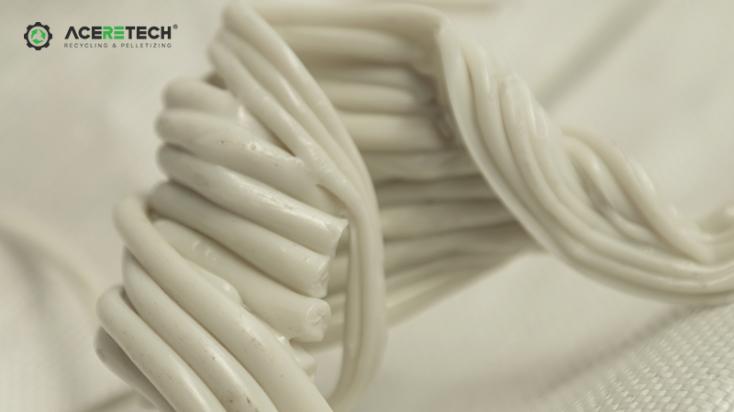
Plastic purge lumps are commonly generated during extrusion, injection molding, machine start-up, material changeovers, and production cleaning.
These materials are typically large, dense, and irregularly shaped. Their physical characteristics make them difficult to feed directly into conventional granulation or crushing equipment.
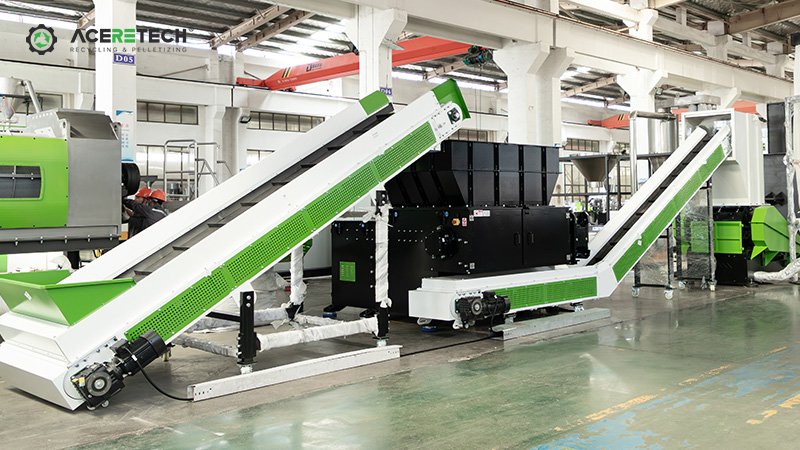
For this application, ACERETECH uses a two-stage size reduction system consisting of an SR1400 single-shaft shredder and a downstream plastic crusher.
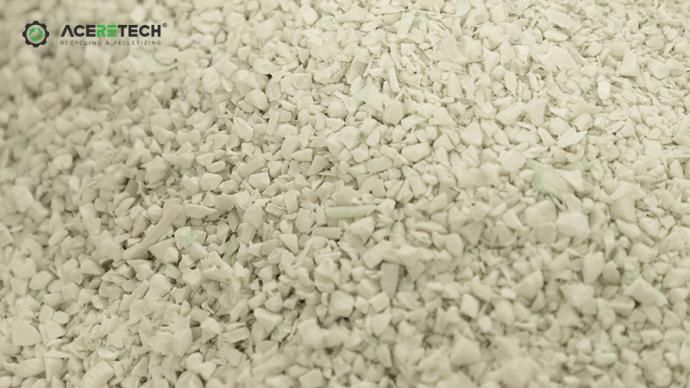
The process reduces large purge lumps through primary shredding and secondary crushing, producing more uniform plastic flakes for subsequent recycling processes.
The application can be summarized as:
Plastic Purge Lumps → SR1400 Shredding → Secondary Crushing → Approx. 14 mm Flakes
The focus of this application is size reduction and material preparation, rather than complete downstream pelletizing.
II. Application Background
Plastic purge lumps are generated as part of normal plastic processing operations.
Typical sources include:
• Extrusion purge material
• Injection molding purge lumps
• Machine startup waste
• Production changeover waste
• Extrusion head waste
Unlike loose film or small production scrap, purge lumps are usually:
• Large
• Dense
• Irregular in shape
• Relatively hard
These characteristics make direct feeding into conventional crushers or pelletizing equipment difficult.
The first requirement is therefore to reduce the size of the material before further processing.
III. The Main Challenge: Large and Dense Purge Lumps
The biggest challenge in this application is the physical form of the incoming material.
Large purge lumps can be difficult to:
• Feed continuously
• Cut with conventional high-speed equipment
• Process directly through a granulator
• Maintain stable downstream material flow
This is why the application uses two different size-reduction stages.
Primary Stage
Low-Speed, High-Torque Shredding
Handles the large and dense purge lumps.
Secondary Stage
High-Speed Crushing
Further reduces the shredded material into smaller and more uniform flakes.
The two machines therefore perform different functions rather than duplicating each other.
IV. Application Process
The actual process presented in this application is:
Plastic Purge Lumps → SR1400 Single-Shaft Shredder → Coarse Shredded Material → Plastic Crusher → Approx. 14 mm Plastic Flakes → Subsequent Recycling Process
The current application uses approximately 40 mm screen size in the shredder for rigid plastics, followed by a crusher with a 14 mm screen.
1. SR1400 Primary Shredding
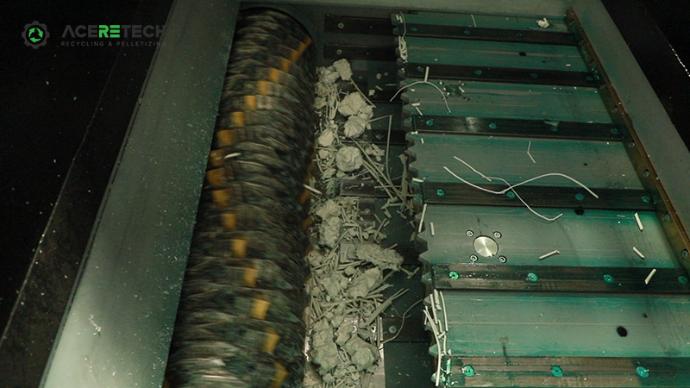
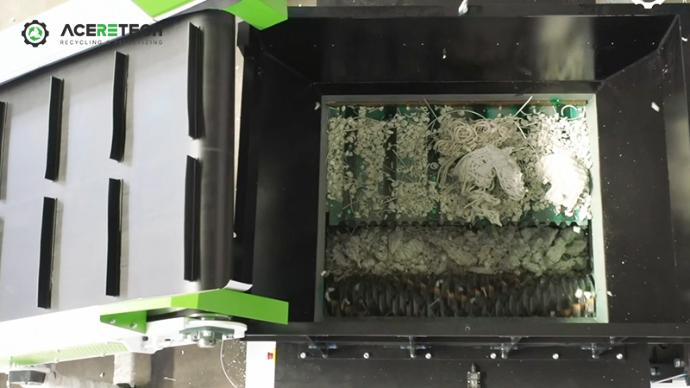
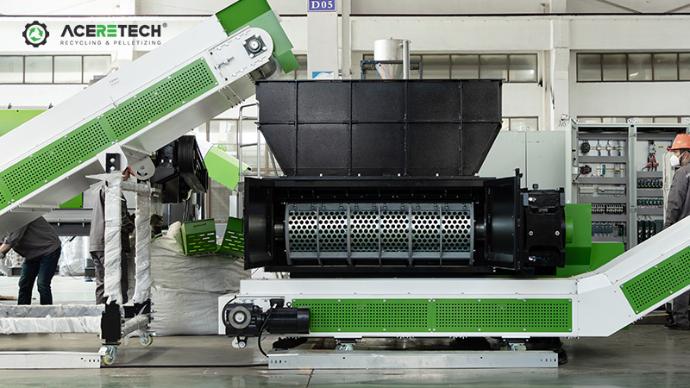
The first stage uses the SR1400 Single-Shaft Plastic Lump Shredder.
The SR1400 is designed for large and rigid plastic materials, including:
• HDPE lumps
• PP lumps
• ABS lumps
• Injection molding purge lumps
• Extrusion head waste
The main function of this stage is coarse size reduction.
The shredder uses a low-speed, high-torque cutting system to process the large purge lumps.
This makes the material substantially smaller and easier to handle in the downstream crusher.
2. Hydraulic Ram Feeding
The SR1400 uses a hydraulic ram feeding system to push the purge lumps toward the cutting rotor.
This is particularly useful for large, irregularly shaped material.
The hydraulic feeding system helps:
• Push dense material into the cutting chamber
• Maintain continuous feeding
• Reduce the possibility of material blockage
• Adapt feeding according to the material load
For hard purge lumps, controlled forced feeding is an important part of stable primary shredding.
3. SR1400 Shredding Configuration
The application page specifies the following SR1400 configuration:
| Item | Specification |
| Shredding Chamber |
830 × 1302 mm |
| Rotor Diameter |
400 mm |
| Screen Mesh Size | 40 mm for rigid plastics |
| Discharge Height | 610 mm |
| Feeding System | L-type conveyor belt |
The purpose of this stage is not to produce the final flake size.
Instead, it prepares the large purge lumps for secondary crushing.
4. Secondary Crushing
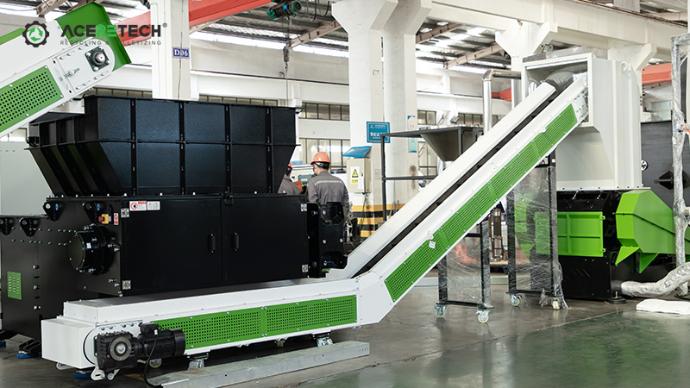
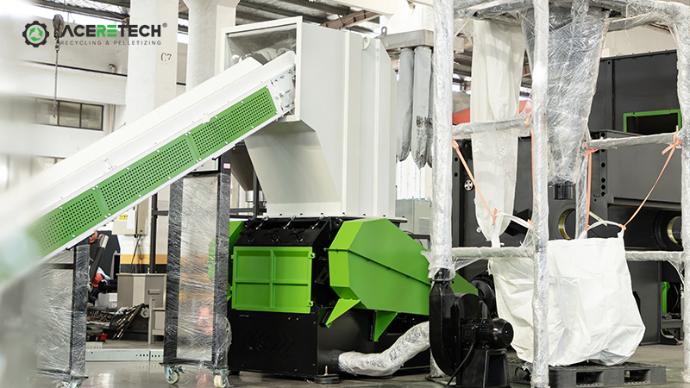
After primary shredding, the material enters the downstream plastic crusher.
The crusher performs the second stage of size reduction.
Its purpose is to further reduce the coarse shredded plastic into smaller and more uniform flakes.
For the application presented on the page, the crusher is configured with:
• 500 mm rotor diameter
• 800 mm rotor width
• 485 × 800 mm crushing chamber
• 14 mm screen
• 37 kW motor
The two-stage configuration therefore follows a clear division of responsibilities:
Shredder = handle large purge lumps
Crusher = produce smaller, more uniform flakes
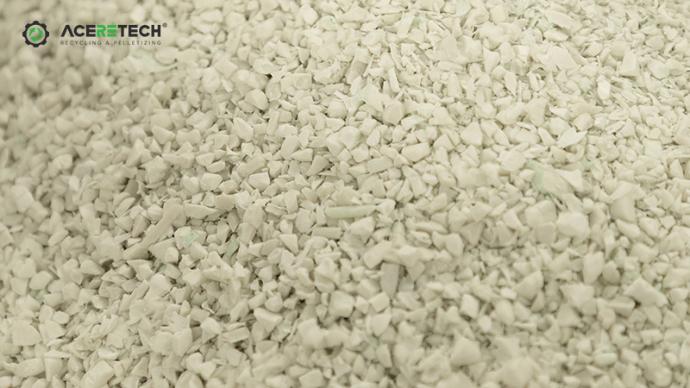
5. Final Output: Approx. 14 mm Plastic Flakes
After secondary crushing, the material passes through the 14 mm screen.
The result is a more uniform plastic flake material suitable for subsequent recycling processes.
Compared with the original purge lumps, the final material is:
• Smaller
• More uniform
• Easier to convey
• Easier to store
• More suitable for downstream processing
The final output in this application should therefore be understood as recyclable plastic flakes, not finished recycled pellets.
6. Why Use Shredding Before Crushing?
This is one of the most important points of the application.
A large purge lump and a small plastic flake require completely different cutting conditions.
The SR1400 is responsible for the first heavy-duty size reduction.
The crusher then performs the finer size reduction.
The process can therefore be understood as:
Large + Dense Material → High-Torque Shredding → Smaller Material → High-Speed Crushing → Uniform Flakes
This staged approach allows each machine to perform the task it is designed for.
V. Application Configuration
| Item |
Application Configuration |
| Feedstock |
Plastic purge lumps / head stock |
| Material Examples | HDPE / PP / ABS |
| Application | Size reduction / pre-treatment |
| Primary Equipment | SR1400 single-shaft shredder |
| Shredder Screen | 40 mm |
| Secondary Equipment | Plastic crusher |
| Crusher Rotor | Ø500 × 800 mm |
| Crusher Screen | 14 mm |
| Crusher Motor | 37 kW |
| Final Output | Approx. 14 mm plastic flakes |
| Downstream | Subsequent recycling process |
VI. Application Value
The main value of this solution is its ability to process large, dense purge lumps that are difficult to handle with a single conventional crusher.
1. Heavy-Duty Primary Size Reduction
The SR1400 handles large and rigid purge lumps using low-speed, high-torque shredding.
2. Controlled Feeding
The hydraulic ram helps push irregular and dense material into the cutting chamber.
3. Secondary Fine Crushing
The downstream crusher further reduces the shredded material.
4. More Uniform Output
The 14 mm screen produces smaller and more consistent plastic flakes.
5. Preparation for Subsequent Recycling
The processed flakes can be transferred to downstream processes such as extrusion and pelletizing, depending on the customer's complete recycling configuration.
VII. From Purge Lumps to Recyclable Flakes
The application can be summarized as:
Large Plastic Purge Lumps → SR1400 Single-Shaft Shredder → Primary Size Reduction → Plastic Crusher → Secondary Size Reduction → Approx. 14 mm Plastic Flakes → Subsequent Recycling
The process converts difficult-to-handle purge lumps into a more manageable feedstock for further recycling.
VIII. Application Summary
This application demonstrates a two-stage size reduction solution for hard plastic purge lumps.
The main challenge is the large size, high density, and irregular shape of the incoming material.
The solution combines:
SR1400 Single-Shaft Shredding
Secondary Crushing
to progressively reduce the material size.
The current configuration uses a 40 mm shredder screen for rigid plastics followed by a 14 mm crusher screen, producing smaller and more uniform plastic flakes.
The resulting material can then enter subsequent recycling processes according to the customer's requirements.
This application therefore focuses on front-end size reduction and material preparation, rather than presenting the system as a complete pelletizing line.
Have Hard Plastic Purge Lumps to Recycle?
If your production generates large and dense purge lumps that are difficult to process directly, a two-stage size-reduction system can provide a practical preparation step for further recycling.
The application presented here combines:
SR1400 Shredding → Secondary Crushing → Approx. 14 mm Plastic Flakes
The processed material can then be transferred to subsequent recycling processes according to the customer's requirements.
Contact ACERETECH to discuss your purge lump size-reduction application.
FAQ
Q1. What materials can the SR1400 process?
A: The application page lists HDPE, PP, and ABS plastic lumps, as well as injection molding purge lumps and extrusion head waste.
Q2. Why is a shredder needed before the crusher?
A: Large purge lumps are difficult to process directly in a high-speed crusher.
The SR1400 first performs heavy-duty primary size reduction, allowing the downstream crusher to process smaller and more manageable material.
Q3. What is the shredder screen size?
A: The configuration presented for rigid plastics uses a 40 mm screen.
Q4. What is the final output size?
A: The downstream crusher uses a 14 mm screen, producing approximately 14 mm plastic flakes in the configuration presented.
Q5. Are the final flakes recycled pellets?
A: No. The final output of this application is crushed plastic flakes.
If pelletizing is required, the flakes can subsequently be processed through an appropriate extrusion pelletizing system.