I. Efficient Size Reduction of Tough and Flexible PA66 Airbag Fabric
PA66 airbag fabric is a high-strength engineering textile widely used in automotive safety systems.
During vehicle dismantling, airbag replacement, and automotive component manufacturing, waste airbag fabric can be generated in the form of complete fabric pieces, folded material, production offcuts, or other irregular fabric waste.
Unlike conventional rigid plastic scrap, PA66 airbag fabric is strong, flexible, lightweight, and prone to tangling.
These characteristics make the material difficult to feed and process with conventional high-speed crushing equipment.
For this application, ACERETECH uses the HS Series Single-Shaft Shredder as the primary size-reduction equipment for PA66 airbag fabric.
The focus of this application is to provide stable feeding and controlled shredding of difficult flexible fabric waste, reducing its size and bulk and making the material easier to handle in subsequent recycling processes.
II. Application Background
Waste PA66 airbag fabric can come from several sources, including:
• Airbags removed from end-of-life vehicles
• Airbag replacement during vehicle repair
• Scrap from airbag manufacturing
• Production waste from automotive component manufacturers
• Defective or off-specification airbag products
The material is typically made from high-strength PA66 fibers.
Depending on the source, the waste fabric may also contain coatings or other components that need to be considered during subsequent recycling.
For the shredding stage, the most important characteristics are the physical properties of the fabric:
• High tensile strength
• High toughness
• Flexible structure
• Low bulk density
• Large volume
• Strong tendency to tangle
These characteristics make stable size reduction more challenging than processing rigid plastic materials.
III. The Main Challenge: Tough and Flexible Airbag Fabric
The key challenge in this application is the combination of high strength and flexibility.
Airbag fabric is designed to withstand substantial mechanical forces during vehicle operation and deployment.
As a result, the material does not behave like ordinary plastic film or rigid plastic scrap when entering a size-reduction machine.
1. High Tensile Strength
The woven PA66 fabric is strong and resistant to tearing.
The cutting system therefore needs sufficient torque to continuously engage the material.
2. Flexible Material Structure
Unlike rigid plastic, airbag fabric can deform instead of breaking immediately when contacted by a cutting tool.
3. Material Winding
Large pieces of fabric can wrap around the rotor or cutting components if they are not effectively drawn into the cutting zone.
4. Low Bulk Density
Airbag fabric is lightweight relative to its volume.
This can make gravity feeding unstable and may result in insufficient material entering the cutting chamber.
5. Large and Irregular Pieces
Airbag waste can enter the machine in irregular shapes and sizes, creating additional feeding challenges.
For this application, stable feeding and controlled tearing are therefore as important as cutting force itself.
IV. Why a Single-Shaft Shredder Is Used
For PA66 airbag fabric, the HS Series Single-Shaft Shredder provides a low-speed, high-torque size-reduction process.
Instead of relying primarily on high-speed impact cutting, the machine gradually engages and tears the fabric through the interaction between the rotor and fixed knives.
This operating principle is suitable for tough and flexible materials that are difficult to process using conventional high-speed crushers.
The HS system combines:
Feeding → Hydraulic Pushing → Material Engagement → Tearing & Cutting → Size Reduction
The purpose is to maintain a stable material flow while progressively reducing the size of the airbag fabric.
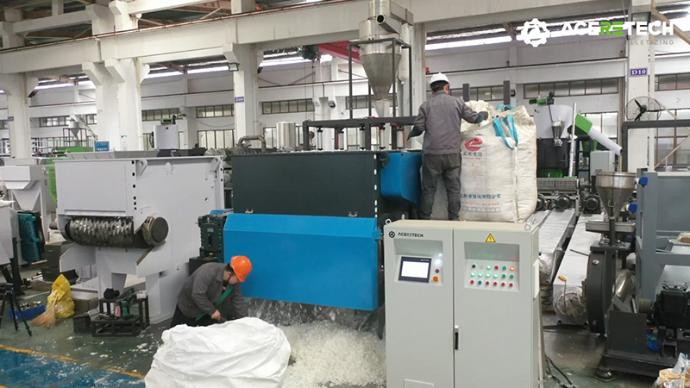
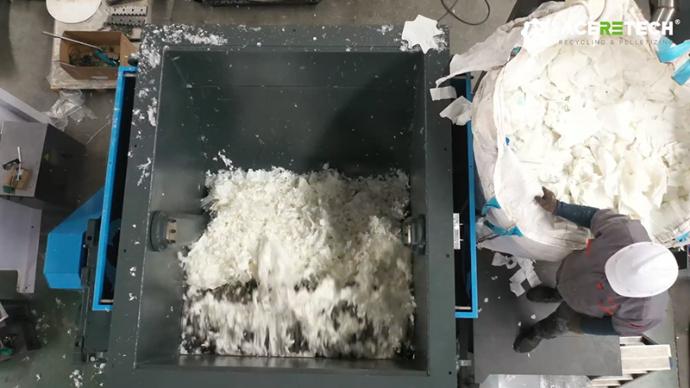
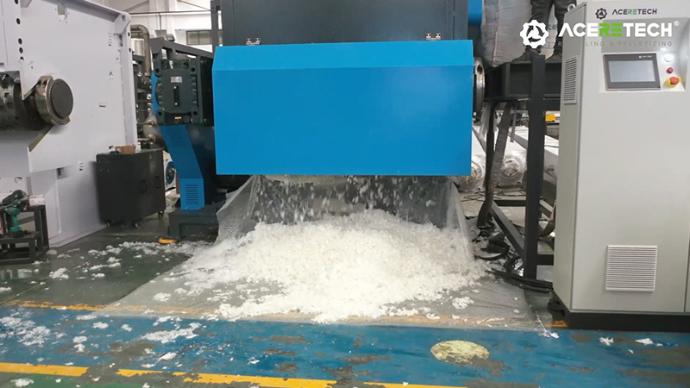
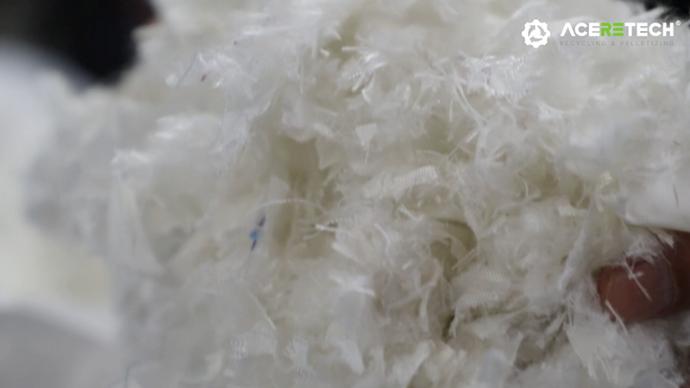
1. Feeding of PA66 Airbag Fabric
Because airbag fabric is lightweight and bulky, stable feeding is an important part of the application.
The HS system uses a controlled feeding arrangement to move the material toward the shredding chamber.
The feeding system helps reduce problems such as:
• Material bridging
• Rotor idling
• Uneven feeding
• Manual feeding interruptions
Once the material enters the hopper, the hydraulic ram assists in pushing it toward the rotor.
This allows the machine to actively engage bulky fabric instead of relying only on gravity.
2. Intelligent Hydraulic Ram System
The hydraulic ram is particularly important when processing lightweight and flexible fabric.
The ram pushes the material toward the cutting area and helps maintain contact between the material and rotor.
The system can adjust the feeding action according to the operating load of the main shaft.
This helps maintain a more stable feeding process when the density and shape of the incoming airbag fabric vary.
The hydraulic feeding system also helps reduce the possibility of:
• Material bridging
• Rotor idling
• Unstable feeding
• Excessive manual intervention
3. Low-Speed, High-Torque Shredding
The HS Series uses a low-speed, high-torque drive system.
This operating principle is particularly suitable for tough flexible materials such as PA66 airbag fabric.
Instead of attempting to process the fabric through high-speed impact, the rotor gradually grabs and tears the material.
This provides the torque required to process high-strength fabric while helping reduce problems such as:
• Blade slippage
• Material wrapping
• Motor overload
• Unstable cutting
The low-speed shredding principle is therefore an important part of the solution for this application.
4. High-Strength Cutter System
PA66 airbag fabric has high tensile strength and can create significant mechanical stress on the cutting tools.
The HS Series uses high-strength alloy steel cutters designed for heavy-duty shredding applications.
The cutter arrangement allows the rotor to progressively:
Grab → Tear → Shear → Convey
the fabric through the shredding chamber.
This cutting action helps the machine continuously engage the flexible material instead of allowing large pieces of fabric to simply move around the rotor.
The cutters are also designed for convenient maintenance and replacement when required.
5. Wear-Resistant Rotor
The HS Series is equipped with a wear-resistant rotor surface.
For applications involving tough and abrasive materials, rotor wear can affect long-term shredding performance.
The wear-resistant treatment helps protect the rotor surface in high-friction areas and supports stable operation over extended periods.
For PA66 airbag fabric recycling, this provides an additional level of protection for a key mechanical component of the shredding system.
6. Anti-Winding and Material Guidance
One of the major challenges when shredding flexible fabric is preventing the material from continuously wrapping around the rotor.
The HS Series uses its hopper structure, material-guiding arrangement, and rotor configuration to guide the material toward the cutting zone.
This helps reduce excessive material accumulation around the rotor.
The objective is not simply to cut the fabric, but to maintain a continuous cycle of:
Feeding → Engagement → Shredding → Discharge
This is particularly important for large and flexible PA66 airbag fabric.
7. Intelligent PLC Control and Overload Protection
The HS Series is equipped with a PLC control system for automatic machine operation and protection.
The system monitors the operating condition of the shredder and can respond to overload situations.
When excessive resistance or non-crushable foreign material is detected, the rotor can automatically reverse to help clear the problem.
The control system provides functions including:
• Automatic start/stop
• Forward/reverse operation
• Overload protection
• Jam protection
• Fault monitoring
• Operating parameter control
This helps protect the cutters, gearbox, motor, and other critical components during operation.
V. The Process Covered by This Application
The core process for this application is:
PA66 Airbag Fabric → Controlled Feeding → Hydraulic Pushing → HS Single-Shaft Shredding → Reduced-Size PA66 Fabric
This is the main application demonstrated by the HS Series.
The shredded material can then be transferred to subsequent recycling or processing equipment according to the customer's requirements.
Related Articles
PA6/PA66 Fiber Filament Disk-Type Shredder
VI. Why Shredding Comes Before Further Processing
Large pieces of PA66 airbag fabric are difficult to handle efficiently because of their size, flexibility, and low bulk density.
After shredding, the material is reduced to a smaller and more manageable form.
This provides several practical benefits:
• Reduced material volume
• Easier material handling
• More stable downstream feeding
• Easier transportation and storage
• More suitable feedstock for subsequent processing
Therefore, the HS shredder serves as an important front-end preparation step when large and flexible airbag fabric needs to be further recycled.
VII. Downstream Processing
The HS shredder is responsible for the size-reduction stage.
What happens after shredding depends on the actual condition of the PA66 airbag fabric and the customer's final recycling requirements.
Depending on the application, the shredded material may be transferred to subsequent processes such as:
• Further crushing
• Washing
• Dewatering
• Drying
• Pelletizing
• Other material processing
These downstream processes are determined separately according to the material condition and required recycled product.
They are not part of the HS shredding configuration described in this application.
VIII. Application Value
The value of the HS Series in this application is primarily its ability to make tough, bulky, and flexible PA66 airbag fabric easier to process.
Before shredding, the material can be difficult to feed, transport, and process because of its large volume and flexible structure.
After controlled size reduction, the material becomes easier to handle and can be transferred to subsequent recycling processes.
The application can therefore be summarized as:
Bulky PA66 Airbag Fabric → Stable Feeding → Low-Speed, High-Torque Shredding → Controlled Size Reduction → More Manageable Recycled Material
The HS Series provides the front-end size reduction required to prepare this difficult flexible material for further processing.
IX. Key Advantages of the HS Series in This Application
1. Low-Speed, High-Torque Operation
Provides sufficient torque for high-strength PA66 fabric and reduces reliance on high-speed impact cutting.
2. Hydraulic Ram Feeding
Actively pushes lightweight and bulky fabric toward the rotor for more stable feeding.
3. High-Strength Cutters
Designed to handle tough and high-tensile materials.
4. Wear-Resistant Rotor
Provides additional protection for the rotor during continuous shredding.
5. Anti-Winding Design
Helps reduce excessive accumulation of flexible fabric around the rotor.
6. Intelligent Overload Protection
Automatic reverse operation helps clear blockages and protect the mechanical system.
7. Controlled Size Reduction
Produces a more manageable shredded material for subsequent processing.
X. Application Summary
This application demonstrates the use of the ACERETECH HS Series Single-Shaft Shredder for PA66 airbag fabric waste.
The main challenge is the physical structure of the material.
PA66 airbag fabric is:
• Strong
• Tough
• Flexible
• Lightweight
• Bulky
• Prone to tangling
These characteristics make direct processing with conventional high-speed crushing equipment difficult.
The HS Series addresses these challenges through:
Hydraulic Feeding + Low-Speed High-Torque Drive + High-Strength Cutters + Wear-Resistant Rotor + Material Guidance + Intelligent PLC Protection
The result is a more stable shredding process and reduced-size PA66 airbag fabric that is easier to handle and suitable for subsequent recycling processes.
The core process is:
PA66 Airbag Fabric → Controlled Feeding → HS Single-Shaft Shredding → Reduced-Size Material
The HS Series therefore provides a practical front-end size-reduction solution for automotive PA66 airbag fabric recycling applications.
Looking for a PA66 Airbag Fabric Shredding Solution?
For bulky, tough, and flexible PA66 airbag fabric waste, the ACERETECH HS Series Single-Shaft Shredder provides a dedicated front-end size-reduction solution.
The system combines:
Hydraulic Feeding → Low-Speed High-Torque Shredding → Anti-Winding Material Guidance → Controlled Size Reduction
to make difficult airbag fabric waste easier to handle and prepare for subsequent recycling processes.
Contact ACERETECH to discuss your PA66 airbag fabric recycling application.
FAQ
Q1. Why is PA66 airbag fabric difficult to shred?
A: PA66 airbag fabric is made from high-strength woven nylon fibers. It is tough, flexible, and resistant to tearing, while its fabric structure also makes it prone to wrapping and tangling during processing.
Q2. Why use a single-shaft shredder instead of a high-speed crusher?
A: A single-shaft shredder operates at lower speed with higher torque and progressively tears the material.
This operating principle is more suitable for tough and flexible materials that may wrap around the rotor or cutting shaft in high-speed crushing equipment.
Q3. How does the hydraulic ram help process airbag fabric?
A: The hydraulic ram actively pushes bulky and lightweight airbag fabric toward the rotor.
This helps reduce bridging, rotor idling, and unstable feeding.
Q4. Does this application include a complete PA66 pelletizing line?
A: The HS shredding application itself covers the front-end size-reduction stage.
Whether further washing, drying, or pelletizing is required depends on the customer's specific recycling process.
Q5. Can the HS Series process other automotive textile waste?
A: Yes. Depending on the material characteristics, the HS Series can also be considered for other tough and flexible automotive textile or polymer waste.