I. Introduction: Turning Waste PE Film into Reusable Plastic Pellets
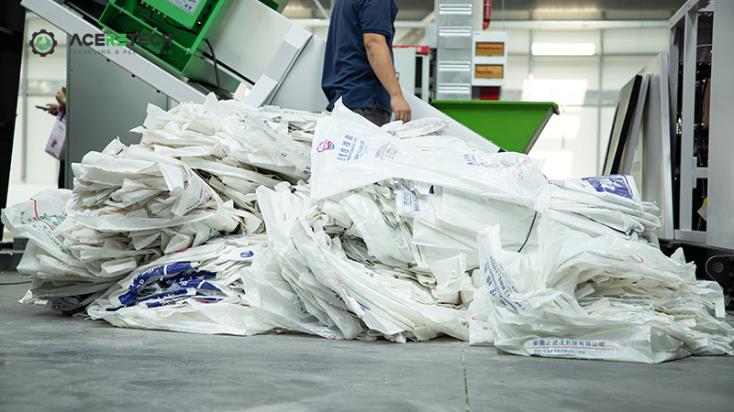
Polyethylene (PE) film is widely used in packaging, agriculture, industrial wrapping and numerous manufacturing sectors. Typical feedstocks include LDPE packaging film, HDPE film, stretch film and production film scrap.
As plastic film consumption keeps rising, recycling production offcuts and recoverable PE film waste has become a key part of plastic resource circularity. Nevertheless, PE film recycling poses notable processing challenges. Its light weight, low bulk density and tendency to fold and tangle easily lead to unstable feeding and extrusion in conventional setups.
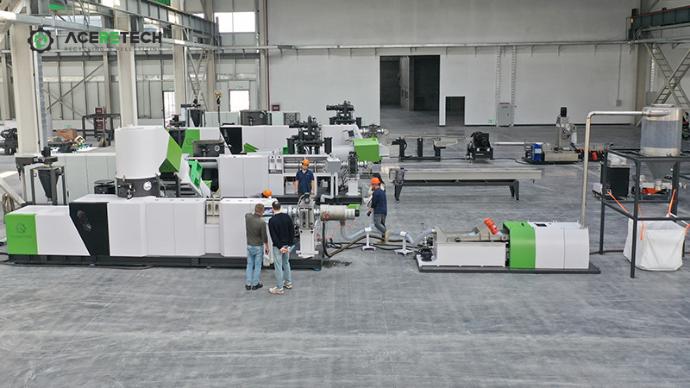
A well-engineered PE film recycling and pelletizing line overcomes these issues by integrating feeding, cutting, compaction, extrusion, melt filtration, pelletizing, cooling and drying into a continuous workflow.
ACERETECH’s ACS-H single-screw cutter compactor pelletizing line is purpose-built for flexible plastic waste such as PE and PP films. By executing cutting and compaction prior to extrusion, the system boosts material density and feeding consistency, delivering a reliable route to convert qualified PE film scrap into usable recycled plastic pellets.
II. Key Challenges in PE Film Recycling
Before selecting a film recycling machine, it is critical to understand the physical properties of incoming scrap.
1. Low Bulk Density & Unstable Feeding
PE film is lightweight and voluminous relative to its weight. Direct feeding into an extruder often causes uneven material supply, fluctuating throughput and poor feeding efficiency.
2. Folding & Tangling of Material
Thin plastic films tend to overlap, fold and tangle during handling. This disrupts steady feeding and complicates continuous processing.
3. Residual Moisture, Dust and Contaminants
Depending on the waste source, PE film may carry moisture, dust, printing ink residues and other impurities. These affect melt behaviour, filtration demands and the final quality of recycled pellets.
4. Consistent Pellet Quality for Downstream Use
Recycled PE pellets require stable size, appearance and processing performance for further reprocessing. Precise control over extrusion temperature, melt filtration and pelletizing parameters is therefore essential.
System selection for PE film recycling and pelletizing should be based on material characteristics, rather than nominal capacity alone.
III. ACS-H PE Film Recycling and Pelletizing Process
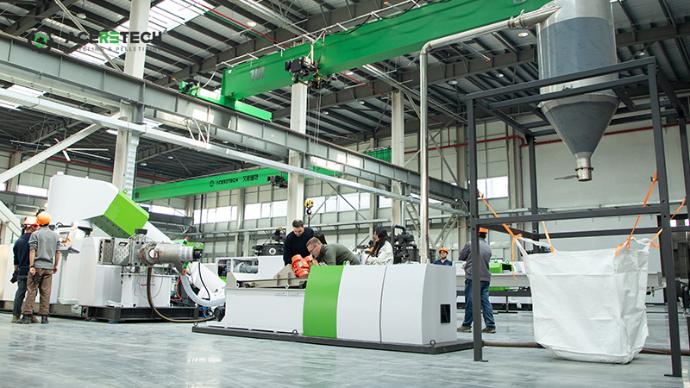
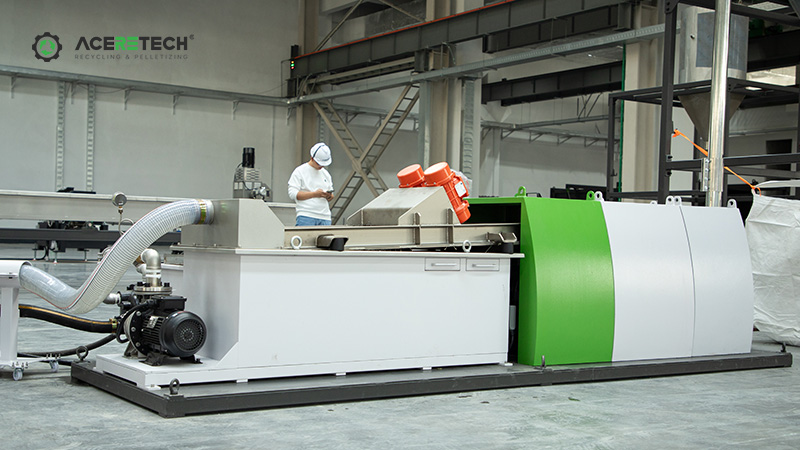
ACERETECH ACS-H cutter compactor pelletizing line consolidates multiple processing stages in one unit, streamlining recycling of lightweight, bulky PE film.
3.1 Automatic Feeding & Metal Detection
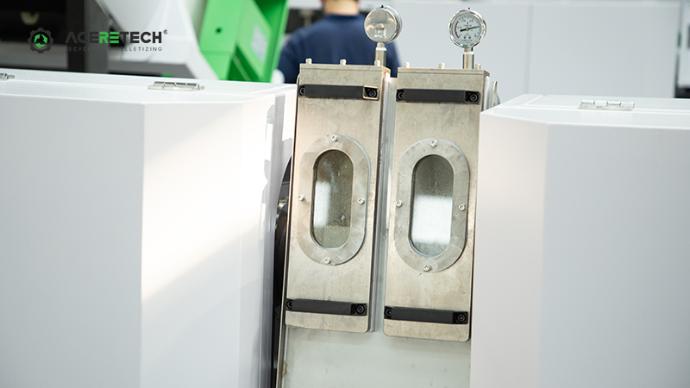
PE film is conveyed to the cutter compactor via belt conveyor.
This configuration features a multi-frequency metal detector linked to the machine control system. If metal contaminants are detected at the feeding section, the line shuts down automatically to avoid damage to downstream equipment.
This interlock detection function provides extra equipment protection. It does not physically separate metal from the feedstock.
3.2 Cutting, Preheating & Compaction
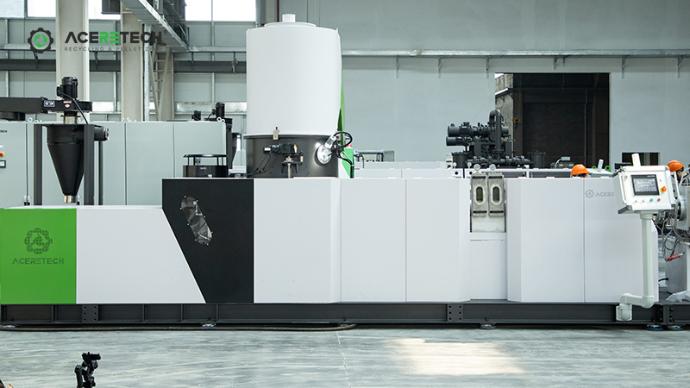
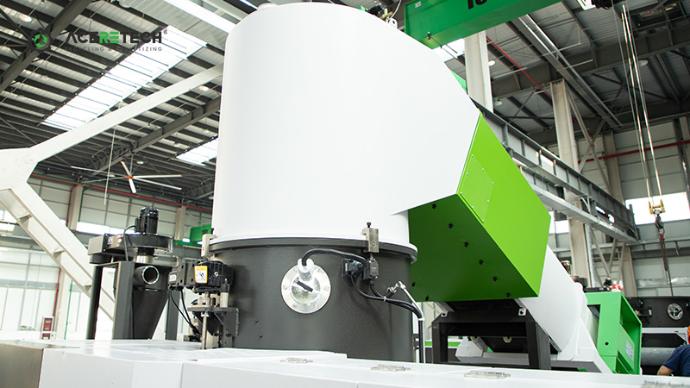
The 500L cutter compactor acts as the core component of the ACS-H PE film recycling line.
Inside the compaction chamber, high-speed rotary knives work with fixed knives to chop PE film into small flakes. Frictional heat generated during cutting preheats and partially dries the material while reducing volume and lifting bulk density.
This integrated cutting-compaction stage brings clear benefits:
- Reduces the volume of lightweight PE film
- Raises bulk density ahead of extrusion
- Removes partial moisture via frictional preheating
- Stabilizes feeding into the extruder
- Eliminates the need for standalone pre-compaction equipment
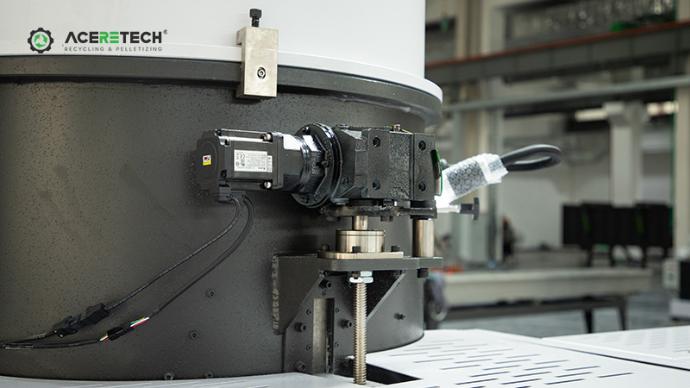
The cutter compactor is fitted with a VFD to adjust rotor speed according to material properties and process requirements. A servo-driven sliding gate meters the discharge of compacted material into the extruder.
Auxiliary dust & moisture collection and hot-air heating are also available for material conditioning.
3.3 Single-Screw Extrusion & Plasticization
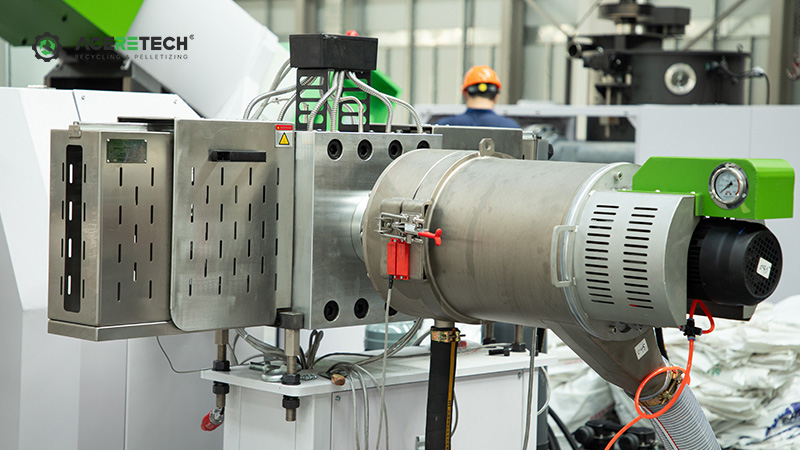
After compaction, conditioned PE material enters the single-screw extruder for melting, plasticization and homogenization.
Specifications of this tested ACS-H setup
- Screw Diameter: 100 mm
- Screw L/D Ratio: 42:1
- Screw Construction: Bimetallic design
- Screw Base Material: 38CrMoAlA nitrided steel with nickel-based alloy overlay
- Screw Hardness: HRC 56–60
- Barrel Construction: Bimetallic design with wear-resistant iron-based alloy lining
- Heating System: Ceramic heaters with stainless steel covers
- Cooling System: Air cooling
The bimetallic screw and barrel are engineered for superior wear resistance, corrosion resistance and long service life under continuous recycling operation.
Optimized screw geometry together with precision temperature control ensures stable plasticization and consistent melt quality.
3.4 Vacuum Degassing & Continuous Melt Filtration
During extrusion, melt passes through a vacuum degassing unit to strip residual moisture, volatiles and low-molecular fractions.
Effective degassing minimizes defects such as bubbles and stabilizes melt flow. Actual performance depends on incoming feedstock and process parameters.
For this PE film recycling application, the line is equipped with a plate type screen changer with a filtration diameter 260mm.
Core advantages:
- Large filtration area for efficient impurity removal
- Extended screen service intervals under suitable working conditions
- Non-stop screen change without production halt
- Reliable sealing structure to prevent melt leakage
3.5 Automatic Water-Ring Pelletizing System
After melt filtration, molten PE enters the water-ring pelletizing unit.
The unit is equipped with an automatic knife adjustment mechanism. Cutter speed is regulated according to melt pressure, while a pneumatic assembly keeps blades pressed firmly against the die face.
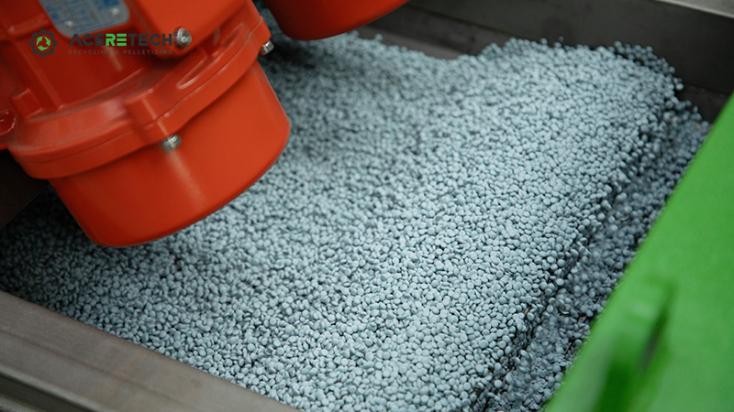
High-precision pressure sensors maintain consistent cutting pressure, yielding uniform recycled PE pellets. Pellet size is customizable to 3–5 mm in this test case.
3.6 Cooling, Dewatering & Pellet Collection
Upon cutting, pellets go through a vibrating dewatering screen followed by a centrifugal dryer to cut residual moisture.
Dried pellets are then transferred to a 700L storage silo for temporary collection.
This combined cooling and dewatering arrangement prepares pellets for packaging, storage or downstream conversion.
Related Articles
PE Film Shredding Solutions
PE Film Washing Solutions
IV. Actual PE Film Recycling Test Results
To validate performance, ACERETECH carried out a PE film recycling trial on a customized ACS-H500/100 configuration.
The trial ran continuous processing of PE film covering cutting, compaction, extrusion, filtration, water-ring pelletizing and dewatering.
Test Configuration & Results
| Item |
Specification |
| Feedstock |
PE Film |
| Machine | ACS-H Single-Screw Cutter Compactor Pelletizing Line |
| Compactor Volume | 500 L |
| Screw Diameter | 100 mm |
| Screw L/D Ratio | 42:1 |
| Melt Filtration | Plate Type Screen Changer |
| Filtration Daimeter | 260mm |
| Pelletizing Type | Water-Ring Pelletizing |
| Pellet Size | 3–5 mm |
| Tested Throughput | Approx. 300–350 kg/h |
| Collection Silo | 700 L |
The throughput of 300–350 kg/h was achieved under defined test conditions. Real output varies with PE film thickness, bulk density, moisture content, contamination level, feeding stability and pellet quality targets.
Finished recycled PE pellets can be used for suitable downstream processes such as film extrusion and blown film production, subject to material properties and end-product standards.
V. Why Choose the ACS-H for PE Film Recycling?
The ACS-H cutter compactor pelletizing system is developed to tackle the feeding and processing challenges of lightweight flexible plastics.
Key strengths for PE film recycling:
1. Integrated Process Layout
Cutting, compaction, extrusion, filtration and pelletizing are combined in one line, removing the need for separate pre-compaction equipment.
2. Improved Feeding Stability
The cutter compactor densifies fluffy PE film, delivering steady and uniform feed into the extruder.
3. Wear-Resistant Extrusion Package
Specially formulated bimetallic screw and barrel deliver outstanding wear and corrosion resistance for non-stop recycling.
4. Flexible Filtration Options
Filtration modules can be selected based on feedstock cleanliness and pellet quality requirements.
5. Automated Pelletizing & Drying
Automatic water-ring pelletizing paired with vibrating screening and centrifugal drying enables continuous pellet production and collection.
6. Intelligent PLC Control
The central control system supports interlocked start/stop, temperature regulation and real-time process monitoring. Safety functions include emergency stop and protective interlocks.
ACERETECH customizes ACS-H configurations according to feedstock characteristics, target throughput, filtration needs and pellet specifications for individual PE film recycling projects.
VI. Applications of Recycled PE Pellets
Recycled PE pellets produced from qualified film scrap can be reused across many plastic manufacturing routes, depending on polymer properties, contamination grade and quality requirements.
Typical downstream uses:
- Recycled PE film production
- Garbage bag and liner manufacturing
- Plastic bag extrusion
- General-purpose PE articles
- Selected extrusion and injection moulding applications
Reusability is determined by polymer composition, melt flow index, mechanical properties and end-product specs.
High-grade applications may require extra sorting, washing, fine filtration or material modification.
VII. Conclusion: A Practical Solution for PE Film Recycling
Efficient PE film recycling is more than simply melting waste plastic. Stable feeding, effective compaction, controlled plasticization, proper melt filtration and consistent pelletizing collectively define line performance.
ACERETECH ACS-H single-screw cutter compactor pelletizing line integrates all these steps into a complete system dedicated to flexible plastic waste recycling.
In this PE film trial, the customized ACS-H setup reaches 300–350 kg/h output with 3–5 mm recycled pellets.
For recyclers and processors handling PE film production scrap and other suitable flexible plastic waste, matching equipment selection to actual material behaviour is the foundation of stable, efficient production.
Interested in a PE film recycling and pelletizing solution?
Contact ACERETECH to discuss your feedstock, target capacity and recycling requirements.
FAQ
Q1: What types of PE film can this pelletizing line process?
A: A properly configured line handles multiple PE grades including LDPE film, LLDPE stretch film, HDPE film, packaging film and eligible industrial production scrap. Final setup depends on film thickness, bulk density, moisture content, contamination level and material composition.
Q2: How does a cutter compactor boost PE film recycling efficiency?
A: A cutter compactor performs cutting, mixing, preheating and compaction within one chamber. Rotary and fixed knives reduce film into flakes, while frictional heat partially dries and densifies the material. Higher bulk density greatly stabilizes extruder feeding, especially for lightweight PE scrap.
Q3: What throughput can the ACS-H PE film recycling machine reach?
A: Capacity varies by ACS-H model and feedstock conditions. The demonstrated ACS-H100 test runs at approximately 300–350 kg/h. Other ACS-H variants cover different throughput ranges to meet diverse production targets.
Q4: Can the ACS-H line process printed or lightly contaminated PE film?
A: Yes. The ACS-H can be configured for printed PE film and moderately contaminated film scrap. Vacuum degassing removes moisture and volatiles, while melt filtration captures solid impurities. Filtration grade must be matched to contamination type and load. Heavily polluted material requires upstream washing and pre-treatment.
Q5: What is the function of a plate screen changer in PE pelletizing?
A: The plate type screen changer provides continuous melt filtration and enables screen exchange without stopping production. Its large filtration area accommodates higher impurity loads and extends screen life under suitable conditions, supporting uninterrupted extrusion and consistent melt quality.
Q6: Are recycled PE pellets suitable for blown film production?
A: Pellets made from qualified feedstock can be used for blown film. Suitability hinges on melt flow behaviour, mechanical performance, cleanliness and finished film quality standards. Blending with virgin resin or compound modification may be necessary for premium applications.