I. Efficient Recycling of EPS, EPE, EPP and Other Plastic Foam Waste
Plastic foam materials are widely used because of their lightweight structure, cushioning properties, thermal insulation, and impact resistance.
Typical applications include packaging, electronics protection, automotive components, building insulation, food packaging, logistics protection, and industrial products.
During manufacturing, transportation, construction, and product use, large quantities of foam waste are generated.
Typical examples include:
• EPS packaging foam
• EPE foam / pearl cotton
• EPP automotive foam
• XPS insulation boards
• Industrial foam offcuts
• Production foam scrap
The main challenge in recycling these materials is their very low bulk density and large volume.
A relatively small amount of foam waste can occupy a large amount of storage and transportation space. At the same time, loose foam is difficult to feed continuously into conventional plastic recycling equipment.
For this reason, foam recycling requires a process that first makes the bulky material easier to handle and feed, followed by appropriate melting, filtration, and pelletizing processes where required.
Related Plastic Foam Recycling Videos
II. Application Background
Plastic foam waste is generated across a wide range of industries.
For example:
1. Packaging Industry
EPS and EPE are widely used to protect household appliances, electronics, furniture, precision equipment, and other products during transportation.
2. Automotive Industry
EPP and other engineering foam materials are used in automotive energy-absorbing and interior components.
3. Construction Industry
XPS and other rigid foam boards are commonly used for thermal insulation.
4. Industrial Manufacturing
Foam offcuts and production scrap are generated during cutting, forming, and manufacturing operations.
Although these materials are recyclable, their physical structure creates several practical challenges.
Foam waste typically has:
• Extremely low bulk density
• Large volume
• Irregular shapes
• Difficult feeding characteristics
• Different melting temperatures depending on the polymer
• Potential contamination depending on the source
Therefore, the recycling process needs to be selected according to both the foam structure and polymer type.
III. Different Types of Plastic Foam
Plastic foam is not a single material.
The recycling process needs to distinguish between different polymer types.
1. EPS Foam — Expanded Polystyrene
EPS is commonly used as protective packaging and insulation material.
Typical sources include:
• Appliance packaging
• Electronics packaging
• Protective packaging
• Food insulation boxes
• Building insulation
EPS has extremely low density and a large volume, making volume reduction one of the most important steps before further recycling.
After appropriate recycling and pelletizing, the recovered PS material can be used in various recycled plastic applications.
2. EPE Foam — Expanded Polyethylene
EPE, commonly known as pearl cotton, is a flexible polyethylene foam.
It is commonly used for:
• Electronics packaging
• Furniture protection
• Precision equipment packaging
• Industrial transportation protection
Compared with EPS, EPE has greater flexibility and toughness.
The recycling process therefore needs to consider its different feeding and plasticizing characteristics.
3. EPP Foam — Expanded Polypropylene
EPP is an expanded polypropylene material with good impact resistance and heat resistance.
Typical applications include:
• Automotive components
• Energy-absorbing structures
• Interior components
• Reusable logistics packaging
The material has a higher mechanical strength than many conventional packaging foams.
4. XPS Foam — Extruded Polystyrene
XPS is primarily used for thermal insulation.
Typical sources include:
• Insulation boards
• Construction offcuts
• Renovation waste
• Building material scrap
Compared with loose EPS packaging foam, XPS generally has a higher density and more stable board structure.
This difference affects the required size-reduction and feeding process.
5. PA Foam and Other Engineering Foams
Some engineering plastic foams are based on materials such as polyamide.
These materials may have higher material value but also require greater control of:
• Processing temperature
• Plasticizing
• Filtration
• Melt quality
Therefore, engineering foam should not automatically be treated in exactly the same way as EPS or EPE.
IV. Why Plastic Foam Requires Specialized Recycling Equipment
The main challenge in foam recycling is not simply melting the material.
It starts with material handling and feeding.
Extremely Low Bulk Density
Foam occupies a large volume compared with its actual polymer weight.
Direct feeding into an extruder can therefore result in insufficient and unstable material flow.
Large Volume
Large foam pieces require significant storage and transportation space.
Reducing the volume at an early stage can improve material handling efficiency.
Irregular Shape
Foam waste can arrive as:
• Blocks
• Boards
• Packaging pieces
• Offcuts
• Irregular fragments
These different shapes can make direct feeding difficult.
Different Polymer Types
EPS, EPE, EPP, and XPS are chemically different materials.
The extrusion temperature, screw design, filtration requirements, and pelletizing conditions therefore need to correspond to the actual polymer being processed.
V. Plastic Foam Recycling Process
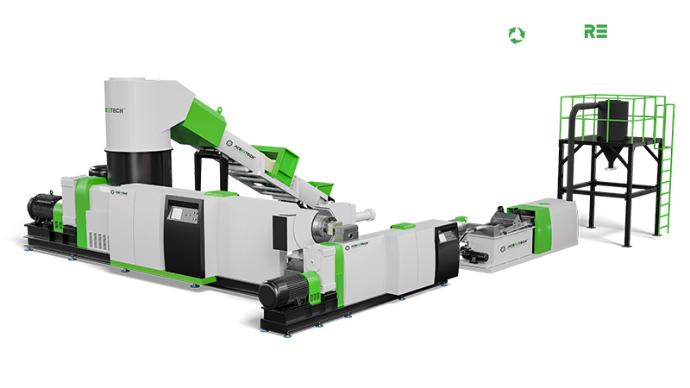
The general recycling route for suitable plastic foam waste can be summarized as:
Plastic Foam Waste → Size Reduction → Compaction / Densification → Melting & Plasticizing → Melt Filtration → Pelletizing → Recycled Plastic Pellets
The actual equipment configuration depends on the specific foam material, contamination level, required capacity, and final application.
The purpose of each stage is different.
1. Foam Size Reduction
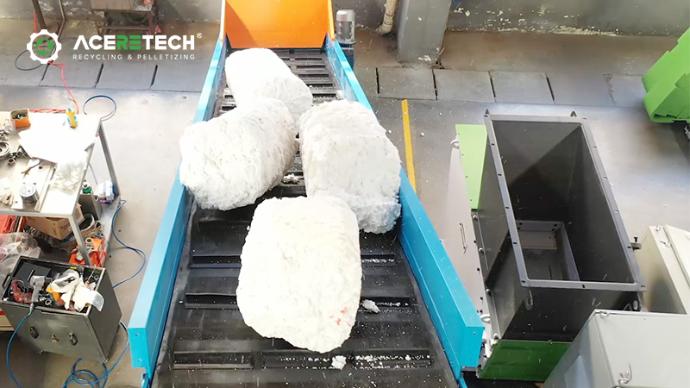
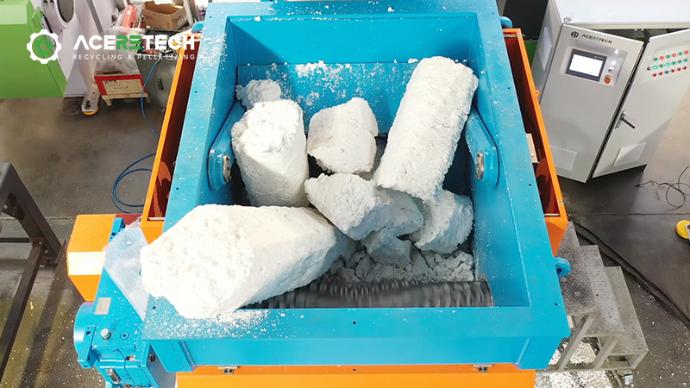
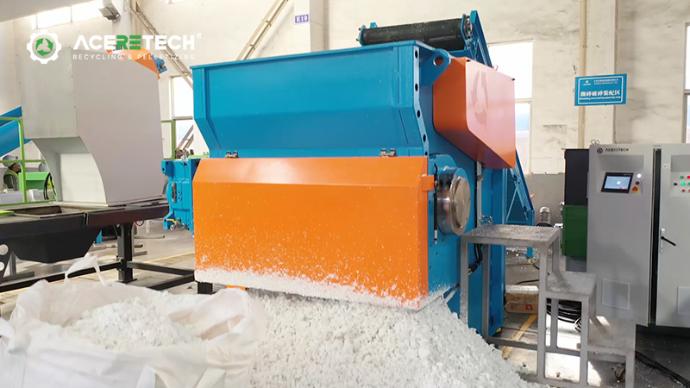
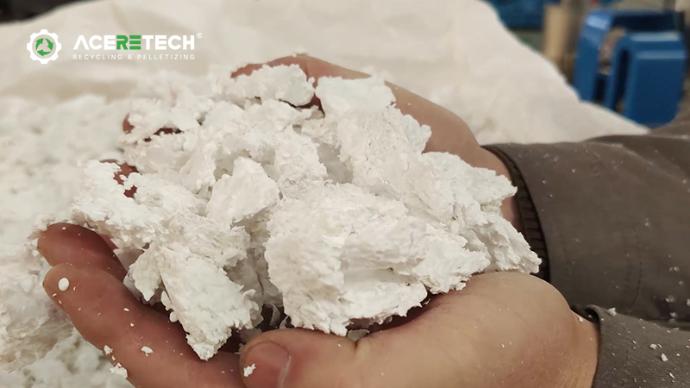
Large and bulky foam waste is first reduced to a more manageable size.
This can be carried out using suitable shredding or size-reduction equipment selected according to the physical structure of the foam.
The purpose is to:
• Reduce material volume
• Break down large pieces
• Improve material handling
• Facilitate conveying
• Provide more consistent feedstock for subsequent processing
For lightweight foam materials, size reduction is particularly important because large pieces are difficult to transport and feed continuously.
After size reduction, the material becomes easier to convey and prepare for the next stage.
Related Articles
Plastic foam shredding solutions
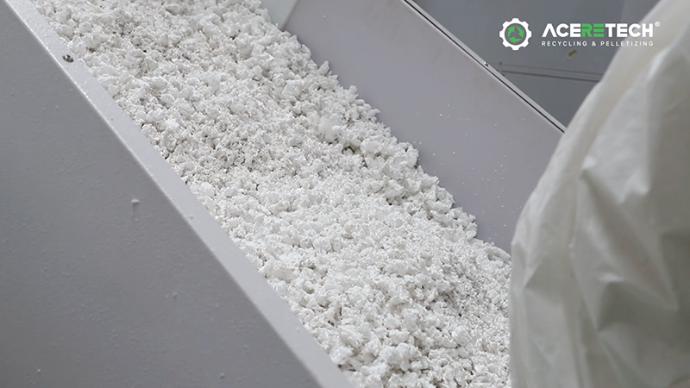
2. Compaction and Densification
After size reduction, lightweight foam may still have a very low bulk density.
Directly feeding this material into an extruder can result in:
• Unstable feeding
• Material bridging
• Insufficient material supply
• Low conveying efficiency
A compaction system can therefore be used to reduce the material volume and increase its bulk density.
During this stage, the foam is:
Cut → Compressed → Densified → Preheated
The resulting material is more suitable for continuous feeding into the extrusion system.
For materials such as EPS and EPE, stable densification can be an important part of the overall recycling process.
3. Melting and Plasticizing
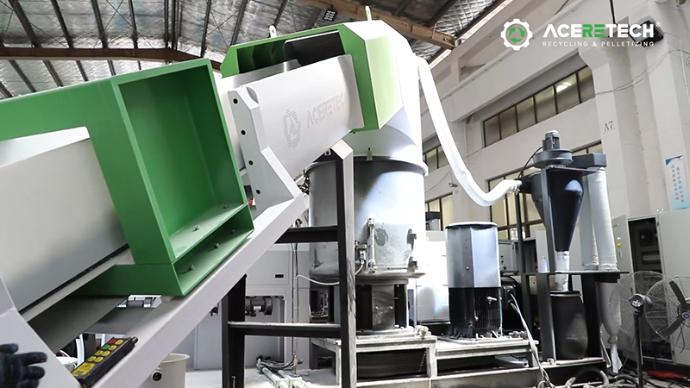
After densification, the material enters the extrusion system.
Inside the extruder, the foam undergoes:
• Heating
• Melting
• Plasticization
• Mixing
• Homogenization
The extrusion system needs to be selected according to the actual polymer.
For example, EPS is based on PS, while EPE is based on PE and EPP is based on PP.
Therefore, these materials cannot simply be treated as one universal foam material.
The extrusion system should be configured according to the polymer type and required processing conditions.
4. Vacuum Degassing When Required
Depending on the raw material condition, vacuum degassing can be incorporated into the extrusion process.
The vacuum system helps remove:
• Air
• Moisture
• Volatile substances
• Other gases released during processing
This can be particularly useful when processing foam waste with printing, residual moisture, or other volatile contamination.
Whether vacuum degassing is required depends on the actual feedstock and final pellet requirements.
5. Melt Filtration
After plasticization, the polymer melt passes through a filtration system.
The purpose of melt filtration is to remove solid contaminants such as:
• Foreign particles
• Metal residues
• Unmelted material
• Other solid impurities
The required filtration system depends on the cleanliness of the incoming foam waste.
Possible configurations include:
• Continuous screen changer
• Plate-type filter
• Self-cleaning filtration system
For cleaner production scrap, a simpler filtration configuration may be sufficient.
For more contaminated material, a more advanced filtration system may be required.
6. Pelletizing
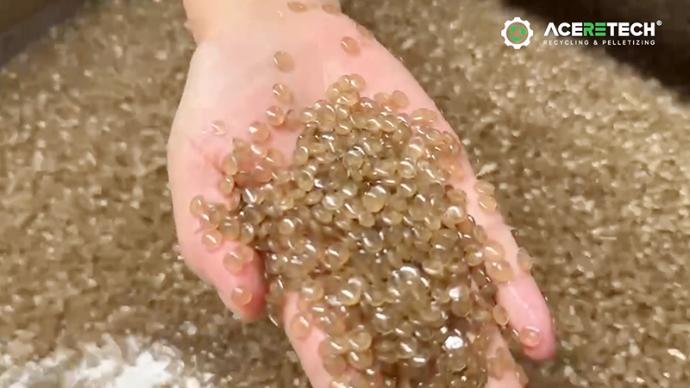
After melting, homogenization, and filtration, the polymer melt can be converted into recycled pellets.
Depending on the application, pelletizing can use different methods, including:
• Water-ring pelletizing
• Strand pelletizing
• Underwater pelletizing
The appropriate pelletizing method depends on:
• Polymer type
• Melt characteristics
• Required pellet size
• Production capacity
• Final product requirements
The objective is to produce a stable and manageable recycled material for subsequent manufacturing.
Related Articles
Plastic foam pelletizing solutions
VI. Different Foam Materials Require Different Recycling Conditions
The polymer type is equally important.
| Foam |
Base Polymer | Typical Consideration |
| EPS |
PS |
Low density, brittle structure |
| EPE | PE | Flexible and tough |
| EPP | PP | Higher strength and impact resistance |
| XPS | PS | Higher density, rigid board structure |
| PA Foam | PA | Higher processing and temperature requirements |
VII. From Foam Waste to Recycled Plastic Material
The overall application can be summarized as:
Low-Density Foam Waste → Size Reduction → Volume Reduction / Compaction → Stable Feeding → Melting & Plasticizing → Melt Filtration → Pelletizing → Recycled Plastic Material
The key objective of the process is to transform difficult-to-handle, low-density foam waste into a more manageable recycled material.
VIII. Application Value
The main value of a dedicated foam recycling process is not only the recovery of polymer.
It also addresses several practical problems associated with foam waste.
1. Reduced Volume
Size reduction and compaction significantly improve the handling characteristics of low-density foam.
2. Improved Feeding
Densified foam can be fed more consistently into downstream equipment.
3. Reduced Transportation Requirements
Reducing the bulk volume can make storage and transportation more efficient.
4. Material Recovery
Instead of treating foam waste as disposable material, suitable waste can be processed into recycled plastic materials.
5. Flexible Recycling Routes
Different foam materials can be processed using different configurations according to their polymer type and material condition.
IX. Recycling Process for Various Types of Foam Waste
1. Application Example: EPS and EPE Foam
For lightweight packaging foam such as EPS and EPE, the main challenge is typically the combination of large volume and low bulk density.
The general processing logic is:
Waste Foam → Shredding → Compaction / Densification → Extrusion → Filtration → Pelletizing
The shredding and compaction stages improve the material's physical condition before extrusion.
The extrusion and filtration stages then convert the densified foam into a homogeneous polymer melt suitable for pelletizing.
2. Application Example: XPS Foam
XPS generally enters the recycling process in the form of relatively rigid insulation boards and offcuts.
Compared with loose EPS packaging waste, the material has a higher density and more stable structure.
The size-reduction requirement may therefore be different.
A typical process can be:
XPS Boards / Offcuts → Size Reduction → Compaction / Feeding → Extrusion → Filtration → Pelletizing
The actual configuration should be selected according to the board dimensions, contamination level, throughput, and final application.
3. Application Example: EPP Foam
EPP is based on polypropylene and has relatively high strength and impact resistance.
The recycling process therefore needs to take its material characteristics into account.
The basic process remains:
EPP Foam Waste → Size Reduction → Densification → Melting & Plasticizing → Filtration → Pelletizing
The extrusion and filtration configuration should be selected according to the actual EPP feedstock.
X. Application Summary
Plastic foam recycling presents a different set of challenges from conventional rigid plastic recycling.
The main issues are:
• Extremely low bulk density
• Large material volume
• Irregular shapes
• Difficult feeding
• Different polymer types
A suitable recycling process therefore needs to address both material handling and polymer processing.
The general process is:
Foam Waste → Size Reduction → Compaction → Melting & Plasticizing → Filtration → Pelletizing
The exact equipment configuration depends on the foam type, material condition, contamination level, required capacity, and final recycled product.
ACERETECH provides plastic foam recycling equipment and process solutions for different foam materials, including EPS, EPE, EPP, XPS, and selected engineering plastic foams.
Looking for a Plastic Foam Recycling Solution?
Plastic foam waste can be difficult to handle because of its low density, large volume, and irregular physical form.
ACERETECH provides recycling solutions covering the key stages of foam processing:
Size Reduction → Compaction → Extrusion → Filtration → Pelletizing
Solutions can be adapted to different foam materials, including EPS, EPE, EPP, XPS, and selected engineering plastic foams.
The appropriate equipment configuration depends on the actual polymer type, feedstock condition, contamination level, capacity, and final recycled product requirements.
Contact ACERETECH to discuss your plastic foam recycling application.
FAQ
Q1. What types of plastic foam can be recycled?
A: Common recyclable foam materials include EPS, EPE, EPP, XPS, and certain engineering plastic foams.
However, each material should be evaluated separately because the polymer type and physical structure affect the recycling process.
Q2. Why does foam need to be shredded before recycling?
A: Foam waste usually has a very low bulk density and large volume.
Size reduction makes the material easier to convey, handle, and feed into subsequent recycling equipment.
Q3. Why is compaction important for foam recycling?
A: Even after shredding, foam may remain very lightweight.
Compaction increases the bulk density and reduces the material volume, helping provide more stable feeding into the extruder.
Q4. Can EPS and EPE use the same recycling machine?
A: Not necessarily. EPS is primarily PS, while EPE is PE.
Although both are foam materials, their melting behavior, extrusion conditions, screw design, and filtration requirements can be different.
Q5. Can EPP foam be recycled into pellets?
A: Yes. Suitable EPP production waste and other clean EPP foam waste can be processed through an appropriate size-reduction, extrusion, filtration, and pelletizing process.
Q6. Can XPS insulation boards be recycled?
A: Yes. XPS boards and production/construction offcuts can be processed after appropriate size reduction and preparation.
The actual process depends on contamination and the required recycled product.
Q7. Does all foam waste require washing?
A: No. Clean production scrap may not require washing.
If the foam contains dirt, oil, food residue, construction contamination, or other impurities, additional cleaning or pretreatment may be necessary.
Q8. Is vacuum degassing always required?
A: No. The need for vacuum degassing depends on the moisture, volatile content, contamination, and final pellet requirements of the feedstock.
Q9. What can recycled foam pellets be used for?
A: Depending on the polymer type and pellet quality, recycled material may be used in packaging, injection molding, construction products, automotive components, furniture, and other plastic products.
The actual application depends on the properties of the recycled material.