I. Efficiently Recycle LDPE Film into High-Quality Recycled Pellets
LDPE films and packaging bags are among the most widely used flexible packaging materials globally. They are commonly found in applications such as packaging films, shopping bags, industrial liners, agricultural films, and logistics packaging.
However, the efficient recycling of LDPE film faces many challenges due to its low bulk density, high moisture content, and tendency to tangle in feeding components. Recyclers frequently encounter issues such as unstable feeding, poor degassing performance, and inconsistent pellet quality.
To address these challenges, ACERETECH developed the ACSS double-stage compacting and pelletizing system—a high-efficiency recycling solution specifically designed for LDPE film and soft plastic waste. Integrating compacting, double-stage extrusion, vacuum degassing, and strands pelletizing process, the system ensures stable production, superior pellet quality, and continuous industrial-scale operation, with a capacity up to 1,000 kg/h.
II. Material Characteristics and Recycling Challenges
LDPE film and packaging bag waste typically presents the following recycling challenges:
* Extremely low bulk density and large storage volume requirements
* High moisture content after washing
* Presence of lightweight contaminants such as dust, labels, and paper scraps
* Unstable feeding caused by film tangling and bridging
* High demands on melt filtration and degassing processes
Without a well-designed recycling system, these challenges can lead to fluctuating output, increased downtime, poor pellet quality, and rising operating costs.
III. ACERETECH ACSS Two-Stage Compacting & Pelletizing Solution
1. Processed Materials
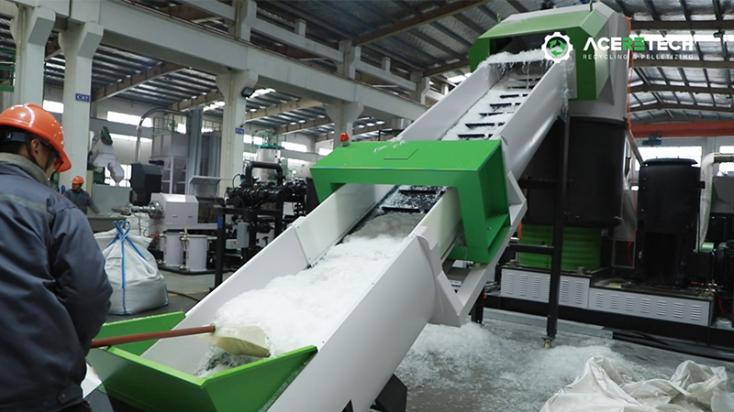
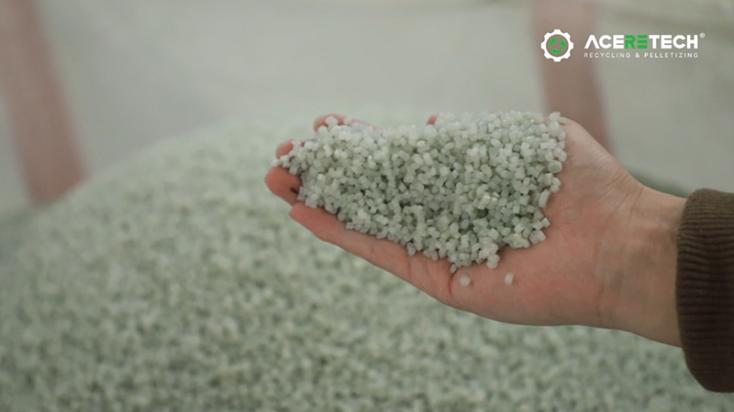
Material: LDPE film / LDPE bags
System Capacity: Approx. 1,000 kg/h
Pelletizing Method: Strands pelletizing
Final Product: High-quality recycled LDPE pellets
2. Key Advantages of the ACSS Pelletizing System
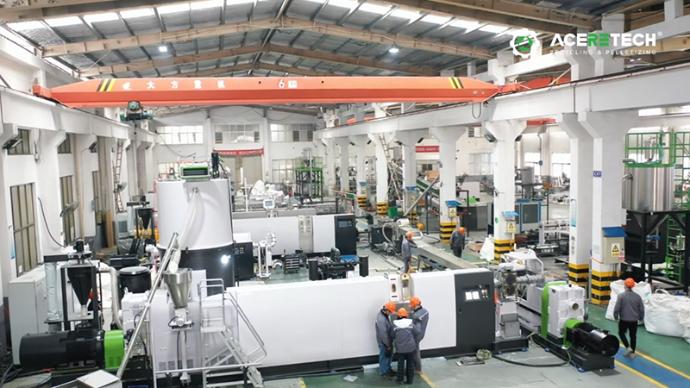
🔹 High-Efficiency Cutter-Compactor for Stable Feeding
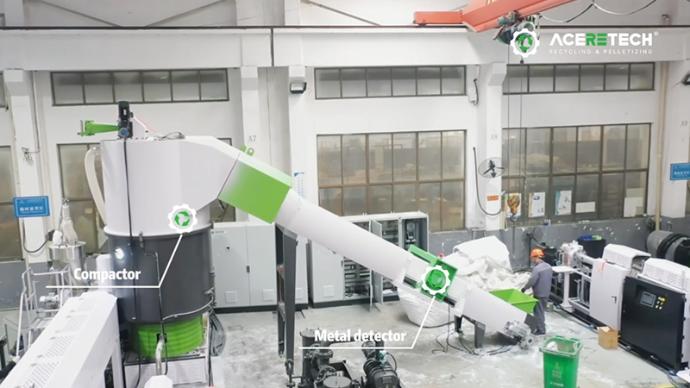
The system features a 2000-liter cutter-compactor chamber that integrates cutting, mixing, drying, and compacting functions.
Advantages include:
Rapid volume reduction of bulky film waste
Evaporation of surface moisture via frictional heating
Material homogenization prior to extrusion
Continuous, stable feeding to the extruder
This design effectively resolves common feeding challenges associated with soft plastic films.
🔹 Intelligent Conveying and Metal Protection System
Belt conveyor equipped with metal detector ensures safe and reliable operation.
Advantages include:
Automatic material conveying
Early detection of metal contaminants
Protection of screw and barrel components
Reduced risk of unplanned downtime
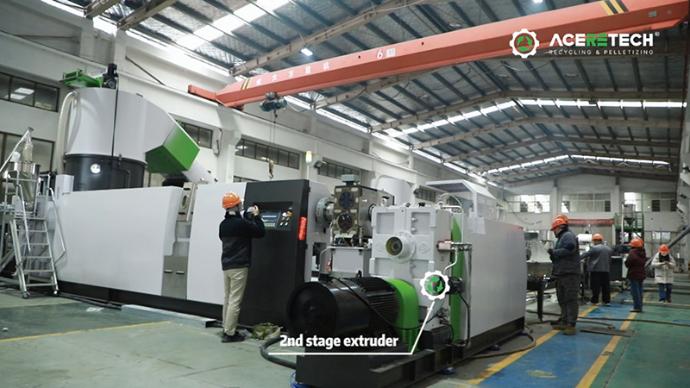
🔹 Two-Stage Single-Screw Extrusion for Superior Melt Quality
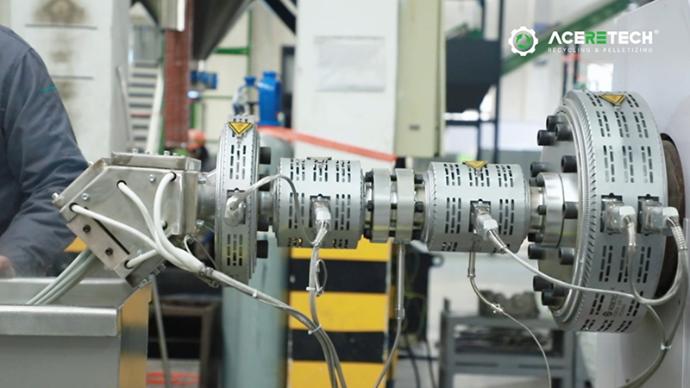
The ACSS system utilizes a two-stage extrusion design:
First-Stage Extruder
Screw diameter: Ø180 mm
Responsible for plasticization and primary filtration
Second-Stage Extruder
Screw diameter: Ø200 mm
Responsible for melt stabilization, homogenization, and fine filtration
Compared to traditional single-stage systems, two-stage extrusion significantly improves melt consistency and pellet quality, making it ideal for high-capacity film recycling applications.
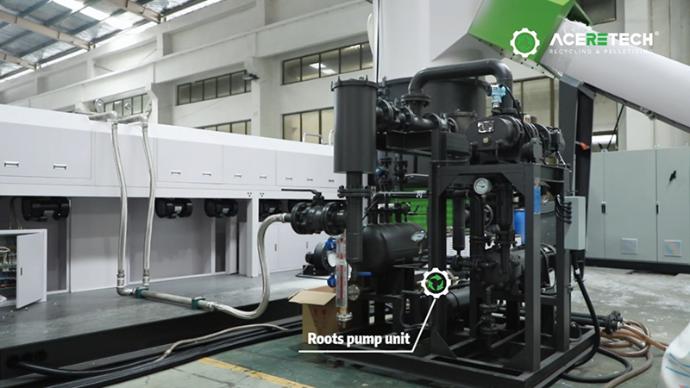
🔹 Enhanced Vacuum Degassing
To enhance the quality of recycled pellets, the system incorporates:
Roots vacuum degassing system
This configuration effectively removes:
Moisture
Volatile compounds
Printing ink residues
Residual odor
This can achieve cleaner melt flow, reduce black spots, lower bubble content, and significantly improve downstream processing performance.
🔹 Stable Strand Pelletizing System
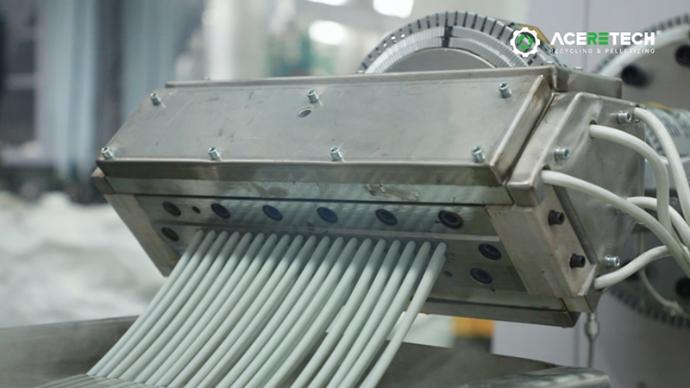
Processed through the strands pelletizing system:
Pellets with uniform size
Pellets with consistent shape
Excellent flowability
The recycled LDPE pellets are suitable for a wide range of secondary manufacturing applications.
IV. Performance and Application Results
Production Capacity
Output: Approx. 1,000 kg/h
Continuous industrial operation
Stable production performance
Optimized energy consumption
Easy maintenance
Applications of Recycled Pellets
Recycled LDPE pellets can be used to produce:
Recycled plastic film
Trash bags
Industrial packaging film
Agricultural film
Plastic sheets
Non-food grade injection-molded products
ACSS Pelletizer Suitable Materials
The ACSS recycling and pelletizing system is suitable for various flexible plastic materials, including:
LDPE agricultural film
LDPE packaging film
LDPE shopping bags
LLDPE stretch film
Industrial packaging bags
Printed film scrap
Post-industrial film scrap
Post-consumer soft plastic waste
This versatility makes the system an ideal choice for plastic recyclers, film manufacturers and waste management companies.
Related Articles
In-house LDPE Film Recycling and Pelletizing Solutions
LDPE Film Washing Solutions
V. Why Choose ACERETECH?
As a professional manufacturer of plastic recycling machinery, ACERETECH is dedicated to providing Turkey recycling and pelletizing solutions to customers worldwide.
Our Core Business
Advantages
Specialized in film and soft plastic recycling
High-capacity plastic pelletizing systems
Customized recycling configurations
Proven project experience worldwide
Reliable after-sales technical support
Stable equipment performance suitable for long-term operation
The ACSS two-stage compacting and pelletizing system has been successfully commissioned in numerous recycling plants globally, consistently helping customers enhance recycling efficiency and profitability.
Conclusion
As the global demand for recycled plastics continues to rise, efficient LDPE (low-density polyethylene) film recycling is increasingly becoming the key to achieving sustainable manufacturing and promoting circular economy development.
Integrating efficient compacting, two-stage extrusion, advanced degassing, and stable pelletizing technologies, the ACERETECH ACSS system offers a reliable solution for recycling LDPE films and packaging bags. Whether handling industrial film scrap or post-consumer soft plastic waste, ACERETECH provides customized recycling solutions for your specific production needs.
Contact ACERETECH today to discuss your material characteristics, production capacity goals, and project requirements.
FAQ
Q1. Which equipment is best suited for LDPE film recycling?
A: Compactor-integrated pelletizing systems are widely recognized as one of the most effective solutions for LDPE film recycling, as they enhance feeding stability, reduce material volume, and produce high-quality recycled pellets.
Q2. Why is LDPE film recycling challenging?
A: LDPE film has a very low bulk density and often contains moisture, dust, labels, and printing residues. These characteristics make the feeding, degassing, and filtration processes more challenging compared to rigid plastics.
Q3. What are the advantages of a two-stage pelletizing system?
A: The two-stage extrusion process offers superior melt filtration, pressure stability, and material homogenization, resulting in higher pellet quality and a more stable production process.
Q4. What products can be made from recycled LDPE pellets?
A: Recycled LDPE pellets are commonly used to manufacture trash bags, packaging films, agricultural films, plastic sheets, and various non-food-grade injection-molded products.
Q5. What is the typical capacity of an LDPE film recycling and pelletizing line?
A: Depending on material conditions and equipment configuration, the capacity of industrial-grade LDPE film pelletizing systems typically ranges from 300 kg/h to over 1,500 kg/h. The ACERETECH ACSS system used in this project has a capacity of approximately 1,000 kg/h.