Introduction: PP Non-Woven Bag Recycling—An Overlooked, High-Value Plastic Resource
PP non-woven bags (polypropylene non-woven bags) are widely used for shopping bags, packaging, medical supplies, agricultural coverings, and industrial packaging due to their advantages of being lightweight, strong, moisture-resistant, durable, and cost-effective. With increasingly stringent global environmental regulations and the growing popularity of the circular economy concept, the recycling of large quantities of waste PP non-woven bags is becoming a key area of development within the plastics recycling industry.
Although PP (polypropylene) is a thermoplastic that can be recycled multiple times, the characteristics of non-woven bags—such as their softness, bulkiness, tendency to tangle, and high volume—often make them difficult for traditional shredding equipment to process reliably. Consequently, efficient shredding as a pre-treatment step is crucial to the entire PP non-woven bag recycling process, as it determines the efficiency of subsequent washing and pelletizing, as well as the quality of the recycled material.
I. Why Is PP Non-Woven Bag Recycling Becoming Increasingly Important?
1. Reducing Plastic Pollution and Promoting the Circular Economy
Waste PP non-woven bags can take hundreds of years to decompose naturally. Direct landfilling consumes vast amounts of land, while incineration can increase carbon emissions.
Through professional recycling processes, waste PP can be reprocessed into recycled plastic, enabling resource circulation and reducing reliance on virgin petroleum resources—aligning with global trends toward a plastic circular economy.
2. Creating Significant Economic Value
PP non-woven bags possess high material purity, making them an excellent source of recycled plastic.
After undergoing processes such as shredding, washing, and pelletizing, they can be used to manufacture:
PP non-woven products
Plastic pallets
Plastic logistics crates
Plastic trash bins
Injection-molded products
Automotive interior parts
Construction formwork
Industrial packaging products
Thus, PP non-woven bags are not merely waste; they are an "urban mine" with enduring commercial value.
3. Meeting Global Environmental Regulatory Requirements
In recent years, countries across Europe, the Americas, and Asia have continuously advanced plastic recycling policies to increase plastic recycling rates. For plastic processing, packaging, and recycling enterprises, establishing a comprehensive PP non-woven fabric recycling system not only enables compliance with environmental regulations but also enhances their ESG performance and brand competitiveness.
II. What challenges are faced in recycling PP non-woven bags?
Although PP non-woven bags possess high recycling value, their unique material properties often make stable and efficient processing difficult for conventional shredding equipment.
1. Bulky material leads to high transportation and storage costs
PP non-woven bags have low density and large volume; they occupy significant space during transport and storage, thereby increasing logistics costs.
2. Flexible material is highly prone to entanglement
This is the most common issue encountered during the recycling of PP non-woven fabrics.
When processing soft non-woven fabrics, conventional high-speed shredders are prone to material wrapping around the cutter shaft, resulting in:
Motor overload
Cutter shaft jamming
Downtime for maintenance
Reduced processing efficiency
In severe cases, this can even disrupt the continuous operation of the entire production line.
3. Difficulties with continuous feeding
PP non-woven bags of varying specifications, sizes, and thicknesses are often mixed together. Furthermore, some products feature handles, stitching, lamination, or printed layers. These factors make the material prone to "bridging" inside the hopper, which hinders continuous feeding.
Therefore, specialized shredding equipment capable of stable material pushing is required.
III. How does the ACERETECH HS Series single-shaft shredder solve PP non-woven bag recycling challenges?
To address the soft, bulky, and wrapping-prone nature of PP non-woven bags, the ACERETECH HS Series single-shaft shredder has been specifically optimized. It delivers stable, efficient pre-processing, providing uniform material for subsequent washing and pelletizing stages.
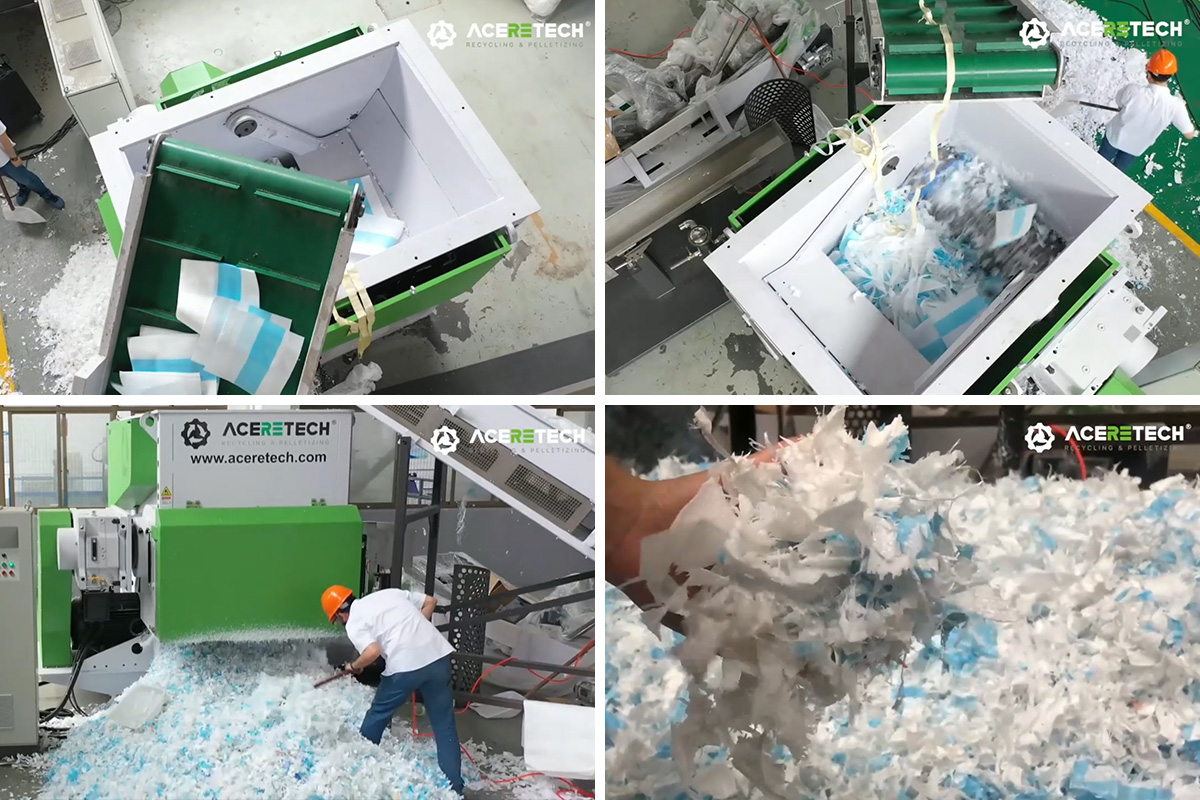
1. Low-speed, high-torque design
The HS Series utilizes a low-speed, high-torque drive system that delivers consistent shearing force, rather than relying on high-speed impact for size reduction.
This operating method is particularly well-suited for:
PP non-woven fabrics
PP woven bags
Bulk bags (FIBCs)
PE film
Agricultural film
Various flexible plastics
Compared to high-speed shredders, this design effectively minimizes the risk of wrapping while reducing cutter wear and energy consumption, ensuring stable, long-term operation.
2. Optimized Rotor Structure to Minimize Material Wrapping
The HS series features specially designed V-shaped rotary blades and a strategically arranged stationary blade configuration, ensuring continuous shearing action on flexible materials.
The high-strength, wear-resistant blades can be resharpened multiple times, extending service life and effectively reducing maintenance costs.
Uniform output particle size creates ideal conditions for subsequent washing and granulation processes.
3. Intelligent Hydraulic Pusher System
To address the issue of bulky materials bridging, the HS series is equipped with an intelligent hydraulic pusher system.
The hydraulic pusher automatically adjusts its feed speed based on the rotor load, continuously and evenly feeding material into the cutting zone. This ensures stable, continuous production while preventing momentary overloads and enhancing overall processing efficiency.
4. Intelligent PLC Control System
The machine utilizes an intelligent PLC control system featuring:
Automatic start/stop
Automatic reverse rotation
Overload protection
Fault alarms
Operational status monitoring
This system not only simplifies manual operation but also improves the stability and safety of equipment operation.
IV. Typical Recycling Process for PP Non-Woven Bags
Different recycling processes may be employed depending on the source of the PP non-woven bags.
Industrial Scrap (Clean Material)
Scrap generated during factory production typically has low contamination levels and can proceed directly to the pelletizing process.
Recommended Process:
Belt Conveying → Single-shaft Shredding → Metal Separation → Compaction Feeding → Melt Extrusion → Melt Filtration → Pelletizing → Recycled PP Pellets
Post-Consumer PP Non-Woven Bags
For post-consumer waste such as shopping bags and packaging bags, a washing step is recommended due to potential contamination from dust, oil, and other impurities.
Recommended Process:
Conveying → Single-shaft Shredding → Washing → Rinsing → Dewatering → Compaction & Pelletizing → Melt Filtration → Pelletizing → Recycled PP Pellets
The resulting recycled PP pellets can be widely used in applications such as injection molding, extrusion, blow molding, and non-woven fabric production, enabling high-value recycling.
Conclusion
Although PP non-woven bags are typical single-use plastic products, their core material—polypropylene (PP)—possesses excellent recyclability. Through scientific and efficient recycling processes, this waste can be fully reintegrated into the plastic supply chain, enabling resource circularity.
As a critical piece of pre-treatment equipment in the recycling line, the shredder directly impacts downstream washing and pelletizing processes, as well as the quality of the final recycled material. Addressing the specific characteristics of PP non-woven bags—such as their softness, bulkiness, and tendency to tangle—the ACERETECH HS series single-shaft shredder delivers stable and efficient pre-treatment performance. It achieves this through features such as a low-speed, high-torque design, an optimized rotor structure, an intelligent hydraulic pusher system, and automatic PLC control, thereby ensuring the reliability of the entire recycling line.
Whether for the recycling of factory offcuts or the reprocessing of post-consumer PP non-woven bags, ACERETECH offers a comprehensive, one-stop plastic recycling solution—covering shredding, washing, and pelletizing. This enables customers to boost production efficiency, reduce operating costs, and produce high-quality recycled PP pellets, achieving a win-win outcome of economic profitability and environmental sustainability.
FAQ
Q1. Can PP non-woven bags be 100% recycled?
A: PP non-woven bags are primarily made of polypropylene (PP), a thermoplastic material that can be melted and reprocessed multiple times. The actual recycling rate depends on factors such as the level of contamination, impurity content, and the specific recycling process used. High recycling rates are typically achievable with industrial scrap; for post-consumer waste, however, adding washing and sorting steps is recommended to ensure higher-quality recycled pellets.
Q2. Should I choose a single-shaft or dual-shaft shredder for PP non-woven bags?
A: For PP non-woven bags destined for further washing or pelletizing, a single-shaft shredder is usually the ideal choice. Single-shaft equipment offers precise control over output particle size and minimizes material tangling, providing uniform, stable feedstock for the subsequent pelletizing stage. Dual-shaft shredders, by contrast, are better suited for coarse shredding or volume reduction tasks.
Q3. Is washing necessary during the PP non-woven bag recycling process?
A: Not all PP non-woven bags require washing. If the feedstock consists of clean factory production scrap, it can proceed directly to shredding and pelletizing. However, for post-consumer waste—such as shopping bags or packaging—adding washing, rinsing, and dewatering steps is recommended to remove dust, oil, and other impurities, thereby enhancing the quality of the recycled pellets.
Q4. Can shredded PP non-woven bags be directly processed into granules?
A: If the raw material is clean and contains minimal impurities, shredded PP non-woven bags can be fed directly into a compaction and granulation system. However, for waste that is heavily contaminated or mixed with other materials, it is recommended to wash and dewater the material before granulation to ensure higher melt purity and granule quality.
Q5. What products can be made using recycled PP granules?
A: High-quality recycled PP granules are widely used in the manufacture of non-woven products, plastic pallets, logistics crates, trash cans, automotive interior parts, construction materials, and packaging, as well as in various injection molding, extrusion, and blow molding applications. Specific applications depend on the grade of the recycled material.