In the transformation towards a circular economy for plastics by 2026, choosing efficient pelletizing equipment is crucial for maximizing return on investment (ROI). Aceretech offers two flagship solutions for different types of waste plastics: the ACS-H™ compacting and pelletizing system and the ASE™ single-screw extrusion system.
This article will provide a multi-dimensional comparison, analyzing the core differences between the two systems in terms of processing technology, applicable materials, and production efficiency, offering you a scientific selection guide.
I. Core Technology Path Comparison: Compacting vs. Direct Extrusion
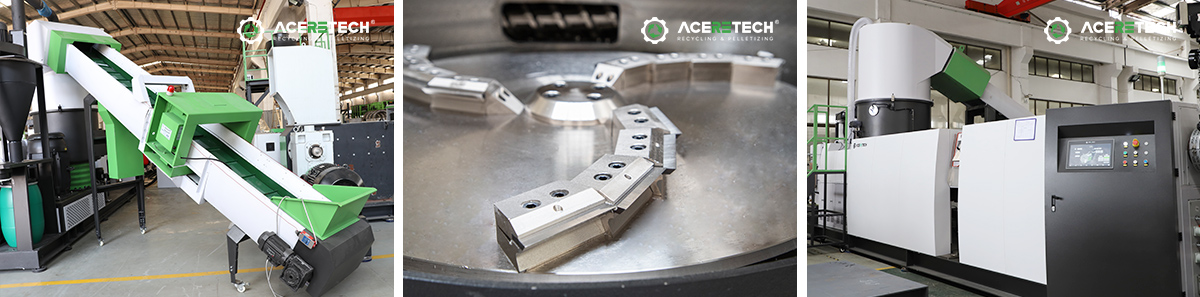
The ACS-H (Compacting & Pelletizing System) is designed specifically for high-volume, low-bulk-density materials.
Process Flow: Integrates shredding, compacting, and plasticization.
Core Advantages: The material is densified through a preheating and compacting unit (Compactor) before entering the screw, solving the problems of difficult feeding and unstable output for films and foamed materials.
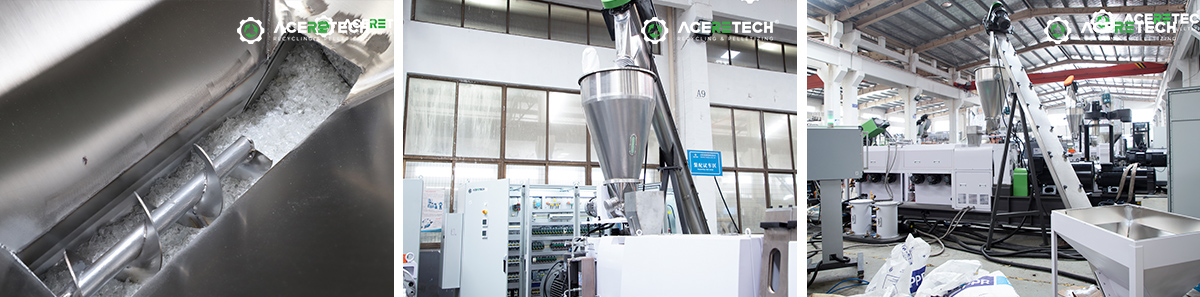
The ASE (Single Screw Extrusion System) is the ideal choice for rigid plastics after shredding.
Process Flow: Direct feeding + high-efficiency plasticization.
Core Advantages: Simplified structure and lower energy consumption. For rigid materials already shredded into flakes or chunks, the ASE provides more precise temperature control and melt filtration.
II. Detailed Selection Guide: Your Raw Materials Determine the Technology Path
Scenario A: If you are processing "soft/fluffy" materials
Recommended Model: ACS-H series
Applicable Materials: PE/PP film, BOPP, drawn/woven bags, non-woven fabrics, EPS/XPS foamed materials.
SEO Keywords: Film recycling pelletizing, compacting pelletizer, soft plastic recycling production line.
Technical Highlights:
Automated Feeding: Intelligent monitoring of compactor load and automatic adjustment of feeding speed.
Footprint: The integrated design saves 30% space compared to traditional crushing + granulation lines.
Scenario B: If you are processing "hard/crushed" materials
Recommended model: ASE series
Applicable materials: Washed HDPE bottle flakes, PP barrel materials, ABS/PS electronic waste scraps, defective hard pipes.
SEO Keywords: Hard material pelletizer, single-screw extrusion line, bottle flake recycling pelletizing system.
Technical Highlights:
High speed and high output: Optimized length-to-diameter ratio (L/D) ensures melt homogenization.
Low operating costs: Fewer maintenance points and longer service life of wear parts.
III. Technical Specifications Comparison Table
| Feature |
ACS-H Series (Cutting and Compacting Type) |
ASE Series (Standard Single-Screw Type) |
| Main Raw Materials | Films, filaments, foamed materials, woven bags | Bottle flakes, crushed blocks, hard scraps |
| Feeding Method | Cutting and compacting chamber | Belt conveyor/forced feeder |
| Integration Level | High (Crushing + Compacting + Granulation) | Medium (Requires pre-crushing assistance) |
| Typical Materials | LDPE, LLDPE, PP, EPS | HDPE, PP, ABS, PS |
| Output Quality |
Uniform, high density |
High transparency, low degradation |
Conclusion: How to make the final decision?
In a highly competitive environment, efficiency is the lifeline. If your business covers various forms of waste materials, the versatility of the ACS-H will provide you with greater flexibility; if you focus on high-yield recycling of a single type of hard plastic, the cost-effectiveness of the ASE is a better choice.
Want to get more technical parameters or customized solutions?
Contact Aceretech now for professional answers.
Frequently Asked Questions (FAQ)
Q1: How should I make the final decision between ACS-H and ASE based on the raw material form?
A: The core basis is the bulk density of the material.
If your material is lightweight, fluffy, and easily entangled (such as PE film, PP woven bags, filamentous waste), you must choose the ACS-H, because its integrated cutting and compacting chamber can forcibly densify the material, ensuring continuous production without bridging. If your materials are heavy, hard, and already crushed (such as HDPE bottle flakes, ABS scraps, or pipe sections), the ASE system is a more cost-effective option, as its direct feeding system provides higher extrusion efficiency.
Q2: Does the "cutting and compacting" function of the ACS-H system cause material degradation due to frictional heat?
A: No. Aceretech's ACS-H system is equipped with a precise temperature monitoring and cooling system. The heat in the compaction chamber is mainly used for preheating and removing trace amounts of surface moisture. Through variable frequency control, the system maintains the material at the critical softening point, not the melting point, thus preserving the molecular chain structure and physical properties of the plastic to the greatest extent while ensuring consistent feeding.
Q3: Under energy consumption standards, which model is more energy-efficient?
A: Energy efficiency depends on the production line matching.
For hard materials, the ASE system is more energy-efficient overall due to the absence of a motor-driven compaction chamber.
For soft film materials, the ACS-H's "three-in-one" design avoids the energy consumption losses of separate crushers and dryers, resulting in an average energy consumption per ton that is 15%-20% lower than traditional separate production lines.
Q4: Do these two systems support processing waste materials containing printing ink or heavy labels?
A: Both can support it, but with different configurations.
The ACS-H can volatilize some ink solvents during the compaction stage.
For materials with heavy ink content, we recommend equipping the ACS-H or ASE with a dual-stage vacuum degassing system and a large-area, large-diameter filtration system to ensure that the recycled granules are bubble-free and impurity-free, meeting the requirements for blown film applications.
Q5: Can Aceretech's granulation system be integrated into the factory's Industry 4.0 digital management platform?
A: Yes. The 2026 models of both the ACS-H and ASE systems natively support IoT smart gateways. Through the PLC control system, you can monitor equipment operating current, melt pressure, hourly energy consumption, and production capacity data in real time. This data can be directly integrated with your ERP or MES system, enabling visualization and traceability of the production process.