In PET processing, moisture control before extrusion is one of the most important factors determining final product quality.
Although PET chips may appear dry, they can absorb approximately 3000–4000 ppm moisture from the environment during normal storage and transportation. During melt processing, this residual moisture can trigger hydrolytic degradation, breaking PET molecular chains and causing IV loss.
Why Effective Drying Matters
Insufficient drying before processing allows residual moisture to react with PET polymer chains during melting. This hydrolysis reaction reduces molecular weight and IV retention, causing strength loss, internal void formation, and potential defects in the final product.
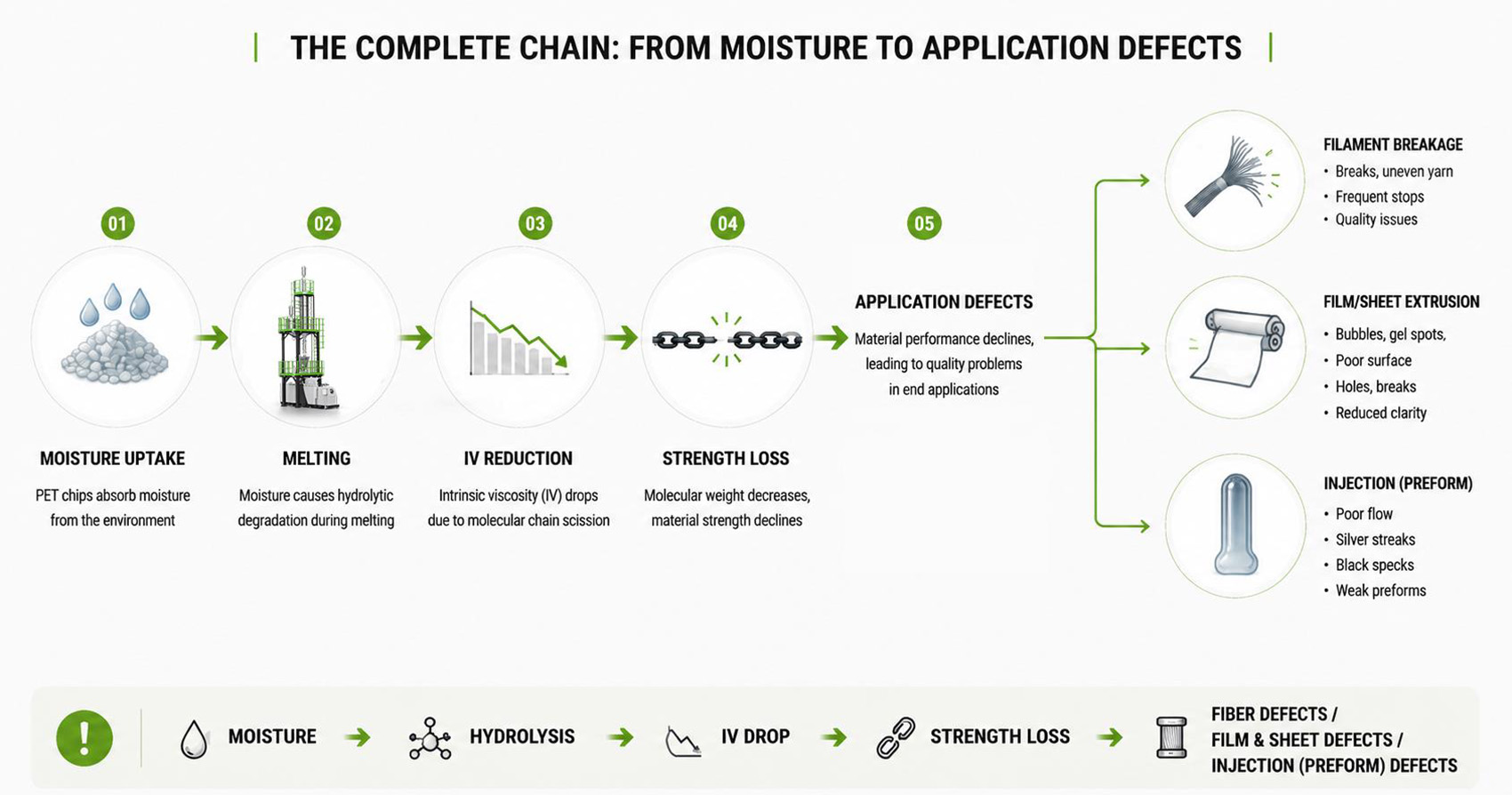
Moisture → Hydrolysis → IV Reduction → Strength Loss → Product Defects
According to Molecular Weight Reduction Caused by Hydrolysis
M_n'=M_n/(1+(x M_n/1800))
Where:
• Mₙ is the initial number-average molecular weight of PET
• Mₙ′ is the number-average molecular weight after hydrolytic reaction with water
• x represents the moisture content (wt%)
Assuming an industrial-grade PET material with an initial Mₙ of approximately 25,000 (corresponding to an IV value of around 0.8 dL/g), the theoretical molecular weight reduction under different initial moisture conditions can be calculated as follows:
| Moisture | Final Mn | IV Loss (Est.) | Quality Status |
| 3 ppm |
≈24960 | Negligible | Fully qualified, stable spinning |
| 30 ppm | ≈24600 | Slight | Acceptable, risky for high-IV yarn |
| 50 ppm | ≈24390 | ≈0.05 | Obvious viscosity loss, lower yarn tenacity |
| 100 ppm | ≈23810 | ≈0.07 | Noticeable degradation, high-IV yarn quality drops |
| 300 ppm | ≈21700 | ≈0.08 | Severe viscosity drop, low yield |
| 3000 ppm | ≈10600 | ≥0.30 | Failed, unspinnable & scrapped |
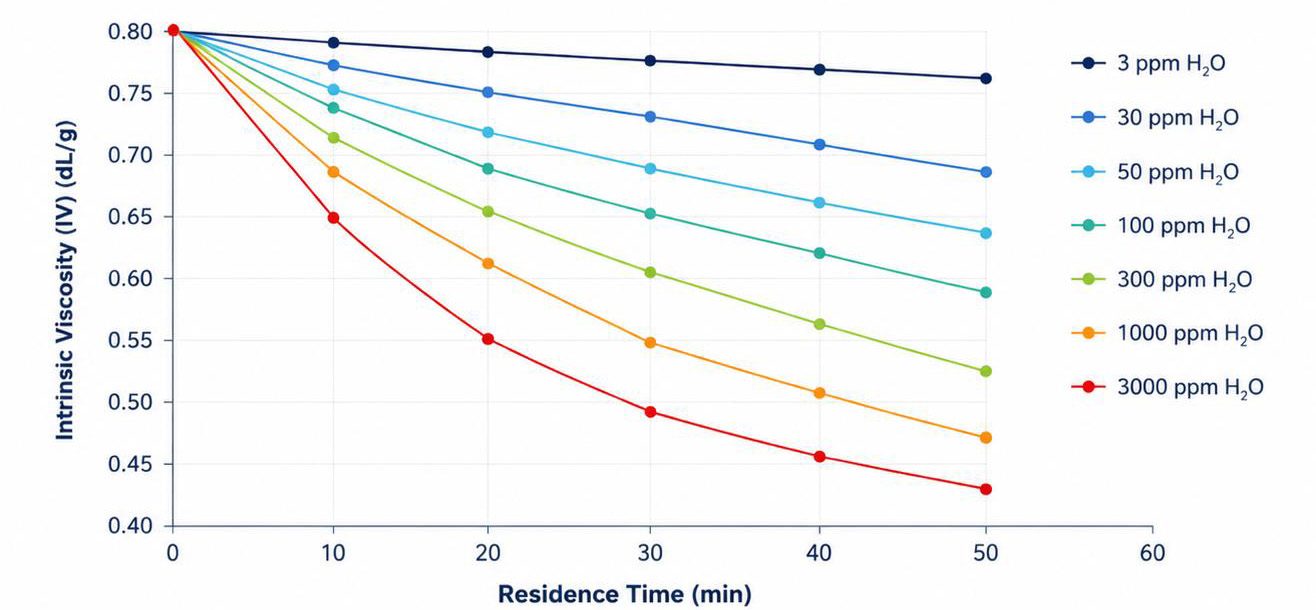
PET Melt IV Degradation vs. Residence Time & Initial Moisture Content
High IV PET Requires More Precise Moisture Control
High IV PET (IV 0.9–1.0) is more sensitive to residual moisture than standard PET. During melt processing, moisture can cause hydrolytic degradation, leading to molecular chain scission, IV reduction, and loss of mechanical properties.
The relationship between PET melt viscosity, IV, and temperature can be described by:
η_0=0.129(IV)^5.35 exp(6800/T)
Where η₀ is zero-shear melt viscosity, IV is intrinsic viscosity, and T is absolute temperature (K).
As IV increases, PET requires more stable processing conditions. Effective drying is therefore essential to minimize hydrolysis, maintain IV retention, and ensure consistent recycled PET quality.
PET Drying Technology Comparison: Moisture Removal Performance
| Drying Technology | Residual Moisture | Crystallization Time | Drying Time | Critical Parameters | Energy Consumption |
| Twin-Tower Molecular Sieve Desiccant Dryer | 30-200ppm | 60-90min | 240-360min | Dew point, time, temperature | 140kwh/T |
| Honeycomb Desiccant Rotor Dryer | 60-200ppm | 60-90min | 240-360min | Dew point, time, temperature | 160kwh/h |
| Vacuum Dryer | 15-50ppm |
60-90min | 60-120min | Vacuum level, time, temperature | 110kwh/T |
ACERETECH PET Drying Technologies: From Dehumidification to Vacuum Drying
| Comparison Item | Twin-Tower Desiccant Dryer / Honeycomb Rotor Dryer | ACERETECH VacuPure System |
| Picture for reference | 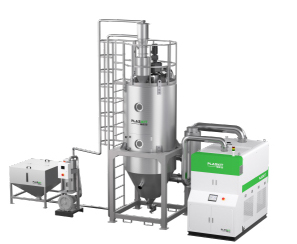 |
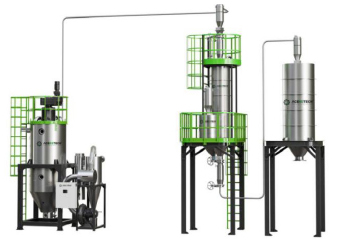 |
| Residual Moisture After Drying | 30-200ppm |
15-50ppm |
| Working Principle | Uses a continuously rotating honeycomb desiccant rotor to provide stable low dew point dry air for moisture removal. | Removes moisture from PET materials under vacuum conditions, accelerating moisture diffusion while reducing thermal stress. |
| Moisture Removal Performance | Provides stable dehumidification performance with continuous low dew point air supply. | Enables more efficient moisture removal and achieves lower residual moisture levels. |
| Impact on PET Quality | Provides uniform drying and helps maintain stable processing conditions. | Minimizes hydrolytic degradation, protects molecular chains, and improves IV retention. |
| Drying Efficiency | Suitable for continuous crystallization and pre-drying processes. | Faster moisture diffusion under vacuum conditions, reducing drying time and improving efficiency. |
| Energy Efficiency | Honeycomb rotor design reduces airflow resistance and improves energy efficiency compared with conventional desiccant dryers. | Lower drying temperature requirements reduce thermal energy consumption and minimize oxidation risk. |
| Material Protection | Dust-free desiccant structure helps prevent contamination during drying. | Under vacuum conditions, PET is protected from oxygen exposure, minimizing oxidation damage and enabling efficient decontamination and devolatilization. |
| Typical Applications | PET flakes pre-drying, PET recycling lines, PET fiber, film and sheet applications. | Bottle-to-bottle recycling, high IV PET recycling, food-grade rPET |
If you are facing unstable IV, filament breakage, high scrap rates or quality issues in PET applications such as fiber spinning, preform injection, film, sheet or PET strap production, the root cause may be insufficient drying and moisture-induced hydrolysis.
Excessive moisture during PET processing can cause molecular chain degradation and IV reduction, resulting in various product defects, including:
• Fiber spinning: filament breakage, reduced fiber strength and unstable production quality.
• Preform injection: silver streaks, black spots, reduced preform strength and poor blow molding performance.
• Film & sheet extrusion: bubbles, gels, surface defects, reduced transparency and mechanical performance.
• PET strap production: lower tensile strength, unstable dimensions and strap breakage during use.
Based on your specific application requirements, PET grade and production capacity, ACERETECH provides customized drying solutions, including Honeycomb Desiccant Rotor Dryer, Twin-Tower Molecular Sieve Desiccant Dryer and advanced Vacuum Drying Technology.
For demanding applications such as high-quality rPET production and food-grade PET applications, our advanced vacuum drying system provides excellent decontamination and devolatilization performance, while helping maintain PET molecular properties and IV stability.
We provide free customized trial services for global partners, including moisture testing, process evaluation and technical recommendations.
Looking forward to establishing long-term win-win cooperation with you.