I. ACSS Double-Stage Plastic Pelletizing Machine — Enabling Stable, Continuous Recycling and Pelletizing
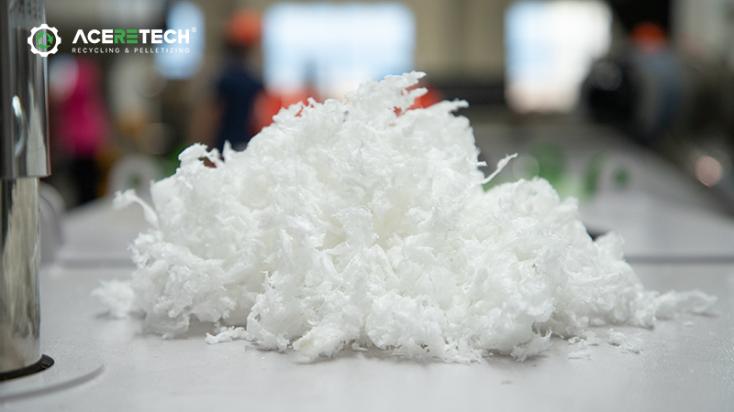
Plastic waste—such as films, woven bags, filaments, and flexible packaging materials—is typically lightweight, bulky, and characterized by low bulk density. During the recycling and pelletizing process, these materials often present challenges such as unstable feeding, moisture content, residual volatiles, impurity filtration issues, and the need for frequent screen changes.
To address these typical challenges in plastic recycling, the ACERETECH ACSS double-stage single-screw compacting and pelletizing machine integrates multiple process steps—including cutting, compacting, plasticizing, extruding, degassing, melt filtration, and pelletizing—into a single continuous recycling system. It offers a highly efficient and stable solution for processing plastic films and other flexible plastic waste.
The ACSS utilizes a double-stage single-screw extrusion configuration: the first stage handles material melting and plasticizing, while the second stage ensures melt homogenization, degassing, and stable conveying. This design improves the quality of the recycled melt and enhances the consistency of the final pellets.
In this trial run, plastic film was used as the test material to demonstrate the actual operation of the ACSS machine, showcasing the complete process flow—from material conveying and pre-treatment (compacting) to extrusion, degassing, filtration, and water-ring pelletizing.
II. ACSS Plastic Recycling and Pelletizing Process
ACSS integrates multiple functional units into a single plastic recycling and pelletizing system. The typical process flow is as follows:
Plastic waste → Belt conveying → Metal detection → Cutting and compacting → Two-stage single-screw extrusion → Vacuum degassing → Melt filtration → Water-ring pelletizing → Vibration sieve → Centrifugal dewatering → Finished product storage
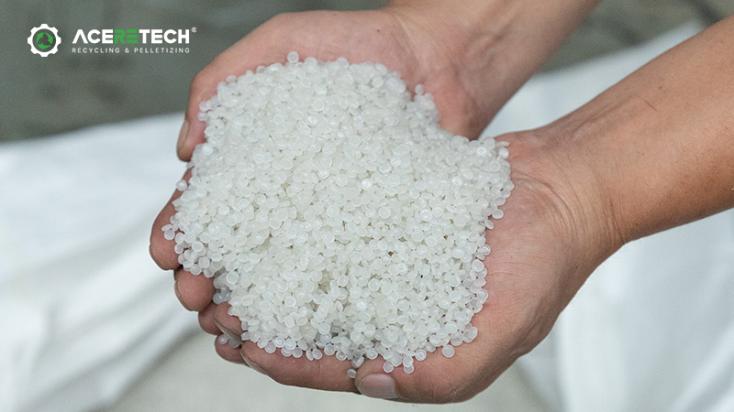
The cutting and compacting system improves the feeding characteristics of low-bulk-density plastic waste; the two-stage extrusion system handles plasticization, homogenization, and melt conveyance; vacuum degassing and melt filtration further enhance melt quality; and finally, the water-ring pelletizing system converts the melt into uniform recycled plastic pellets.
This integrated design minimizes material transfer between different pieces of equipment and enhances the continuity of the entire recycling and pelletizing process.
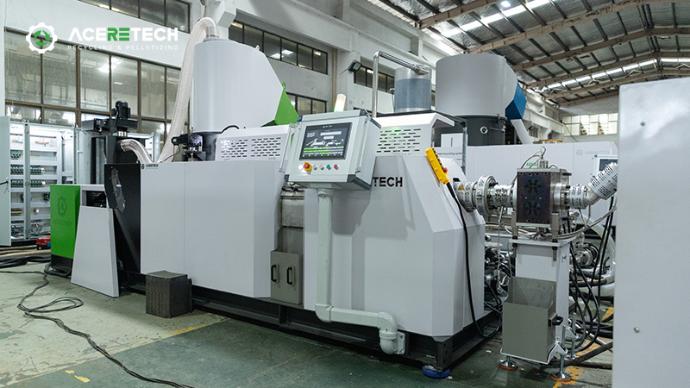
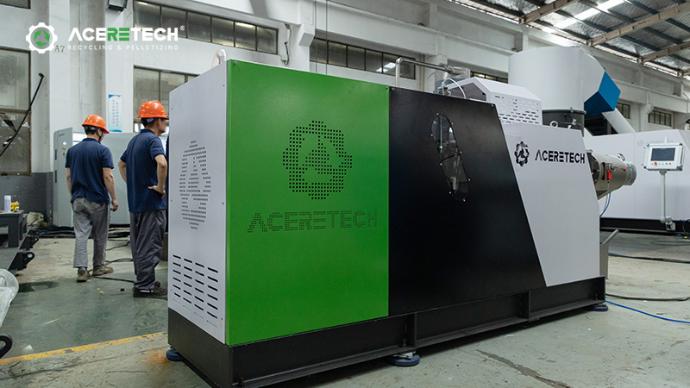
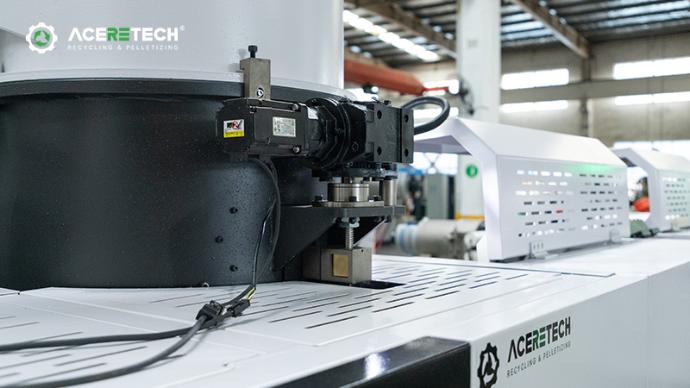
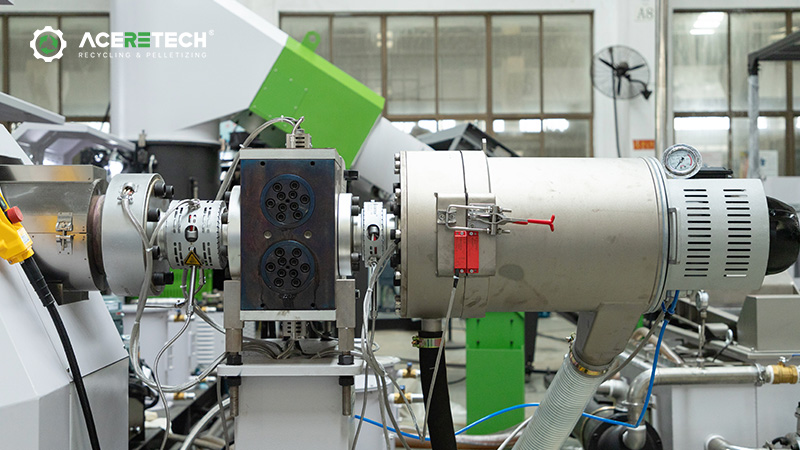
1. Cutting and Compacting System: Improving Feeding Stability for Low-Density Plastics
Plastic film and woven waste materials typically have large volumes and low densities; feeding them directly into an extruder often leads to inconsistent feeding and reduced conveying efficiency.
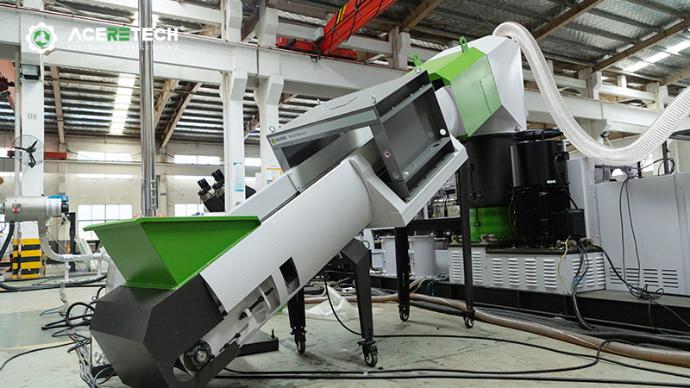
ACSS utilizes a cutter-compactor system that integrates pretreatment functions such as cutting, volume reduction, preheating, drying, and compacting.
A high-speed rotating cutter disc works with stationary blades to cut the material while utilizing frictional heat to preheat and partially dry it, thereby reducing the volume of the bulky plastic waste and increasing its bulk density.
The compacted material enters the extruder more steadily, improving the feeding conditions for low-bulk-density plastics during continuous production.
The ACSS compacting system also allows for control configurations tailored to specific materials and production conditions, further optimizing material residence time and conveying characteristics within the compaction chamber.
2. Metal Detection System: Protecting Equipment Operation
ACSS allows for the integration of a metal detection unit into the belt conveyor system.
When foreign metal objects are detected during the feeding process, the system triggers an alarm and halts the relevant equipment, thereby reducing the risk of equipment damage caused by metal contaminants entering the downstream cutting and extrusion systems. For plastic recycling feedstocks with complex origins, metal detection serves as a crucial upstream safeguard, enhancing the operational safety of the entire production system.
3. Two-Stage Single-Screw Extrusion System: The Core Technology of ACSS
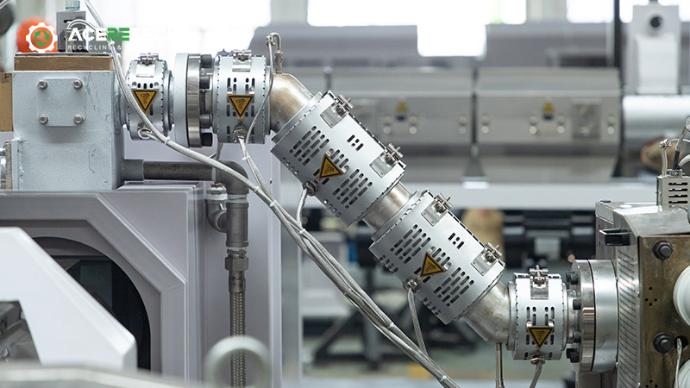
A key feature of the ACSS is its two-stage single-screw extrusion configuration.
Compared to traditional single-stage extrusion and pelletizing systems, the two-stage structure allows for the rational distribution of processing tasks, such as plasticization and melt homogenization.
Stage 1: Melting and Plasticization
The first stage is primarily responsible for material conveying, melting, and plasticization.
Equipment configuration for this trial run:
Screw diameter: Ø80 mm
Screw L/D ratio: 42:1
The high L/D ratio ensures thorough plasticization and melting of the material, creating stable conditions for subsequent melt processing.
Stage 2: Homogenization and Stable Extrusion
Stage 2 configuration:
Screw diameter: Ø120 mm
Screw L/D ratio: 12:1
The second stage further homogenizes and degasses the melt while ensuring stable conveyance, maintaining a consistent processing state before the melt enters the filtration and pelletizing systems.
The ACSS two-stage system is particularly well-suited for plastic waste characterized by high moisture content, heavy printing ink residues, poor flowability, temperature sensitivity, and high impurity levels.
4. Vacuum Degassing System: Improving Melt Quality
During the recycling process, plastic waste may contain moisture, volatile substances, and low-molecular-weight compounds.
The ACSS is equipped with a vacuum degassing system that reduces volatile components in the melt through vacuum extraction during extrusion.
This helps to:
Remove moisture from the melt;
Reduce volatile substances;
Minimize processing defects such as gas bubbles;
Enhance melt stability;
Improve the consistency of recycled pellet quality.
Regarding ACSS configuration, first-stage vacuum degassing is standard, while second-stage vacuum degassing is optional, depending on specific material requirements.
Consequently, the vacuum degassing system plays a vital role in applications involving printed films, high-moisture plastic waste, and processes requiring high melt quality.
5. Non-stop Piston Type Filter: Minimizing Production Downtime
Recycled plastic materials often contain a certain proportion of solid impurities, making melt filtration a critical step in the regeneration and pelletizing process.
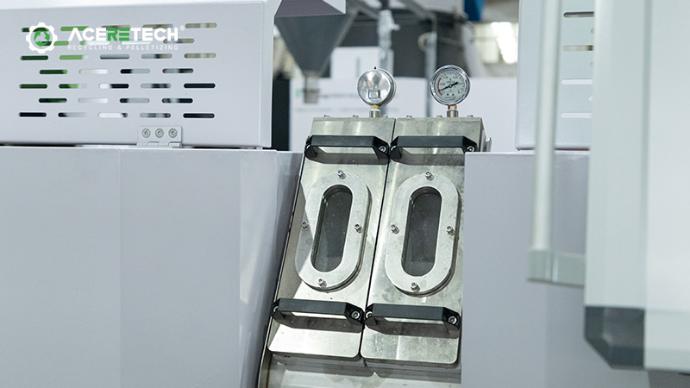
The equipment used in this trial is configured with a dual-station, non-stop piston type filter.
This filtration system offers a large filtration area and allows for screen switching during continuous production, thereby reducing downtime caused by screen changes.
Key advantages include:
Large melt filtration area;
Extended screen service life;
Reduced frequency of screen changes;
Screen replacement without stopping production;
Minimized production downtime;
Lower maintenance and operating costs.
ACSS can also configure various melt filtration solutions based on material contamination levels and specific customer production requirements, including non-stop piston type filters and the optional SCF self-cleaning filtration system.
6. Water-Ring Pelletizing System: Stable Production of Uniform Recycled Pellets
After plasticization, homogenization, degassing, and melt filtration, the molten plastic enters the water-ring pelletizing system.
ACSS supports multiple pelletizing methods, including:
Water-ring pelletizing;
Underwater pelletizing;
Strand pelletizing.
A water-ring pelletizing system is used for this trial.
After being extruded through the die head, the melt is cut by rotating blades to form recycled plastic pellets, which then undergo cooling, screening, and dewatering processes.
The water-ring pelletizing system features functions such as automatic adjustment of blade pressure and rotation speed, helping to maintain stable pelletizing conditions and consistent pellet quality.
7. Vibration Sieve and Centrifugal Dewatering: Comprehensive Pellet Post-Processing
The pelletized plastic enters the post-processing system.
ACSS configuration:
Vibration Sieve + Centrifugal Dewatering Unit + Finished Product Storage Silo
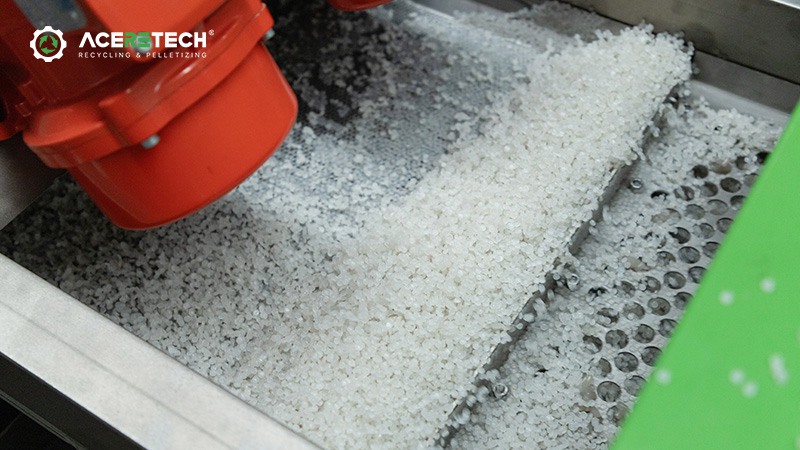
The vibration sieve is used for pellet conveying and screening, while the centrifugal dewatering unit further reduces residual surface moisture. The processed recycled plastic pellets are then conveyed to the finished product storage silo.
This comprehensive post-processing system ensures the recycled pellets are well-suited for subsequent packaging, storage, and further processing.
8. Intelligent PLC Control System
The ACSS utilizes an intelligent PLC control system to centrally manage key production stages, including material conveying, compacting, extrusion, temperature control, filtration, and pelletizing.
The equipment incorporates high-quality electrical components and gearboxes, ensuring stability and reliability during long-term, continuous operation.
Centralized control allows operators to easily monitor the equipment's operating status and adjust production parameters based on the specific processing characteristics of different materials.
III. Core Advantages of the ACSS Two-Stage Plastic Film Pelletizing Machine
Based on its structural design and practical applications, the ACSS two-stage single-screw plastic film compacting and pelletizing machine offers the following key advantages:
1. Highly Efficient Integrated Recycling Process
It integrates multiple stages—cutting, compacting, plasticizing, extruding, degassing, filtering, pelletizing, cooling, and dewatering—into a single production system.
2. Two-Stage Extrusion for Enhanced Melt Processing
It improves the processing quality of the recycled melt through a two-stage process: initial melting and plasticizing, followed by melt homogenization, degassing, and stable conveying.
3. Wide Material Compatibility
The ACSS is suitable for a variety of plastic waste materials, including PE, LDPE, PP, BOPP, CPP, OPP, PA, PC, PS, PU, ABS, and PET; specific configurations are tailored to the material's characteristics.
4. Suitable for Challenging Recycled Materials
The two-stage structure, combined with advanced degassing and filtration systems, provides superior melt processing capabilities for plastic waste that is high in moisture, heavily printed, temperature-sensitive, or contains high levels of impurities.
5. Continuous Production
A non-stop filtration system minimizes production interruptions caused by screen changes, thereby enhancing the equipment's continuous operational capacity.
6. Flexible Pelletizing Methods
Depending on the plastic material and the required pellet specifications, users can choose from water-ring, strand, or underwater pelletizing systems.
IV. Application Scope of the ACSS Plastic Compacting and Pelletizing Machine
The ACSS two-stage cutting, compacting, and recycling pelletizing system is primarily designed for the recycling and reprocessing of plastic film and other flexible plastic waste.
Typical applications include:
PE film;
LDPE film;
PP film;
BOPP/OPP film;
CPP film;
Printed film;
Woven bags;
Filaments/tapes;
Fiber-based plastic waste;
Partially foamed plastics;
Other plastic waste suitable for extrusion pelletizing.
Actual production capacity and equipment configuration must be assessed based on material type, contamination level, moisture content, feed condition, and target output.
V. Summary
The core value of the ACSS lies in its integrated technical solution—combining cutting-compaction, two-stage extrusion, degassing, filtration, and pelletizing—specifically designed for plastic films and various types of flexible, low-bulk-density plastic waste that are otherwise challenging to process.
Through actual machine trials, customers can gain a clear, firsthand understanding of the equipment structure, operational workflow, and pellet production process of the ACSS two-stage plastic recycling and pelletizing system.
The ACERETECH ACSS two-stage single-screw plastic film compacting and pelletizing machine provides plastic recycling enterprises with an efficient, stable, and continuous solution for recycling and regenerating plastic waste into pellets.
FAQ
Q1. What types of plastic waste is the ACSS two-stage single-screw plastic film pelletizing machine suitable for processing?
A: The ACSS two-stage single-screw plastic film compacting and pelletizing machine is primarily designed for recycling and pelletizing various plastic films and flexible plastic wastes, such as PE, LDPE, PP, BOPP, CPP, and OPP films, as well as printed films, woven bags, filaments/tapes, and partially foamed plastics. The equipment can be configured with appropriate compacting, degassing, filtration, and pelletizing systems based on the specific material's moisture content, contamination level, bulk density, and melting characteristics. For specific materials, it is recommended to conduct actual trial runs to determine the optimal equipment configuration and processing parameters.
Q2. Under what circumstances is a two-stage single-screw structure required for plastic film recycling and pelletizing?
A: Plastic films typically possess characteristics such as low density and a tendency to tangle, and they often contain moisture or volatile substances; a single extrusion stage may struggle to simultaneously meet the requirements for thorough plasticization, melt homogenization, and degassing. The ACSS employs a two-stage single-screw configuration that effectively distributes the tasks of melting and plasticization, followed by melt homogenization, degassing, and stable conveying. This design facilitates a more stable melt state and enhances the overall stability of the continuous pelletizing process. The two-stage structure offers distinct advantages when processing plastic waste characterized by high moisture content, significant impurities, heavy printing, or high levels of contamination.
Q3. How does the ACSS compactor-pelletizer resolve issues with unstable plastic film feeding?
A: Plastic films are characterized by large volumes and low bulk densities; direct feeding often leads to problems such as material bridging and inconsistent conveying. The ACSS is equipped with a cutting and compacting system that cuts, preheats, and densifies the film, thereby reducing volume and increasing bulk density to make the material better suited for continuous feeding into the extrusion system. Additionally, the compacting system utilizes variable frequency control to adjust operating parameters based on the material's condition, thereby improving feeding stability throughout the pelletizing process.
Q4. How does the ACSS two-stage pelletizer ensure the quality of recycled plastic pellets?
A: The ACSS enhances recycled pellet quality through a combination of processes, including two-stage extrusion, vacuum degassing, melt filtration, and stable pellet cutting. Two-stage extrusion ensures thorough plasticization and melt homogenization; the vacuum degassing system removes moisture and volatile substances from the melt; the melt filtration system eliminates residual solid impurities; and the final pellets are formed using methods such as water-ring, strand, or underwater pelletizing. This multi-stage processing minimizes defects and improves the uniformity and consistency of the recycled pellets.
Q5. What is the function of the compacting system in the ACSS two-stage plastic film pelletizer?
A: The ACSS compacting system serves not only to reduce the volume of plastic film but also to improve the material's condition through cutting, friction, and preheating. For fluffy film waste with low bulk density, the compacting process creates a denser material that feeds more stably into the extrusion system. Furthermore, the heat generated during compaction aids in preheating and preliminary drying, thereby enhancing the stability of the subsequent plasticization and extrusion stages.