Efficient Size Reduction of Large-Diameter HDPE Pipes
Large-diameter HDPE pipes are widely used in municipal infrastructure, natural gas transmission, industrial applications, and other heavy-duty projects.
When these pipes reach the end of their service life or generate production scrap, their large dimensions and rigid structure can make them difficult to process with conventional plastic recycling equipment.
For large-diameter pipes, the first challenge is not pelletizing—it is reducing the oversized pipe material into a manageable size for subsequent recycling processes.
For this application, ACERETECH uses a three-step size reduction process:
Pipe Cutting → MS Shredding → GE Fine Crushing
The system reduces large HDPE pipes into approximately 10–20 mm material, providing a suitable feedstock for subsequent washing, pelletizing, or other recycling processes according to the customer's requirements.
I. Application Background
Large HDPE pipes can have very large diameters and substantial wall thicknesses.
Compared with conventional plastic scrap, they present several practical challenges:
• Large physical dimensions
• High material strength
• High resistance to cutting
• Low feeding flexibility
• High mechanical load during size reduction
Trying to process oversized pipes directly through a conventional crusher is therefore not an efficient approach.
The purpose of this application is to gradually reduce the size of the pipe material through several stages.
II. Main Challenge: Oversized HDPE Pipes
The main difficulty in this application comes from the physical dimensions of the incoming material.
For HDPE pipes with diameters exceeding approximately 300 mm, direct feeding into a conventional crusher becomes impractical.
Large pipe sections may be difficult to feed and can place excessive mechanical load on downstream equipment.
Therefore, the material is progressively reduced:
Large Pipe → Short Pipe Sections → Coarse HDPE Fragments → 10–20 mm Material
This staged approach distributes the size-reduction workload across different machines.
III. Three-Step Size Reduction Process
The complete process presented in this application is:
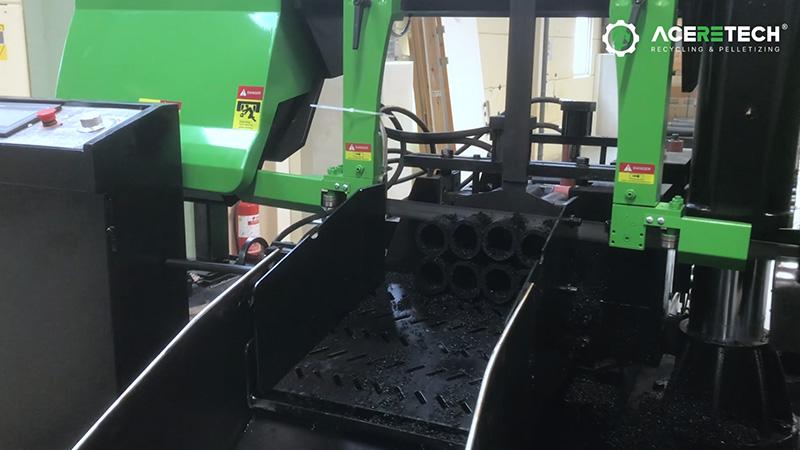
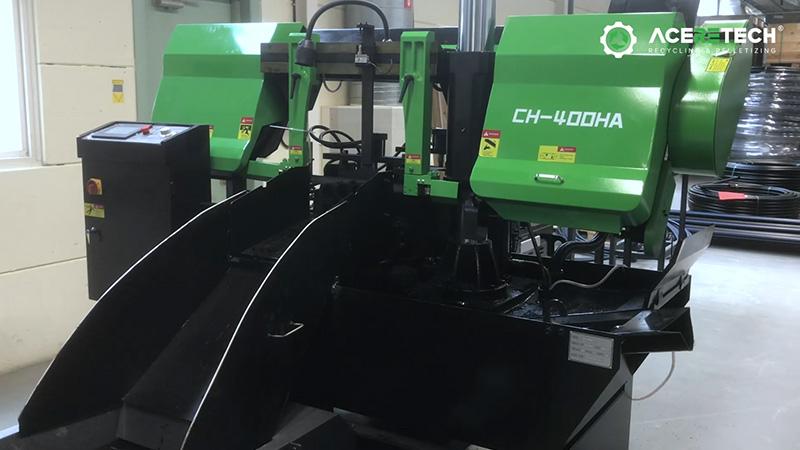
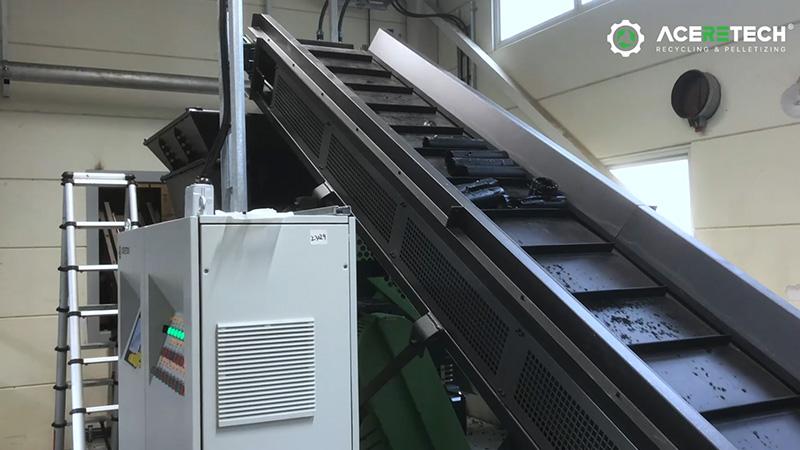
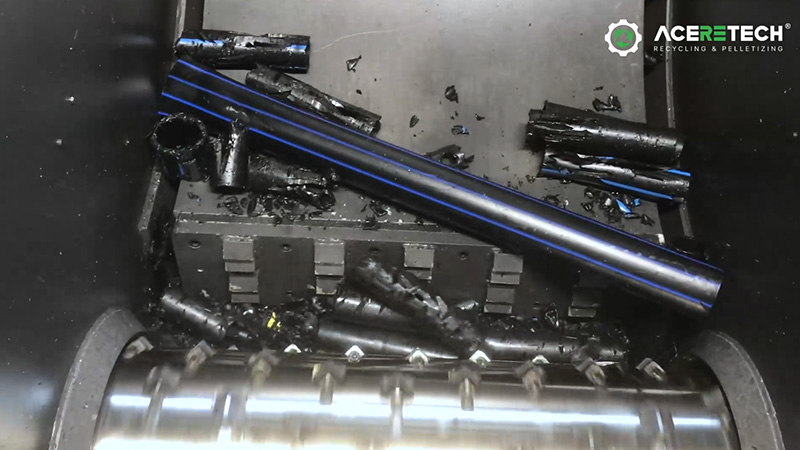
Step 1 — Large HDPE Pipe Cutting
Large pipes are cut into manageable sections.
The first stage is the pre-processing of oversized pipes.
For pipes with diameters exceeding approximately 300 mm, the full-length pipe is cut into shorter sections, typically around 50–100 cm long.
This reduces the physical dimensions of the material before it enters the shredder.
The cutting stage provides several practical benefits:
• Makes oversized pipes easier to handle
• Improves feeding conditions
• Reduces the load on the primary shredder
• Provides more consistent feedstock for the next stage
The objective at this stage is not to produce a final particle size.
It is simply to break down the oversized structure into manageable sections.
Step 2 — MS Series Primary Shredding
The MS Series shredder performs coarse size reduction and volume reduction.
The cut pipe sections are then fed into the MS Series Adjustable Industrial Shredder.
For this application, the shredder is configured with a 1500 mm ultra-wide rotor and a high-torque drive system.
The MS shredder performs the main coarse size-reduction process.
Its function is to transform the large pipe sections into irregular HDPE fragments.
Output from this Stage
The shredded material is approximately:
50–100 mm
The main objective here is volume reduction, rather than final particle sizing.
The resulting fragments are substantially easier to process in the downstream crusher.
Step 3 — GE Series Fine Crushing
The GE Series crusher further reduces the shredded material to approximately 10–20 mm.
After primary shredding, the HDPE fragments enter the GE Series Industrial Plastic Crusher.
For this application, the crusher is configured with:
• 500 mm rotor width
• High-speed cutting system
• Replaceable screen structure
The GE crusher performs the final size-reduction stage in this application.
Its purpose is to convert the irregular 50–100 mm shredded fragments into smaller and more uniform material.
Why Use a Shredder Before the Crusher?
The MS shredder and GE crusher perform different functions.
MS Shredder
High Torque + Coarse Size Reduction
The shredder handles the large and rigid pipe sections.
GE Crusher
High-Speed Cutting + Fine Size Reduction
The crusher handles the smaller shredded fragments.
This staged process avoids putting the entire size-reduction load onto a single machine.
It also provides more suitable feedstock for the fine crushing stage.
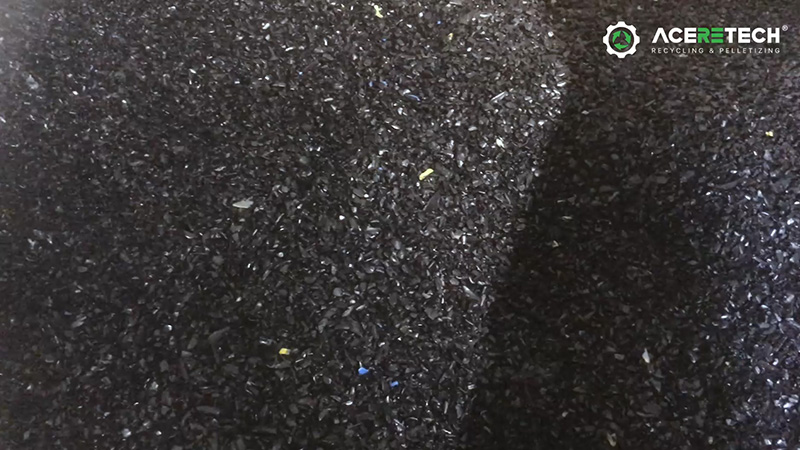
Final Output: 10–20 mm HDPE Material
After passing through the GE crusher, the material is reduced to approximately:
10–20 mm
The resulting material is more uniform and easier to handle than the original large-diameter pipes.
According to the current application, the screen can also be changed to adjust the final particle size according to subsequent process requirements.
This provides flexibility for different downstream recycling processes.
IV. Application Configuration
| Item |
Application Configuration |
| Feedstock |
Large HDPE pipes |
| Application | Size reduction / pre-treatment |
| Step 1 | Pipe cutting |
| Step 2 | MS Series shredder |
| MS Rotor | 1500 mm ultra-wide rotor |
| Shredded Output | Approx. 50–100 mm |
| Step 3 | GE Series crusher |
| GE Rotor Width | 500 mm |
| Final Output | Approx. 10–20 mm |
| Downstream | Washing / pelletizing / other recycling processes |
The above configuration and output sizes are based on the application presented on the current ACERETECH page.
V. Application Value
The main value of this solution is its ability to handle large-diameter HDPE pipe scrap that cannot be conveniently processed directly by conventional crushing equipment.
The system provides:
* Oversized Material Pre-Treatment
Large pipes are first cut into manageable sections.
* Heavy-Duty Primary Shredding
The MS shredder provides high-torque coarse size reduction.
* Fine Crushing
The GE crusher further reduces the shredded material.
* Controlled Final Particle Size
The crusher screen can be selected according to the downstream requirements.
* Preparation for Subsequent Recycling
The final 10–20 mm material can be transferred to subsequent washing, pelletizing, or other recycling processes according to the complete project configuration.
View More Products:
👉 Plastic Shredders & Crushers
👉 Plastic Washing Lines
👉 Plastic Pelletizing Machines
VI. From Large HDPE Pipes to Recyclable Feedstock
This application demonstrates a three-step size-reduction solution for large HDPE pipes.
The system does not attempt to complete the entire HDPE recycling process in one stage.
Instead, it focuses on the initial and critical challenge of reducing oversized pipe material to a suitable size for subsequent processing.
The complete application can be summarized as:
Large-Diameter HDPE Pipes → Pipe Cutting → 50–100 cm Pipe Sections → MS Series Shredding → 50–100 mm HDPE Fragments → GE Series Fine Crushing → 10–20 mm HDPE Material → Subsequent Recycling Process
This staged approach converts oversized HDPE pipe scrap into a more manageable feedstock for further recycling.
The processed HDPE material can then be transferred to the customer's subsequent washing, pelletizing, or other recycling processes.
FAQ
Q1. What type of HDPE pipes can this solution process?
A: The application is designed for large-diameter HDPE pipes, particularly oversized pipe materials that are difficult to feed directly into conventional crushing equipment.
For pipes exceeding approximately 300 mm in diameter, pre-cutting is used before shredding.
Q2. Why does the process need pipe cutting?
A: Large-diameter pipes are difficult to feed directly into the shredder.
Cutting them into approximately 50–100 cm sections makes the material more manageable and improves feeding conditions.
Q3. What is the function of the MS shredder?
A: The MS shredder performs the primary size reduction.
It reduces the cut pipe sections to approximately 50–100 mm fragments.
Q4. What is the function of the GE crusher?
A: The GE crusher performs the subsequent fine crushing stage.
It further reduces the shredded HDPE material to approximately 10–20 mm.
Q5. Can the final particle size be adjusted?
A: Yes. The GE crusher uses a replaceable screen structure, allowing the final particle size to be adjusted according to the requirements of the sub