Abstract
The core challenge in recycling plastic lumps lies in their excessive size, which renders them impossible to process directly.
By utilizing high-torque shredding, the single-shaft shredder reduces these massive lumps to manageable dimensions, serving as a critical pre-processing device for subsequent crushing or pelletizing stages.
Compared to crushers, shredders are far better suited for processing irregular, high-hardness plastic waste.
Through a combined shredding-and-granulation process, enterprises can achieve highly efficient recycling of these lumps—thereby reducing operational costs and boosting profit margins.
I. Plastic Lumps Are Not Waste; They Are "Trapped Profits"
During the production processes of plastic extrusion, injection molding, and blow molding, plastic lumps (start-up lumps, head stock) are generated on an almost daily basis.
While these materials may appear to be mere "production waste," their true nature is quite different:
👉 High-purity plastic material—of the exact same grade as the original raw material.
👉 A "sunk asset" for which the cost has already been paid.
The issue is not whether these materials possess value, but rather:
Most enterprises simply lack the capability to process them.
Common methods for handling these materials remain stuck in outdated practices:
Manual Cutting → Low efficiency + Significant safety risks
Selling Directly as Scrap → Value is severely undervalued
Stockpiling or Discarding → Consumes valuable space + Increases costs
👉 The fundamental reason is singular: The material size is simply too large to enter standard recycling workflows.
II. The Real Bottleneck: Not Pelletizing, But Size Reduction
Many enterprises mistakenly believe the problem lies in the granulation stage; however, this is not the case. The greatest challenge in recycling plastic lumps is actually this:
👉 How to transform "large, hard lumps" into a "processable size."
Plastic lumps possess several typical characteristics:
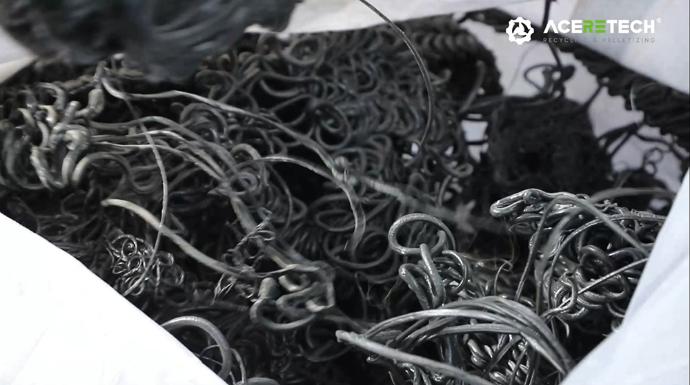
Massive size (sometimes consisting of an entire extruded head)
High density and high hardness
Irregular shapes
Incapable of being fed directly into a crusher or granulator
This leads to a very real practical problem:
👉 Traditional crushers are simply incapable of processing plastic lumps.
III. Why Is a Single-Shaft Shredder—Rather Than a Crusher—Absolutely Essential?
| Comparison Item | Single-Shaft Shredder | Traditional Crusher |
| Processing of Large Headstock Chunks |
✔ Direct Processing |
✖ Unable to Feed |
| Operation Mode | Low-Speed, High-Torque Shredding | High-Speed Shearing |
| Adaptability to Hard Materials | ✔ High | ✖ Prone to Jamming |
| Safety | ✔ Automatic Protection | ✖ Higher Risk |
| Output Control | ✔ Controllable Size | ✖ Unstable |
👉 The conclusion is straightforward:
For headstock material recovery, shredding must be performed first—only then should crushing or granulation be considered.
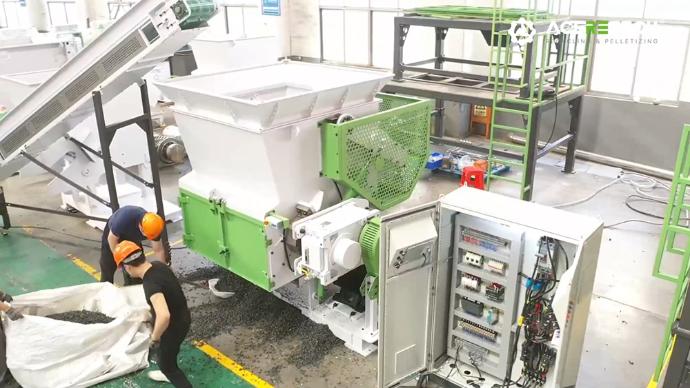
Addressing the "difficult-to-process characteristics" of headstock materials, the MS series is not merely a simple pulverizing device, but rather a highly efficient pre-treatment system.
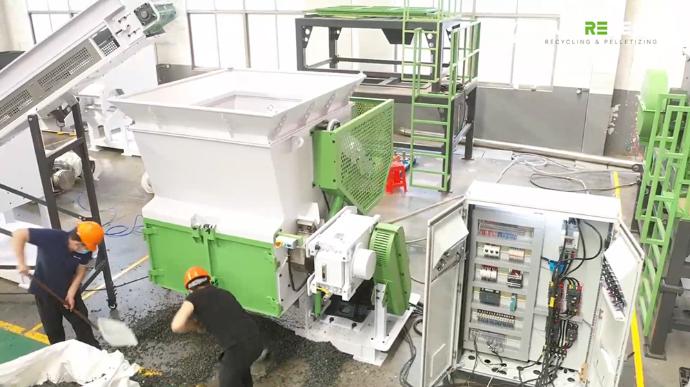
1️⃣ High-Torque Drive: Specifically Solves the "Hard" and "Large" Challenges
Adopts a low-speed + high-torque design:
Can directly shred HDPE / PP / PVC headstock materials
Requires no pre-cutting
Prevents impact damage to the equipment
👉 Key Value: Whole pieces go in; stable output comes out.
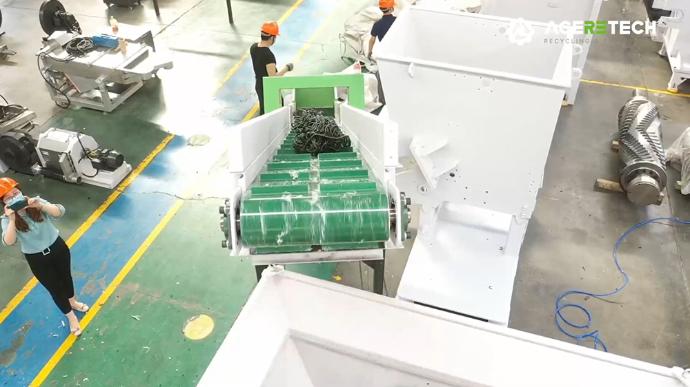
2️⃣ V-Type Feeding System: Prevents Slippage and Idle Running
One of the biggest problems with headstock materials is:
👉 "Slipping" inside the equipment, failing to engage with the cutting blades.
The MS series employs:
Hydraulic-driven feeding
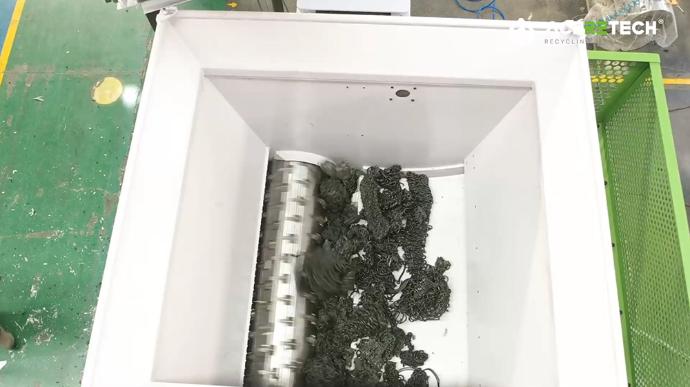
A V-shaped hopper structure
The result:
Forced feeding
Continuous contact with the rotor
Ensured stable shredding
👉 This is a capability that many ordinary shredders cannot achieve.
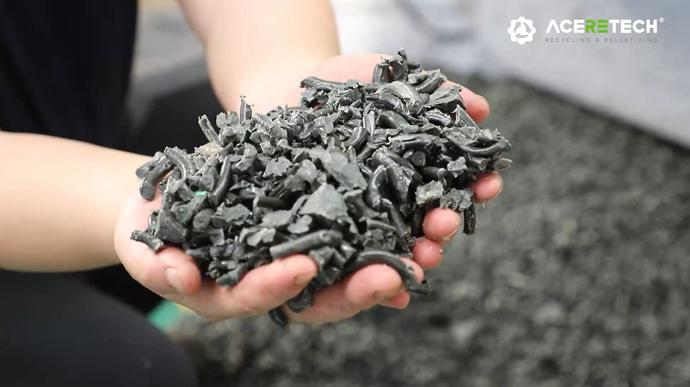
3️⃣ Screen Control: "Sizing" for Downstream Processes
The goal of shredding headstock materials is not simply to make them as small as possible, but rather:
👉 To produce a size suitable for the next piece of equipment (crusher/pelletizer).
The MS series supports screen replacement:
Output size is controllable (e.g., 40–100mm)
Output is uniform and stable
Prevents secondary blockages
👉 Directly boosts the efficiency of the entire recycling line.
4️⃣ Intelligent Protection: Prevents "Stalling" and Equipment Damage
The greatest fear in processing head chunks is:
👉 Machine jamming + Downtime
The MS system is equipped with a PLC control system:
Automatic forward/reverse rotation
Overload protection
Foreign object protection
👉 Enables: Unattended operation + Stable performance
V. The Complete Logic: The Right Way to Approach Head Scrap Recycling
A truly efficient and sustainable solution for recycling purge blocks is not merely a simple combination of machines; it is a proven processing logic:
Purge Blocks → MS Shredding → (Optional Crushing) → Pelletizinging → Production Reuse
Of these steps, the most critical is not the granulating stage, but rather the initial shredding and volume reduction performed at the front end of the process.
FAQ
Q1. Can die-head scrap be processed directly using a crusher?
A: It is not recommended to process die-head scrap directly using a crusher. Head scrap—typically characterized by its large volume, high hardness, and irregular shape—often exceeds the feed size limits and load-bearing capacity of traditional crushers. This can easily lead to: material jamming and shutdowns, cutter damage, or equipment overload.
👉 The correct processing workflow is as follows: First, the material undergoes size reduction using a single-shaft shredder, after which it proceeds to the crushing or granulation stage. This sequence ensures the stable and reliable operation of the entire production line.
Q2. What are the advantages of using a single-shaft shredder to process head scrap?
A: Single-shaft shredders are specifically engineered to handle "large, hard materials," offering distinct advantages over other types of equipment:
✔ Low-speed, high-torque operation capable of directly processing entire blocks of head scrap.
✔ A forced-feeding system that prevents material slippage.
✔ Controllable output particle size, ensuring compatibility with downstream equipment.
✔ An automatic protection system that minimizes the risk of downtime.
👉 Core Value: Transforming head scrap—material that would otherwise be unprocessable—into a reusable resource.
Q3. Can head scrap be sent directly to granulation after shredding?
A: This depends on the particle size achieved after shredding and the specific production requirements.
Generally, there are two possible scenarios:
Small particle size (e.g., ≤ 50mm): Can be fed directly into the granulation system.
Larger particle size: It is recommended to incorporate a secondary crusher for further size reduction (fine crushing).
👉 Key Principle: Ensure that the material size is consistent and uniform to avoid compromising the quality and throughput of the granulation process.
Q4. How do I select the appropriate single-shaft shredder model for processing head scrap?
A: Model selection is primarily determined by the following factors:
Head scrap dimensions (maximum block size).
Material type (e.g., HDPE, PP, PVC).
Throughput requirements (kg/h).
Downstream processing requirements (e.g., whether direct granulation is required).
👉 As a general rule:
Large-sized, high-hardness head scrap → Requires higher torque and a more robust forced-feeding system.
It is recommended to configure the equipment specifically to suit your actual operating conditions, thereby ensuring stable and reliable performance.
Q5. Can head scrap recycling truly generate significant profits?
A: Yes—and its profitability is often underestimated. Head scrap is, in essence, a high-purity raw material; its recycling value is realized through:
Reduced raw material procurement costs.
Lower waste disposal fees.
Improved overall material utilization rates.
A more stable production cost structure.
👉 For medium-to-large-scale manufacturing enterprises, a head scrap recycling system can typically deliver a return on investment (ROI) within a relatively short timeframe.