High-Efficiency PA66 Nylon Fiber Recycling Production Line
A Turnkey Solution from Bulk Material to High-Quality Recycled Pellets
With the tightening of global circular economy regulations by 2025, closed-loop recycling of PA66 (Nylon 66) fiber waste has become an urgent need for the automotive and textile industries.
However, due to its high strength, high toughness, and fibrous structure, PA66 is widely recognized as one of the most challenging engineering plastics to recycle efficiently.
As a leader in plastic recycling technology, ACERETECH has recently delivered a customized PA66 fiber shredding, compacting, and pelletizing production line to a South American customer, providing a stable, industrial-scale solution that transforms bulky fiber waste into high-quality recycled pellets suitable for high-end application.
PA66 Nylon Fiber Recycling Production Line Overview
PA66 nylon fiber is widely used in automotive and industrial textile applications.
However, its high strength, high toughness, and fibrous structure make stable recycling extremely challenging when using conventional equipment.
To achieve stable feeding, consistent output, and high-quality recycled PA66 pellets, a dedicated recycling process design is essential.
This dedicated production line is designed to handle large-volume, low-bulk-density PA66 fiber waste, integrating shredding, compacting, extrusion, degassing, filtration, and pelletizing into one continuous and automated process.
By combining DTS disc shredding technology with the ACS-H compacting and pelletizing system, the line achieves:
Stable feeding of difficult fibrous materials;
Reduced equipment wear and energy consumption;
Consistent pellet quality close to high quality PA66;
To understand why this system is structured in this way, it is essential to first look at the unique challenges of PA66 fiber recycling.
High-Efficiency PA66 Nylon Fiber Recycling Production Line: A Turnkey Solution from Bulk Material to High-Quality Recycled Pellets
With the tightening of global circular economy regulations by 2025, closed-loop recycling of PA66 (Nylon 66) fiber waste has become an urgent need for the automotive and textile industries. As a leader in plastic recycling technology, ACERETECH recently successfully delivered a customized PA66 fiber shredding, compacting, and pelletizing production line to a South American customer, providing a complete solution for the regeneration of high-toughness synthetic fibers.
Why Choose a Dedicated PA66 Recycling System?
PA66 fibers are characterized by high tensile strength, strong abrasion properties, and heat sensitivity.
When processed with conventional pelletizing equipment, these characteristics often lead to:
Difficult and unstable feeding;
Rapid screw wear;
Fiber entanglement;
Declining output and inconsistent pellet quality.
To overcome these limitations, ACERETECH developed a dedicated process logic, built around a dual-machine configuration:
DTS shredding for controlled pre-treatment + ACS-H compacting and pelletizing for stable extrusion
The following core processes explain how each key challenge is addressed step by step.
Why Choose a Dedicated PA66 Recycling System?
PA66 fibers have high strength, high toughness, and are heat-sensitive. Traditional pelletizing equipment often faces challenges such as difficult feeding, rapid screw wear, and declining output. The ACERETECH solution, through the dual-machine linkage of "DTS shredding + ACS-H compacting and pelletizing," perfectly solves these problems.
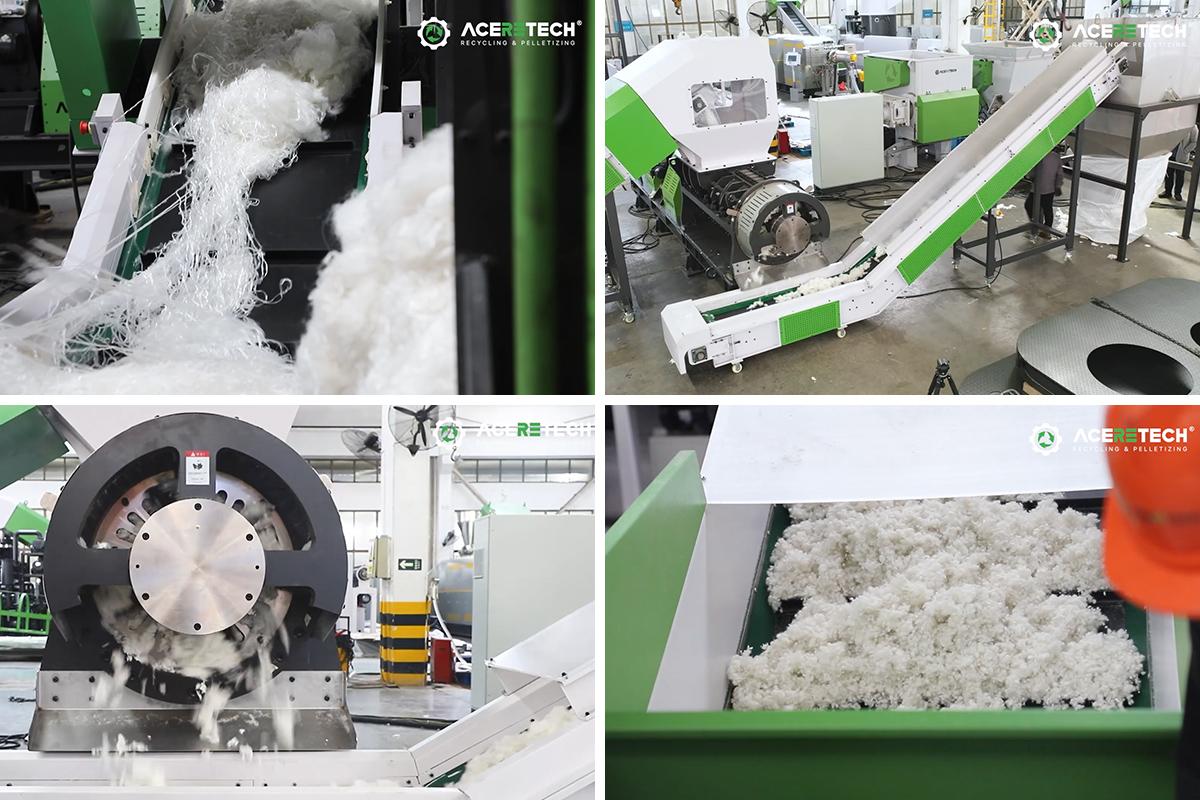
Core Process One: DTS Disc Shredder
Pre-treatment Expert for High-Toughness PA66 Fibers
For large-volume, high-strength PA66 fibers, effective pre-treatment is critical to ensure downstream stability. The DTS series disc shredder is specifically engineered for fibrous and tough materials:
Extra-large rotor design
A 600 mm rotating diameter rotor delivers powerful and stable cutting force, enabling direct processing waste fibers without clogging or wrapping.
Low-energy shredding performance
Optimized blade arrangement reduces energy consumption while ensuring uniform particle size, laying a solid foundation for smooth and continuous extrusion.
By transforming chaotic fiber bundles into consistently sized flakes, the DTS shredder significantly improves feeding stability for the pelletizing stage.
Core Process Two: ACS-H Single-Screw Compacting and Pelletizing Machine
Performance Benchmark for PA66 Fiber Recycling
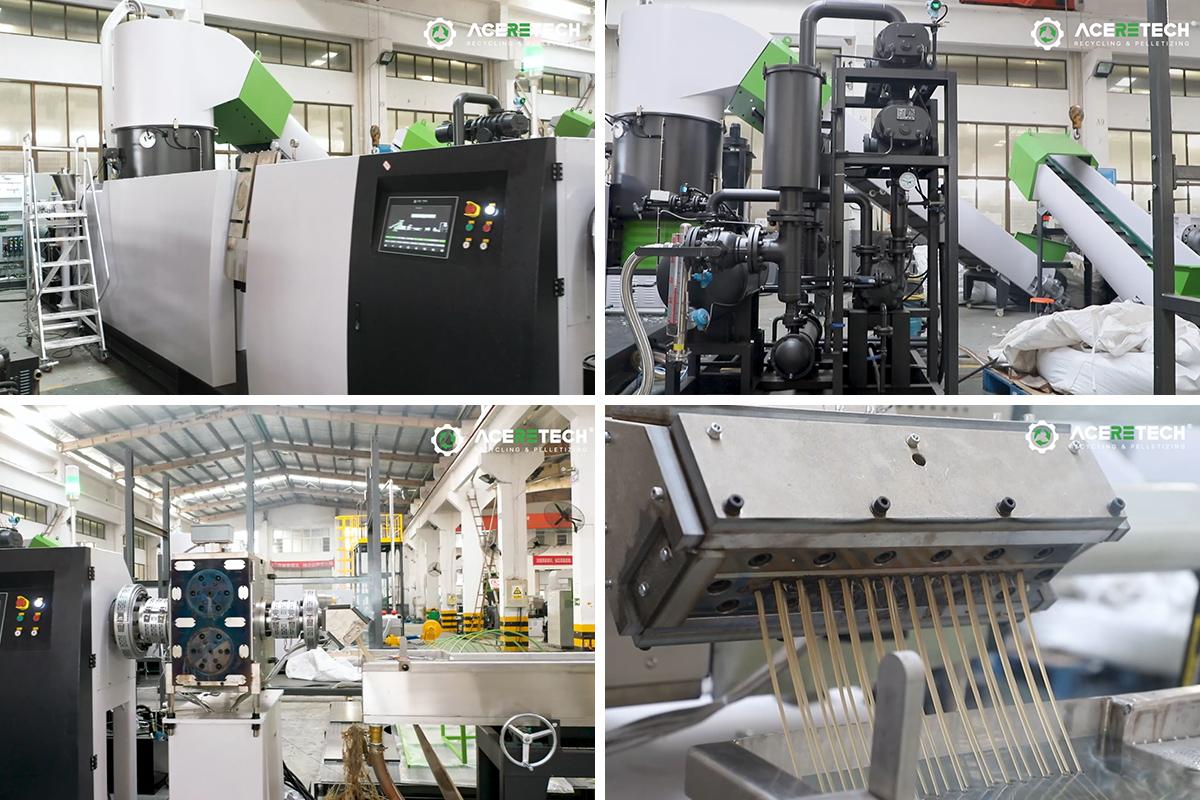
Once pre-treated, low-bulk-density PA66 fibers require a pelletizing system capable of efficient compaction, controlled melting, and intensive degassing. The ACS-H series is specifically designed for this purpose:
1200 L intelligent compacting chamber
A large-volume chamber enables rapid cutting, preheating, and densification of lightweight fibers, dramatically improving feeding efficiency and material continuity.
160 mm Bi-metal wear-resistant screw
Designed to withstand the abrasive nature of PA66, the high-grade dual-alloy screw ensures stable output with no significant performance decline for up to two years, greatly reducing maintenance and spare parts costs.
Vacuum degassing and piston filtration
A high-displacement vacuum pump removes moisture and volatiles, while a dual-station, non-stop piston filter ensures uninterrupted production of high-purity, pore-free recycled pellets.
Automated control system
One-button start/stop operation and intelligent overload protection guarantee long-term, stable, and safe operation of the entire production line.
Together, these features allow the ACS-H system to consistently produce recycled PA66 pellets with excellent appearance and mechanical performance.
2025 Case Study: South American PA66 Recycling Project
To validate the real-world performance of this dedicated PA66 recycling solution, ACERETECH implemented the system at a customer site in South America.
After commissioning in February 2025, the dedicated PA66 fiber recycling line successfully:
Solved the long-standing issue of processing internal PA66 fiber scraps;
Achieved stable, high-output pelletizing performance;
Produced recycled pellets with an appearance and mechanical performance close to virgin material standards.
As a result, the recycled PA66 pellets have been successfully reused in the production of high-end automotive components, closing the loop and significantly increasing material value.
For large-volume, high-strength PA66 fibers, the DTS series shredder performs exceptionally well:
Extra-large rotor design: A 600mm rotating diameter rotor provides immense cutting force, allowing it to directly process large bundles of waste fibers.
Low-energy shredding: Through optimized blade arrangement, it reduces energy consumption by 15% while ensuring uniform output size, laying the foundation for subsequent extrusion.
The ACS-H series integrates compacting and pelletizing, specifically designed for low-bulk-density materials like PA66:
1200L intelligent compacting chamber: Achieves rapid cutting, preheating, and compacting of materials in a large-volume chamber, greatly improving the feeding efficiency of lightweight fibers.
160mm dual-alloy wear-resistant screw: Designed to withstand the abrasive nature of PA66, using high-grade dual-alloy material, guaranteeing no significant decline in output within 2 years, significantly reducing maintenance costs.
Vacuum Degassing and Piston Filtration: Equipped with a high-displacement vacuum pump to remove moisture and impurities, and combined with a dual-station, non-stop piston filter, ensuring the production of high-purity, pore-free recycled granules without interrupting production.
Automated Control: One-button start/stop system and intelligent overload protection ensure long-term stable operation of the production line.
2025 Case Study: South American PA66 Recycling Project
After commissioning in February 2025, this customer not only solved the problem of processing factory scraps, but their produced pelletized products, due to their aesthetically pleasing appearance and performance close to virgin material, have been successfully reused in the production of high-end automotive parts.
FAQ
Q1: Why does PA66 fiber recycling require a specialized shredder instead of a regular crusher?
A: PA66 fibers have extremely high toughness and tensile strength. Regular crushers are prone to fiber entanglement, overheating, and blade damage. ACERETECH’s DTS disc shredder uses a 600 mm large-diameter rotor and optimized blade configuration to efficiently cut fiber bundles, improving safety, stability, and downstream feeding performance.
Q2: How are bubbles and pores in recycled PA66 pellets eliminated?
A: PA66 fibers are highly hygroscopic. The ACS-H system integrates high-efficiency vacuum degassing and a dual-station non-stop piston filter, ensuring complete removal of moisture and gases under high-pressure conditions, resulting in dense, pore-free pellets.
Q3: What is the practical benefit of the 1200 L compaction chamber?
A: Due to extremely low bulk density, PA66 fibers are inefficient to feed conventionally. The 1200 L compaction chamber allows higher material input, while high-speed blades pre-cut, preheat, and densify fibers, boosting production capacity.
Q4: How automated is the PA66 recycling line?
A: The system features intelligent full-line control with one-button start/stop and comprehensive protection functions. Only 1–2 operators are required to monitor the entire process, significantly reducing labor costs and operational risks.
About ACERETECH Machinery
ACERETECH provides advanced and integrated recycling solutions for a wide range of plastic waste streams, including engineering plastics, synthetic fibers, post-industrial scrap, and post-consumer plastics. While this case highlights a dedicated PA66 nylon fiber recycling system, ACERETECH’s expertise extends across comprehensive plastic recycling applications, covering shredding, washing, compacting, extrusion, filtration, and pelletizing technologies.
With a strong focus on process stability, material quality, and long-term operational performance, ACERETECH works closely with customers to design customized recycling lines that address real-world challenges such as difficult feeding, material contamination, high wear, and output consistency.
Looking for a Plastic Recycling Solution?
Whether you are planning a PA66 or engineering plastic recycling project, or seeking a complete solution for mixed or contaminated plastic waste, our technical team can help evaluate your materials and process requirements.
👉 Contact ACERETECH to discuss a tailored plastic recycling solution for your application.