With the rapid development of sectors such as new energy vehicles, energy storage systems, and consumer electronics, the market demand for lithium-ion batteries continues to grow. As a critical component of lithium-ion batteries, the separator plays a vital role in separating the positive and negative electrodes and ensuring the battery's safe operation during production.
The production and processing of lithium-ion battery separators inevitably generate a certain amount of offcuts, edge trimmings, and substandard products. Such waste is typically characterized by concentrated sources, relatively uniform material composition, and high cleanliness. Efficiently crushing and recycling this separator production waste not only helps reduce disposal costs but also improves material utilization rates, enabling resource recycling.
Therefore, selecting the appropriate crushing equipment is crucial for the efficient crushing and recycling of lithium battery separator offcuts. This article focuses on the ACERETECH GE series lithium-ion battery separator crusher, analyzing its equipment features, crushing advantages, and practical application value in separator waste recycling, thereby providing lithium battery separator manufacturers with an efficient and stable waste recycling solution.
I. What is a Lithium-ion Battery Separator? Why Must It Be Recycled?
Lithium-ion battery separators are usually made of polyethylene (PE). They are microporous polymer films located between the positive and negative electrodes. Their main functions include:
Preventing direct contact between the positive and negative electrodes to avoid short circuits
Allowing lithium ions to pass freely
Improving battery safety and cycle life
Although the separator accounts for a small proportion in a single battery cell, its total amount is enormous in large-scale retired lithium-ion batteries, and its recycling value and environmental impact cannot be ignored.
II. Analysis of the Necessity of Lithium-ion Battery Separator Recycling
I. High Recycling Value of Polymer Lithium Battery Separators
Lithium-ion battery separators are typically manufactured from polymer materials such as polyethylene (PE) and polypropylene (PP), which possess significant material value. During the processes of production, coating, slitting, and further processing, the generation of offcuts, edge trimmings, and substandard products is inevitable. As this type of waste originates from the manufacturing stage, the material is relatively clean and holds high recycling value; consequently, recovering and processing it offers significant economic and environmental benefits.
Using specialized shredding equipment to reduce the volume of and break down separator offcuts facilitates subsequent sorting, transport, reprocessing, or resource recovery, thereby minimizing waste and reducing disposal costs. Furthermore, reintegrating high-value polymer separator waste generated during production into the recycling loop helps improve raw material utilization, reduce material loss during manufacturing, and further enhance the enterprise's overall resource efficiency.
2. Resource Recycling and Enhanced Economic Value
Achieving HDPE plastic resource regeneration
After crushing, cleaning, and granulation, the separator can be made into recycled plastic granules for the production of plastic products such as pallets, pipes, and building templates.
Improving overall profitability of lithium-ion battery recycling
In the "disassembly-crushing-separation-purification" process, efficiently separating non-metallic materials such as separator membranes in advance helps to improve the purity and efficiency of lithium, cobalt, and nickel recovery.
III. Challenges and Equipment Requirements for Lithium-ion Battery Separator Membrane Crushing
Lithium-ion battery separator membranes have the following typical characteristics:
* Lightweight and thin texture
* High toughness, easily wraps around the cutter shaft
* Prone to static electricity and fluffy accumulation during the crushing process
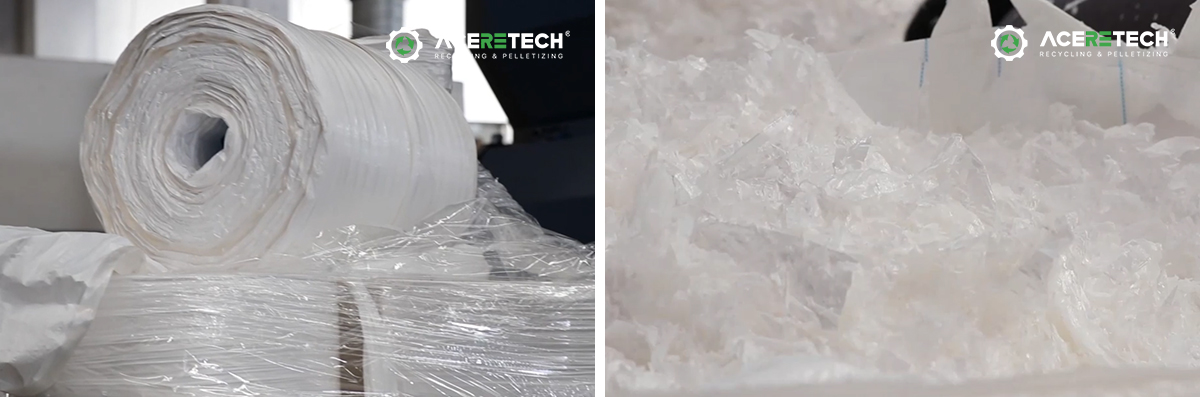
Common problems encountered when processing separator membranes with traditional plastic crushers include:
* Severe shaft entanglement
* Screen clogging
* Uneven output particle size
* Unstable equipment operation
Therefore, a lithium-ion battery separator membrane crusher specifically designed for thin film materials has become a core piece of equipment in the recycling line.
IV. Aceretech GE Series Lithium-Ion Battery Separator Membrane Crusher Solution
Core Equipment: GE Series Economical Plastic Crusher
The Aceretech GE series is a cost-effective crushing equipment specifically designed for films, sheets, and flexible plastic waste, and performs particularly well in the field of lithium-ion battery separator membrane recycling.
1. V-shaped Rotor + X-shaped Shearing Structure for Effective Anti-Tangle Performance
Technical Features:
V-shaped mounting angle for the rotating blades
Forms an X-shaped shearing path with the stationary blades
Dual-shear high-efficiency cutting structure
Application Advantages:
Precise shearing of separator film, preventing stretching and tangling
Stable and continuous crushing process
Uniform output size, facilitating subsequent cleaning and sorting
2. Multiple Rotor Width Configurations to Suit Different Recycling Scales
Available Models:
Rotor width: 500mm – 1400mm
Common models: GE500/500, GE500/700, GE500/1000, etc.
Advantages:
Suitable for small to medium-scale pilot lines to industrial-scale recycling lines
Fully meets the material handling requirements of fluffy separator film
Flexible matching of investment cost and production capacity
3. Intelligent Variable Frequency Feeding System Ensures Continuous and Stable Operation
Belt conveyor + ABB/Schneider frequency converter
Real-time monitoring of main motor load
Automatic adjustment of feeding speed
Core Value:
Prevents instantaneous overload and material blockage
Reduces manual intervention
Enhances overall line automation and safety
4. Industrial-Grade Structural Design, Suitable for Long-Term High-Intensity Recycling Operations
40mm high-strength steel plate crushing chamber
DC53 high wear-resistant blades (62–64 HRc)
Anti-vibration and noise reduction structural design
Convenient and quick maintenance, blade and screen replacement
5. Why Choose Aceretech GE Series Lithium Battery Separator Film Crusher?
Summary of Core Advantages:
Optimized for thin film materials, solving the entanglement problem
Suitable for lithium battery separator film recycling processes
Stable operation, low maintenance costs
Improves the overall efficiency and economics of lithium battery recycling
The Aceretech GE series lithium battery separator film crusher has become an ideal choice for safe, efficient, and economical recycling in the new energy recycling industry.
FAQ
Q1. What are the typical process flows for lithium battery separator film recycling?
A: A typical lithium battery separator film recycling process includes:
Battery disassembly or crushing pretreatment, initial separation of separator film and electrodes, separator film crushing, cleaning, dewatering, drying, and regeneration granulation or classification and utilization.
Q2. Will the lithium battery separator film crusher wear out quickly? Are the maintenance costs high?
A: No. The GE series features DC53 high-wear-resistant blades (62–64 HRc) and a high-strength steel plate crushing chamber.
Compared to ordinary blades: it has a longer service life; requires less frequent blade changes; is easier to maintain; and has overall lower maintenance costs in the industry.
Q3. Can the lithium-ion battery separator film be recycled after crushing?
A: Yes.
The crushed separator film is processed through shredding, shredding, cleaning, drying, and granulation to produce recycled PE/PP plastic granules, which are used in: plastic pallets/pipes/construction formwork/industrial plastic products, achieving resource recycling.
Q4. How to choose a suitable lithium-ion battery separator film crusher manufacturer?
A: When choosing a manufacturer, it is recommended to focus on:
Whether they have experience in processing film materials;
Whether they have case studies in the lithium-ion battery recycling industry;
Whether the blade type and rotor structure are optimized for separator films;
After-sales and technical support capabilities;
Aceretech has mature equipment and engineering experience in the field of lithium-ion battery recycling and plastic regeneration.
Q5. Can the lithium-ion battery separator film crusher handle other materials?
A: Yes.
The GE series is not only suitable for lithium-ion battery separator films, but can also process: PE/PP films; plastic sheets; packaging films; small hollow plastic products; and has good versatility.