I. Overview: Processing Large PP/PE Plastic Purgings
PP and PE plastic purgings (commonly referred to as "lumps" or "start-up lumps") are typical waste materials generated during plastic extrusion, injection molding, and other plastic processing operations. These materials often arise during machine start-ups, color changes, equipment cleaning, or production adjustments.
Unlike films or lightweight packaging waste, plastic purgings are typically thick, bulky, and irregularly shaped. Their hardness and toughness vary depending on the specific production process. Due to these physical properties, direct size reduction (shredding/crushing) is often challenging—especially when the material dimensions exceed the feed and processing capacity of standard plastic granulators.
For plastic processors looking to recycle production scrap, an appropriate size-reduction process is a crucial first step.
ACERETECH offers a two-stage plastic shredding and granulating solution, combining an LS-series single-shaft shredder with a GH-series heavy-duty granulator. This configuration is designed to process large chunks of PP/PE plastic purgings (lumps/heads) through a two-step process—primary shredding followed by secondary granulation—reducing them to a smaller size suitable for subsequent recycling operations.
II. Why do PP/PE plastic purgings require a two-stage size-reduction process?
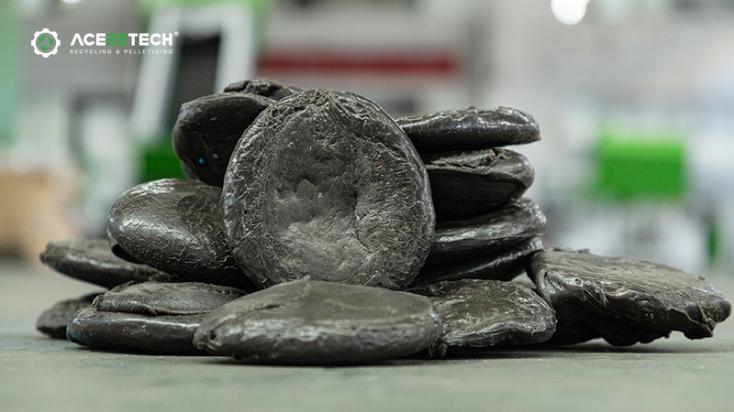
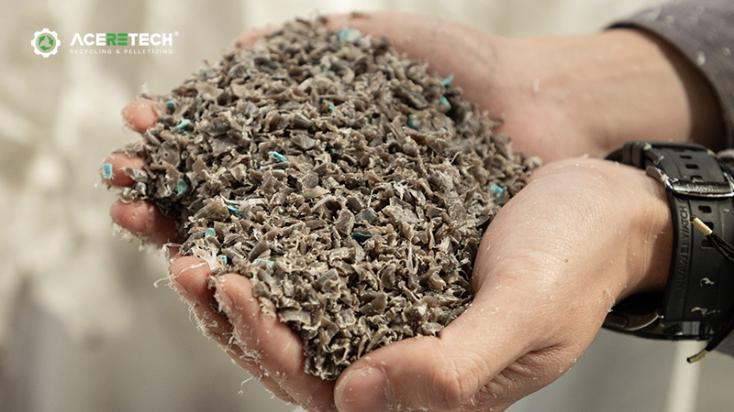
The processing requirements for plastic purgings differ from those for thin-walled or flexible plastic waste. When selecting size-reduction equipment, the following material characteristics must be considered:
1. Large volume and irregular shape
Plastic purgings vary significantly in size and shape. Large pieces are often difficult to feed directly into standard granulators. A primary shredding stage reduces their size, making them manageable for the subsequent secondary granulation process.
2. Thick cross-sections
Compared to films or sheets, thick plastic chunks require greater cutting force for size reduction. Equipment selection must account for the material’s thickness, density, and mechanical properties.
3. Varied material properties
Although both are thermoplastics, PP and PE can exhibit different processing characteristics depending on their grade, formulation, level of contamination, and physical state. These variations can affect throughput, cutting performance, and the final particle size.
4. Downstream processing requirements
The required final particle size depends on the subsequent recycling stages. Smaller, more manageable plastic fragments facilitate downstream processes—such as conveying, washing, or extrusion—tailored to the specific needs of the production workflow. Given these factors, a two-stage shredding and granulating process is a highly practical solution for handling large chunks of PP/PE purge (start-up waste/scrap blocks).
III. Two-Stage Shredding and Granulating Process for PP/PE Plastic Purge
This recycling configuration consists of an LS series single-shaft shredder and a GH series heavy-duty plastic granulator. Rather than relying on a single machine to perform the entire size-reduction process, the two units handle distinct processing tasks.
Stage 1: Primary Shredding with an LS Series Single-Shaft Shredder
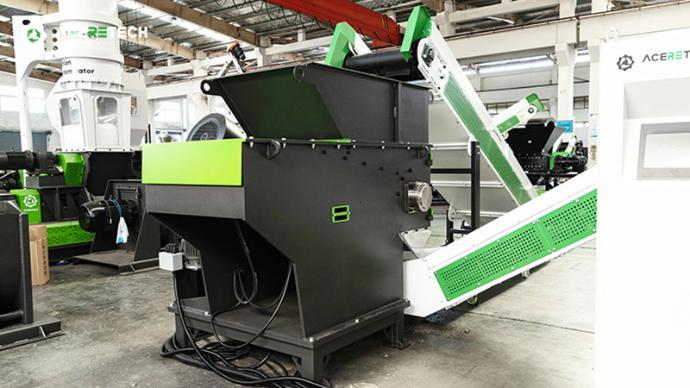
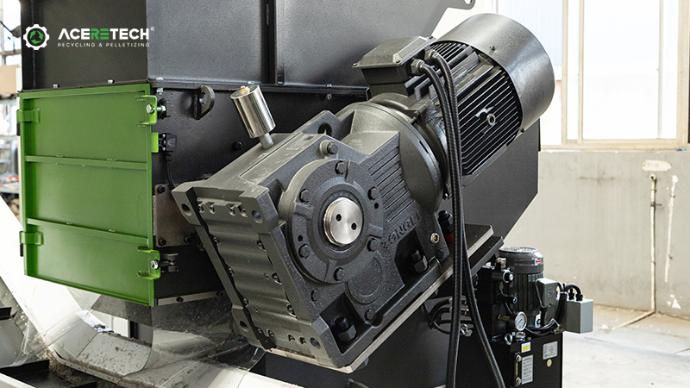
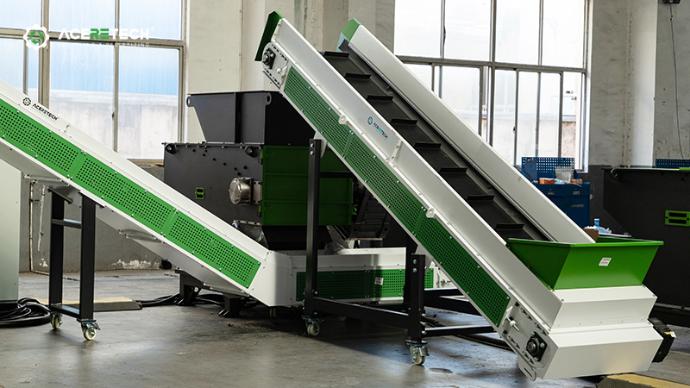
The LS series single-shaft shredder is responsible for the initial size reduction of large PP/PE plastic purge blocks.
A hydraulic pusher system feeds the material toward the rotating cutting rotor based on the current processing load, ensuring a controlled feeding process.
Key design features include:
Hydraulic Pusher System: Automatically pushes material toward the rotor based on the processing load.
Wear-Resistant Rotor: Measuring Ø250 × 900 mm, the rotor utilizes advanced laser cladding technology to enhance wear resistance and extend service life.
Four-Way Indexable Knives: The cutting edges feature a concave-ground design for high-efficiency cutting; the knives can be rotated or flipped for further use when necessary.
Adjustable Screen: Screens with various aperture sizes (ranging from 40 to 100 mm) are available to control the output size after primary shredding.
Hydraulic Screen-Opening Mechanism: Facilitates easy access for screen replacement during maintenance.
Specially Designed Feed Hopper: Helps minimize material splash-back; supports various feeding methods—such as conveyor belts, forklifts, cranes, or loaders—depending on the specific installation configuration.
Rotor Speed: Approximately 61 rpm. The cutting geometry and controlled feeding system are engineered to accommodate a wide variety of plastic waste materials.
Stage 2: Secondary Crushing with the GH Series Heavy-Duty Plastic Crusher
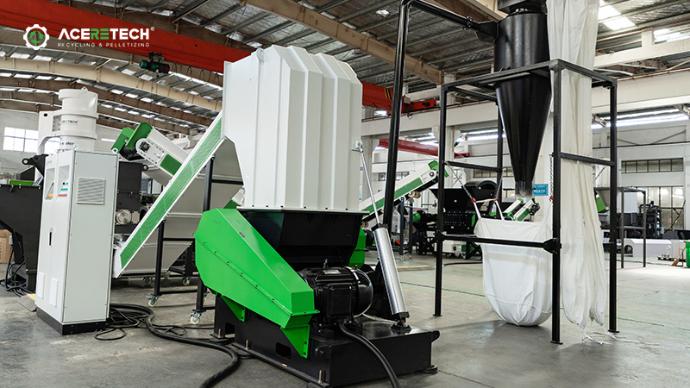
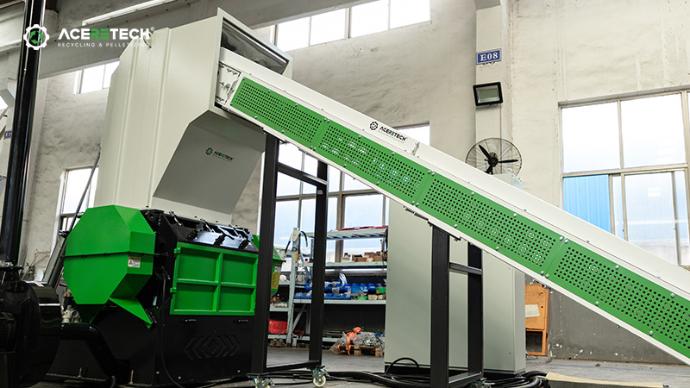
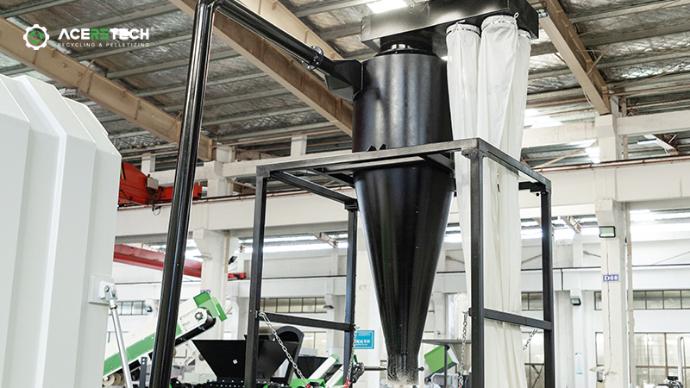
Following primary shredding, the pre-processed material is conveyed to a GH series heavy-duty plastic crusher for further size reduction.
The GH series crusher features a robust welded steel construction and a heavy-duty cutting chamber, specifically engineered for demanding plastic recycling applications.
Key features include:
Heavy-duty rotor: Constructed from welded steel and designed for high-intensity shredding/crushing operations.
V-shaped knife arrangement: Optimizes the cutting geometry between the rotor knives and the stationary (stator) knives.
Heavy-duty cutting chamber: A rugged design capable of processing thicker and tougher plastic materials.
12 mm screen: Effectively controls the final particle size based on the screen configuration and material characteristics.
External bearing design: Minimizes the risk of contaminants entering the cutting chamber.
Wear-resistant chamber liners: Protect the cutting chamber from abrasion.
Anti-vibration frame: Utilizes rubber-to-metal mounts to absorb vibrations and reduce operating noise.
The optimized rotor and cutting geometry not only enhance processing efficiency but also ensure a relatively uniform output particle size.
By combining an LS series shredder with a GH series crusher, large plastic purgings (from injection molding or extrusion processes) can be processed through a continuous, two-stage size-reduction system.
IV. Practical Equipment Testing: PP/PE Plastic Purgings
To demonstrate the processing capabilities of this configuration, ACERETECH conducted equipment tests using PP/PE plastic purgings.
The test process involved primary shredding using an LS series single-shaft shredder, followed by secondary size reduction using a GH series heavy-duty crusher.
Test Configuration and Results:
| Processed Material |
PP/PE plastic purgings (start-up/purge material) |
| Primary Equipment |
LS Single-Shaft Shredder |
| Secondary Equipment | GH Heavy-Duty Plastic Granulator (Crusher) |
| Configured Processing Capacity | Approx. 100 kg/h |
| Final Particle Size | Approx. 12 mm |
| LS Rotor Dimensions | Ø250 × 900 mm |
| LS Screen Size | 40–100 mm |
| GH Rotor Dimensions | Ø500 × 800 mm |
| GH Cutting Chamber | 500 × 800 mm |
| GH Screen Aperture | 12 mm |
Based on the installed GH screen, the final particle size is approximately 12 mm. Actual particle size and distribution may also be influenced by material characteristics and operating conditions.
This test demonstrates how a two-stage shredding and granulating configuration can process PP/PE plastic purgings into smaller fragments, suitable for subsequent recycling.
V. What are the applications for the granulated PP/PE plastic fragments?
Once reduced in size, the resulting PP/PE plastic fragments can be used in various downstream recycling processes. The choice of subsequent processing steps depends on the material's cleanliness, composition, and intended method of reuse.
1. Plastic Washing
If the material contains dust, labels, oil, or other surface contaminants, it may require thorough washing before further processing.
2. Plastic Extrusion and Pelletizing
When the processed fragments meet the feed requirements of an extrusion system, they can serve as raw material for plastic recycling and pelletizing. Depending on the specific condition of the material, additional steps—such as drying, filtration, or other forms of pre-treatment—may be necessary.
Before finalizing a complete recycling workflow, it is essential to evaluate the material's composition and level of contamination. VI. ACERETECH Plastic Shredding and Crushing Solutions
Different types of plastic waste require specific size-reduction strategies. When selecting equipment, factors such as material dimensions, wall thickness, hardness, feeding characteristics, and the desired final particle size must all be taken into account.
ACERETECH offers a comprehensive range of plastic shredding and crushing equipment designed for industrial plastic recycling. These solutions can process large plastic lumps, production scrap, pipes, profiles, sheets, and various other forms of plastic waste.
The LS + GH combination provides a two-stage processing solution, ideal for handling large PP/PE purgings (lumps). The equipment configuration can be flexibly tailored based on the specific characteristics of your material, throughput requirements, and the desired final particle size.
Please contact ACERETECH to discuss your plastic recycling project and determine the optimal shredding and crushing configuration for your needs.
FAQ
Q1: Can PP and PE plastic purgings (lumps) be processed directly using a plastic crusher?
A: This depends on the dimensions, thickness, and hardness of the material, as well as the feed opening size and cutting capacity of the crusher. For larger or thicker plastic purgings, a two-stage process—starting with primary shredding followed by secondary crushing—is generally recommended. This approach helps reduce the load on the secondary crusher.
Q2: Why combine a single-shaft shredder with a heavy-duty plastic crusher?
A: These two types of equipment serve different functions. The single-shaft shredder handles the primary stage by reducing the size of large plastic waste, while the heavy-duty crusher performs further, finer size reduction. This combination offers a practical solution for materials that are difficult to process effectively in a single-stage crushing operation.
Q3: What is the final particle size produced by the LS + GH plastic shredding and crushing line?
A: In demonstration tests, using a 12 mm screen in the GH crusher resulted in a final particle size of approximately 12 mm. The actual particle size distribution may vary depending on material characteristics, the condition of the screen, and specific operating parameters.
Q4: What is the processing capacity of the LS + GH combination when handling PP/PE purgings (lumps)?
A: In demonstration tests, this custom configuration achieved a processing capacity of approximately 100 kg/h. The actual throughput depends on factors such as material size, thickness, hardness, feeding conditions, and equipment operating parameters. We recommend conducting material tests to obtain a more accurate capacity assessment.
Q5: Can the LS + GH system handle other types of plastic waste?
A: The LS and GH series are specifically designed for various plastic waste size-reduction (shredding) applications. Depending on the material characteristics and equipment configuration, they can be used to process plastic lumps, thick-walled scrap, profiles, pipes, sheets, and other industrial plastic waste. A technical assessment is recommended before purchasing equipment.
Q6: Can the shredded PP/PE fragments be used directly for plastic pelletizing?
A: In theory, yes. However, whether they can be fed directly into the process depends on the fragment size, moisture content, level of contamination, and the specific feed requirements of the extrusion system. Depending on the situation, the material may require washing, drying, or further size reduction before it can be pelletized.