I. Project Background
Rigid PVC is widely used in construction, infrastructure, electrical, furniture, and building-material applications.
During manufacturing and processing, a significant amount of rigid PVC scrap can be generated, including pipe offcuts, profile offcuts, window-frame scrap, sheets, panels, and injection-molded parts.
Instead of treating this material as waste, rigid PVC scrap can be processed into reusable PVC powder for further manufacturing.
However, pulverizing rigid PVC requires careful control of feeding, grinding temperature, particle size, and dust handling. Excessive heat generation can affect the material, while inconsistent particle size can influence the performance of downstream processing.
For this application, ACERETECH provides an integrated rigid PVC pulverizing system combining automatic feeding, high-speed pulverizing, water cooling, particle-size classification, pneumatic conveying, and dust collection.
The system is designed to convert pre-processed rigid PVC regrind into PVC powder with a particle size of 10–30 mesh.
II. Material and Application
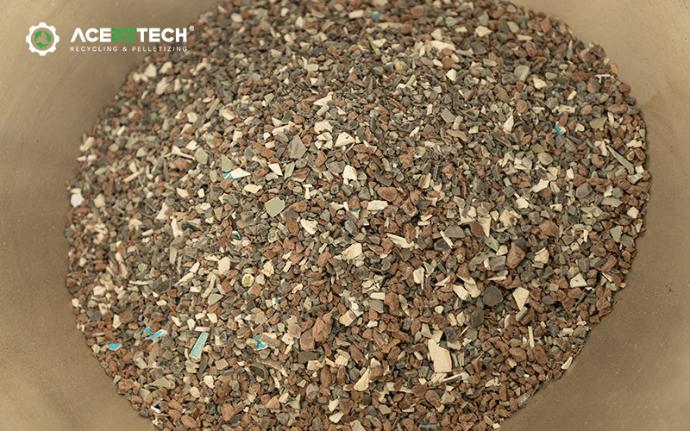
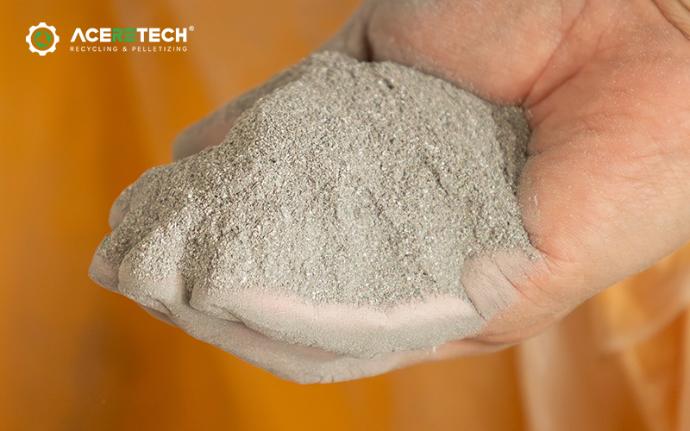
The system is designed for rigid PVC regrind and suitable pre-crushed rigid PVC materials.
Typical input materials include:
• PVC pipe scrap
• PVC profile offcuts
• PVC window-frame scrap
• PVC sheets and boards
• PVC ceiling and wall panels
• PVC injection-molded parts
• In-house PVC production scrap
• Pre-crushed rigid PVC fragments
The pulverized PVC powder can subsequently be reused in applications such as PVC profiles, pipes, sheets, panels, fittings, and other PVC products, depending on the material quality and formulation requirements.
III. Key Recycling Processing Challenges
1. Heat Control During Pulverizing
Rigid PVC is sensitive to excessive heat.
During high-speed pulverizing, mechanical friction generates heat. If the operating temperature becomes too high, PVC may discolor or undergo thermal degradation.
Effective cooling is therefore essential for maintaining stable pulverizing conditions and consistent powder quality.
2. Particle Size Consistency
The final powder particle size is an important consideration for downstream processing.
Inconsistent powder size can affect:
• Material mixing
• Feeding behavior
• Extrusion stability
• Product appearance
• Overall processing consistency
The pulverizing system therefore combines controlled grinding with particle-size classification.
3. Stable Material Feeding
Rigid PVC regrind must be fed continuously and consistently into the pulverizing chamber.
Manual or unstable feeding can result in fluctuations in production and grinding performance.
An automatic vibrating feeder is therefore used to provide controlled and continuous material feeding.
4. Fine Dust Generation
Pulverizing rigid PVC produces fine particles and dust.
An enclosed pneumatic conveying and dust collection system is therefore integrated into the production line to reduce material loss and maintain a cleaner working environment.
IV. ACERETECH Rigid PVC Pulverizing Solution
The complete pulverizing system integrates the following main stages:
Automatic Feeding → High-Speed Pulverizing → Powder Classification → Pneumatic Conveying → Dust Collection
The system is designed for continuous industrial operation and combines feeding, grinding, cooling, screening, conveying, and dust collection into one integrated production process.
V. Main Technical Specifications
| Item |
Specification |
| Material |
Rigid PVC regrind |
| Main Motor | 75 kW (WN brand) |
| Rotor Speed | 3700 rpm |
| Stationary Blades | 19 pcs, SKD11 |
| Rotary Blades | 36 pcs, SKD11 |
| Finished Powder | 10–30 mesh |
| Feeding | Automatic vibrating feeder |
| Cooling | SUS304 water cooling system |
| VFD | ABB |
| Vibrating Screen | Stainless steel, Ø1000 mm |
VI. Rigid PVC Pulverization Process
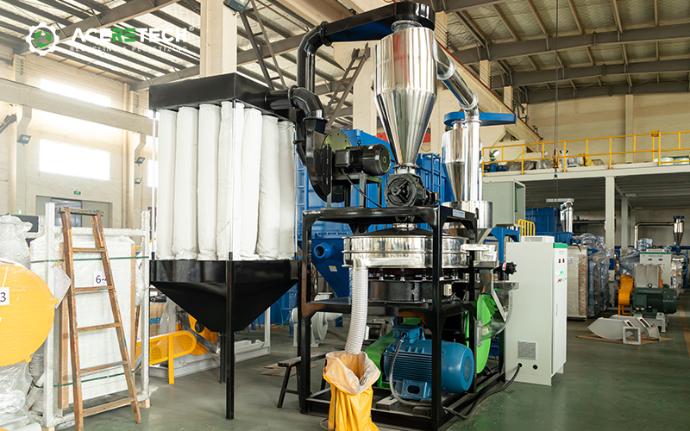
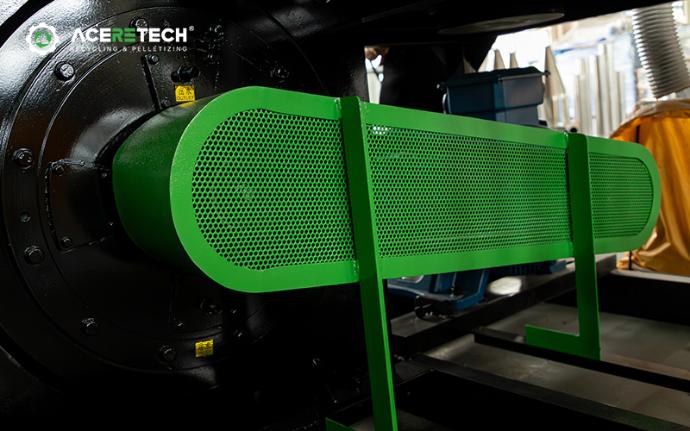
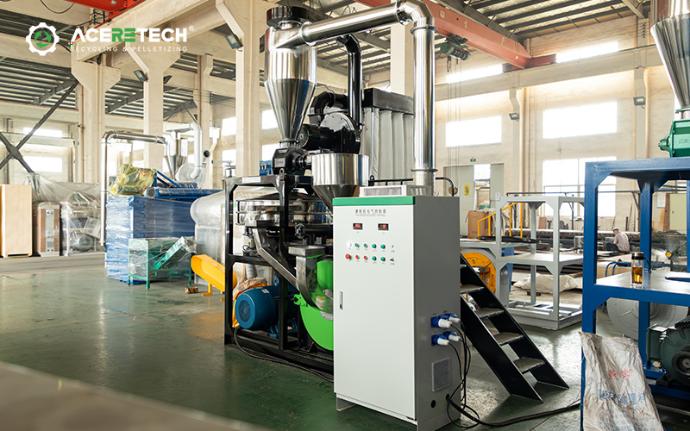
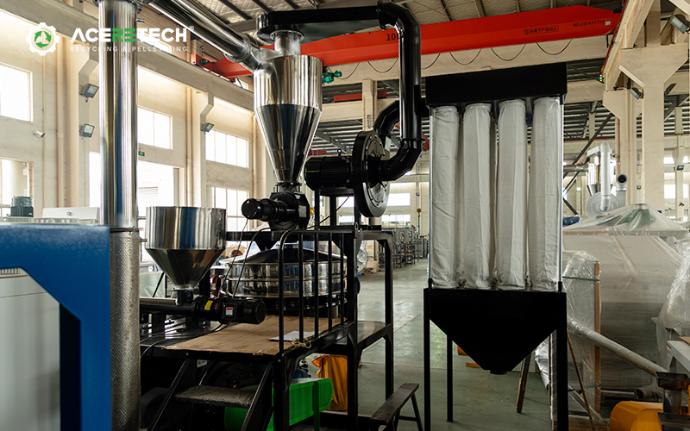
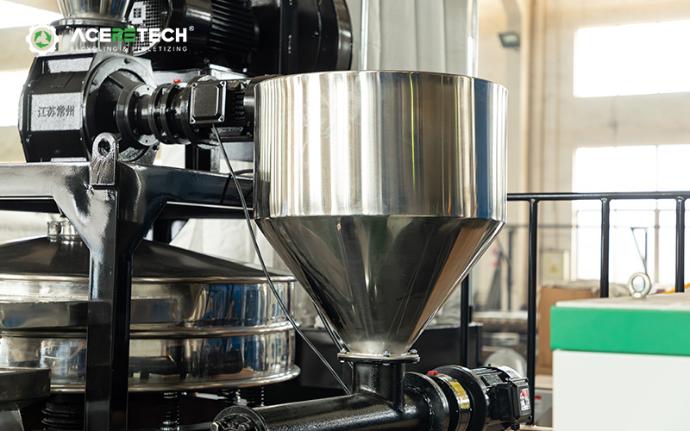
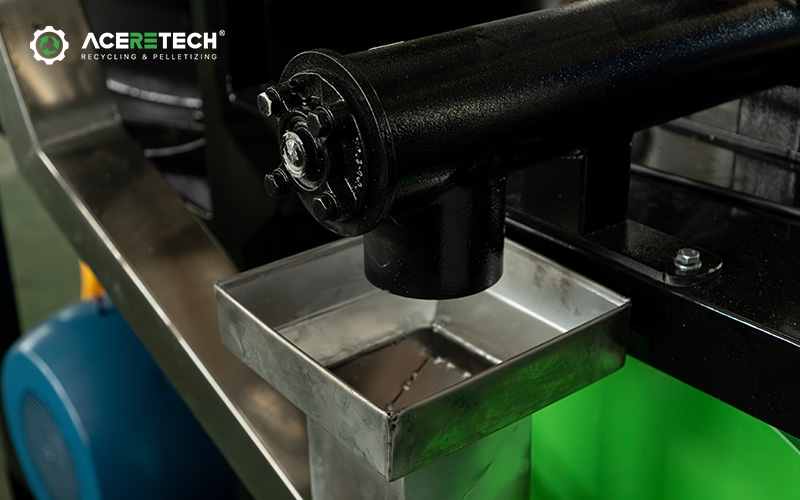
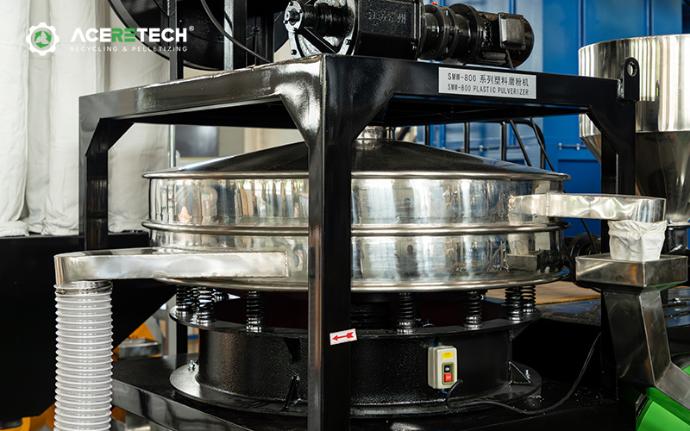
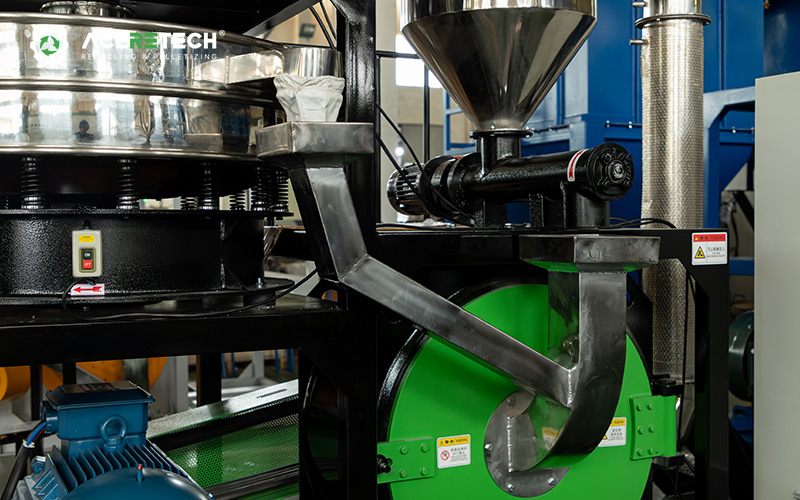
Step 1: Automatic Feeding
The rigid PVC regrind is loaded into a stainless-steel hopper equipped with an automatic vibrating feeder.
The vibrating feeder continuously transfers the material into the pulverizing chamber at a controlled feeding rate.
This helps maintain:
• Continuous operation
• Stable material feeding
• Consistent grinding conditions
• Reduced manual intervention
• Improved production efficiency
Stable feeding is particularly important for high-speed pulverizing because fluctuations in material flow can affect both grinding performance and temperature control.
Step 2: High-Speed Pulverizing
The pulverizing chamber is the core processing unit of the system.
The rigid PVC regrind is pulverized between the rotating and stationary grinding components at a rotor speed of 3700 rpm.
The particle size can be adjusted by controlling the grinding gap between the grinding discs.
The system uses:
• 19 stationary blades
• 36 rotary blades
• SKD11 wear-resistant material
The grinding components are designed to provide stable pulverizing performance and long service life.
Step 3: Water-Cooling System
Temperature control is an important part of rigid PVC pulverizing.
The grinding chamber and grinding components are equipped with a SUS304 water-cooling system.
The cooling system helps remove heat generated during high-speed grinding and maintain stable operating conditions.
This helps reduce the risk of:
• Material discoloration
• Thermal degradation
• Excessive temperature accumulation
• Unstable powder quality
The main shaft is also equipped with cooling and lubrication functions to support stable operation.
Step 4: Powder Classification
After pulverizing, the material enters the circular vibrating screen for particle-size classification.
The finished powder specification for this application is:
10–30 mesh
Qualified powder passes through the screening stage and is transferred to the storage hopper.
Oversized particles are automatically returned to the pulverizing chamber for further processing.
This closed-loop classification process helps achieve:
• More consistent powder particle size
• Stable powder quality
• Improved material utilization
• Reduced oversized material discharge
Step 5: Pneumatic Conveying
After pulverizing and classification, the PVC powder is conveyed through a pneumatic conveying system.
A high-pressure blower transfers the material from the grinding section toward the cyclone separator and vibrating screen.
The enclosed conveying system helps:
• Reduce material loss
• Improve automated material transfer
• Reduce exposure of fine powder to the workshop environment
• Maintain continuous material flow
Step 6: Dust Collection
Fine particles generated during pulverizing and conveying are collected through the cyclone separator and dust collection system.
The dust collection system helps provide:
• A cleaner production environment
• Reduced airborne dust
• Lower material loss
• Improved working conditions
The integrated conveying and dust collection system is an important part of the complete PVC powder production process.
VII. Complete Rigid PVC Pulverizing Process
The complete process can be summarized as:
Rigid PVC Regrind → Automatic Vibrating Feeding → High-Speed Pulverizing → Water Cooling → Circular Vibrating Screening → Oversized Material Recirculation → Pneumatic Conveying → Cyclone Separation → Dust Collection → 10–30 Mesh PVC Powder → Storage Hopper
This integrated process enables continuous production of classified PVC powder from rigid PVC regrind.
VIII. Key Features of the Pulverizing System
1. Controlled Powder Particle Size
The final powder is classified through a circular vibrating screen, with oversized material automatically returned for further pulverizing.
The finished powder specification for this application is 10–30 mesh.
2. Efficient Temperature Control
The SUS304 water-cooling system helps control the temperature of the grinding chamber and grinding components during high-speed operation.
This is particularly important when processing heat-sensitive rigid PVC.
3. Wear-Resistant Grinding Components
The grinding components use SKD11 material, providing good wear resistance for continuous pulverizing applications.
The grinding discs can also be removed and resurfaced when required, helping extend their service life.
4. Automatic Feeding
The vibrating feeder provides controlled and continuous material feeding.
This reduces manual feeding requirements and helps maintain stable grinding conditions.
5. Variable Frequency Control
The system uses an ABB VFD to provide variable frequency control.
The VFD allows operating parameters to be adjusted according to processing requirements and supports stable equipment operation.
6. Integrated Dust Management
The cyclone separator and dust collection system are integrated into the pulverizing process.
This helps reduce airborne dust and material loss while maintaining a cleaner production environment.
IX. Applications of Recycled PVC Powder
The finished PVC powder can be reused in various PVC processing applications, depending on its properties, particle size, formulation, and final product requirements.
Typical applications include:
• PVC pipe production
• PVC profile extrusion
• Door and window profiles
• PVC sheets
• PVC wall panels
• Decorative panels
• Electrical conduits
• PVC pipe fittings
• Construction materials
• PVC compounds and blends
The final application should be determined according to the quality and formulation requirements of the downstream product.
X. From Rigid PVC Scrap to Reusable Powder
The purpose of this pulverizing system is to recover value from rigid PVC scrap by converting pre-processed material into reusable PVC powder.
The process can be summarized as:
Rigid PVC Scrap → PVC Regrind → Pulverizing → Classification → 10–30 Mesh PVC Powder
The resulting powder can then be reused in downstream PVC manufacturing processes where its properties meet the required specifications.
This provides manufacturers with an effective way to improve material utilization and reduce the amount of rigid PVC production scrap sent for disposal.
Related Articles
PVC Powder Pelletizing Solutions
XI. Project Summary
This rigid PVC pulverizing application demonstrates an integrated solution for converting rigid PVC regrind into classified PVC powder.
The system combines:
Automatic Feeding → High-Speed Pulverizing → Water Cooling → Powder Classification → Pneumatic Conveying → Dust Collection
The main pulverizing system is equipped with a 75 kW motor, operates at 3700 rpm, and uses SKD11 grinding components with 19 stationary blades and 36 rotary blades.
The finished powder is classified to 10–30 mesh, while oversized particles are automatically returned to the grinding chamber for further pulverizing.
By integrating automatic feeding, temperature control, closed-loop classification, pneumatic conveying, and dust collection, the system provides a continuous solution for rigid PVC powder production.
Looking for a Rigid PVC Pulverizing Solution?
ACERETECH provides integrated rigid PVC pulverizing solutions combining automatic feeding, high-speed pulverizing, cooling, particle-size classification, pneumatic conveying, and dust collection.
The system can be configured according to the characteristics of the rigid PVC material, required powder specification, and downstream application.
Contact ACERETECH to discuss your rigid PVC pulverizing project and find a suitable solution.
FAQ
Q1. What types of rigid PVC materials can this pulverizing system process?
A: The system can process various rigid PVC materials after suitable pre-processing, including PVC pipe scrap, profile offcuts, window-frame scrap, sheets, boards, ceiling and wall panels, injection-molded PVC parts, in-house production scrap, and pre-crushed rigid PVC fragments.
Q2. What can recycled rigid PVC powder be used for?
A: Depending on the material quality and formulation requirements, recycled rigid PVC powder can be reused in applications such as PVC pipes, profiles, sheets, panels, electrical conduits, fittings, and other PVC products.
Q3. Why is cooling important when pulverizing rigid PVC?
A: Rigid PVC is sensitive to excessive heat. High-speed pulverizing generates frictional heat, so effective cooling is required to help control the operating temperature and reduce the risk of material discoloration or thermal degradation.
This system uses a SUS304 water-cooling system for temperature control.
Q4. How does the system maintain consistent powder particle size?
A: The pulverized material passes through a circular vibrating screen.
Qualified powder is discharged from the screening system, while oversized particles are automatically returned to the pulverizing chamber for further processing.
This closed-loop process helps maintain consistent powder fineness.
Q5. What is the function of the dust collection system?
A: The dust collection system captures fine particles generated during pulverizing and conveying.
It helps reduce airborne dust, minimize material loss, and maintain a cleaner working environment.