I. Project Background
Post-industrial plastic film is generated during film manufacturing and downstream converting processes.
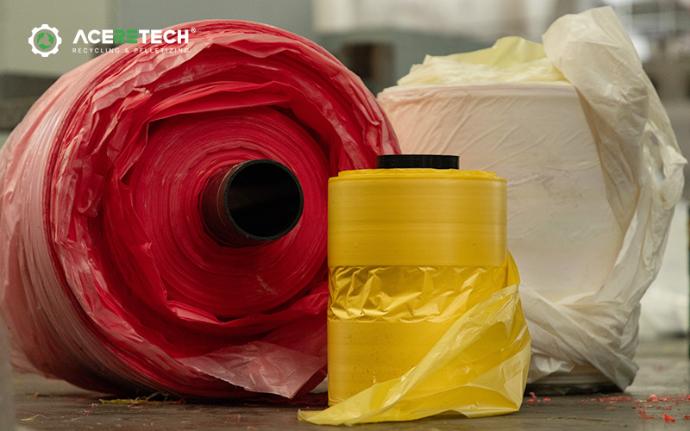
Typical production scrap includes film edge trims, roll remnants, off-spec film rolls, start-up waste, stretch film production waste, packaging film waste, and other clean factory film scrap.
Compared with post-consumer plastic waste, post-industrial film is generally cleaner and more consistent in composition. This makes it particularly suitable for in-plant recycling and direct reuse in downstream plastic processing.
However, plastic film is lightweight, flexible, and difficult to feed consistently. Large rolls, loose film, and accumulated production scrap can create feeding and handling challenges during size reduction.
For this project, ACERETECH supplied an HS Series Single-Shaft Shredder specifically for the size reduction of post-industrial plastic film.
With a processing capacity of 1000–1200 kg/h, the system is designed to continuously process factory film scrap and provide suitable shredded material for subsequent granulation or other recycling processes.
II. Project Overview
| Item |
Specification |
| Material |
Post-industrial plastic film |
| Typical Material | Film edge trims, roll remnants, off-spec film rolls, packaging film waste, stretch film production waste |
| Main Equipment | HS Single-Shaft Shredder |
| Processing Capacity | 1000–1200 kg/h |
| Rotor Diameter | 560 mm |
| Rotor Length | 1600 mm |
| Feeding System | Hydraulic Ram Pusher |
| Equipment Protection | Metal Detector |
| Control System | Intelligent PLC Control |
| Rotor Technology | Laser Cladding |
The project focuses on providing stable and continuous size reduction for clean industrial plastic film scrap before subsequent recycling or granulation.
III. Material Characteristics
The material processed in this application is post-industrial plastic film generated during manufacturing and converting processes.
Typical feedstock includes:
• PE film edge trims
• Roll remnants
• Off-spec film rolls
• Packaging film waste
• Stretch film production waste
• Start-up film waste
• Clean factory plastic film scrap
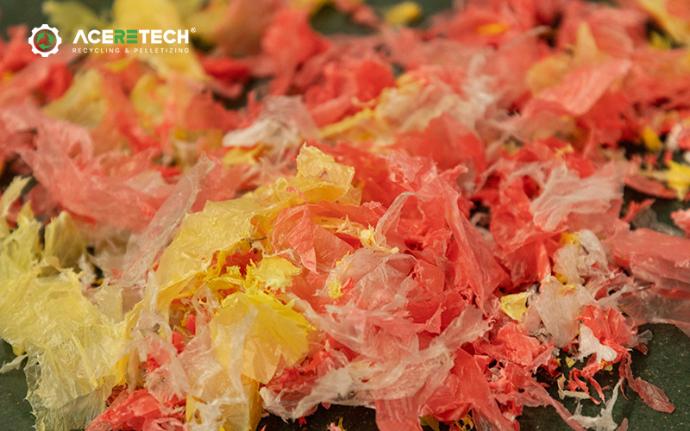
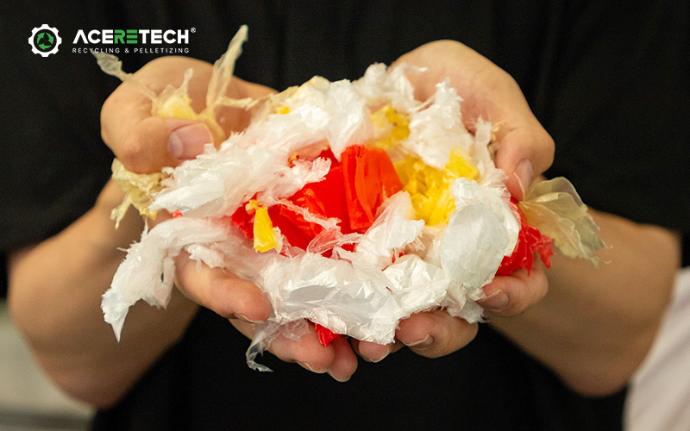
Because these materials are generated before reaching the end user, they are generally cleaner than post-consumer film waste.
Depending on the specific material source, the shredded film can be directly transferred to a downstream granulation system without requiring a complete washing process.
IV. Recycling Challenges
Although post-industrial film is relatively clean, its physical form creates several challenges during shredding.
1. Lightweight and Flexible Material
Plastic film has a low bulk density and can easily fold, stretch, or accumulate.
If the material is not fed properly, unstable feeding can reduce processing efficiency and cause interruptions.
2. Large Film Rolls and Accumulated Scrap
Production waste may be generated in the form of large film rolls, edge trims, or accumulated film scrap.
The shredding system therefore needs sufficient feeding capacity and mechanical strength to continuously process different forms of film waste.
3. Stable Continuous Feeding
For a production recycling system, stable feeding is important for maintaining consistent throughput.
The HS single-shaft shredder uses a hydraulic ram pusher to continuously move the material toward the rotor.
This helps reduce material bridging and supports continuous shredding.
4. Metallic Contaminants
Although post-industrial film is generally clean, accidental metallic contamination can still occur during production, handling, or material collection.
A metal detection system is therefore included to help protect the shredding equipment.
V. ACERETECH HS Single-Shaft Shredding Solution
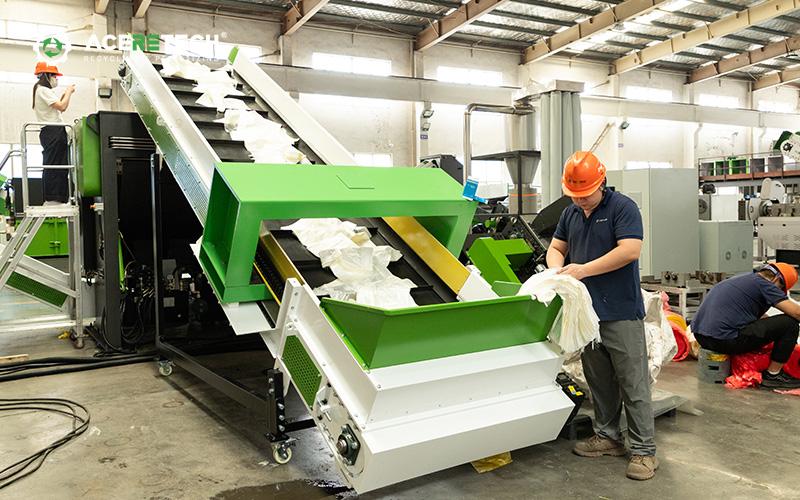
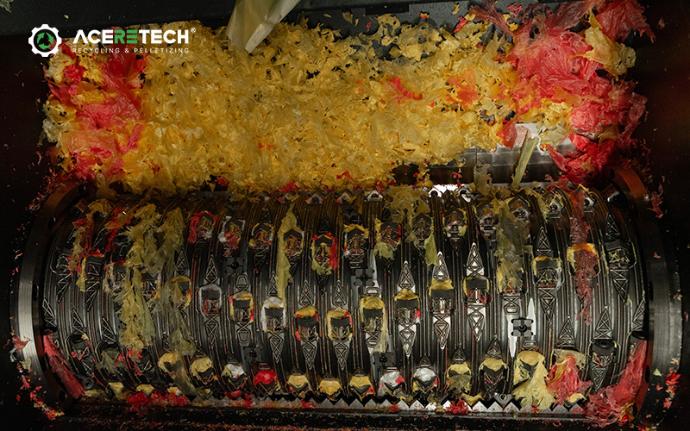
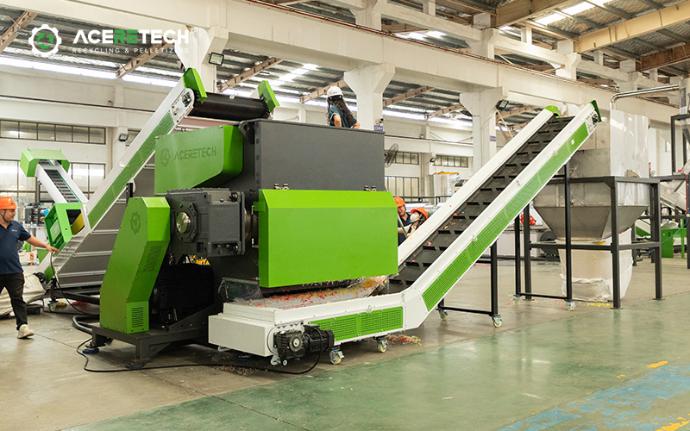
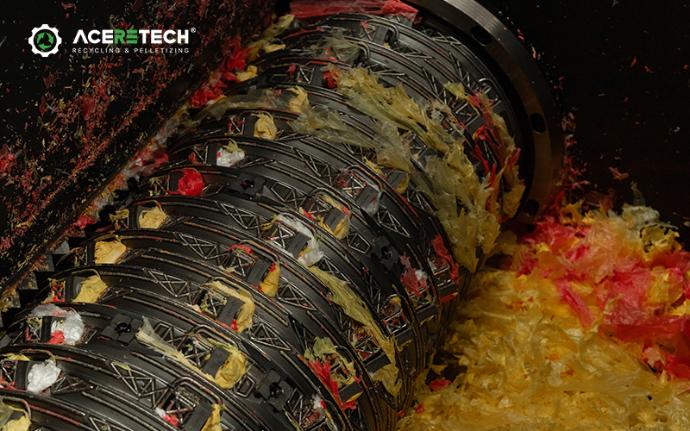
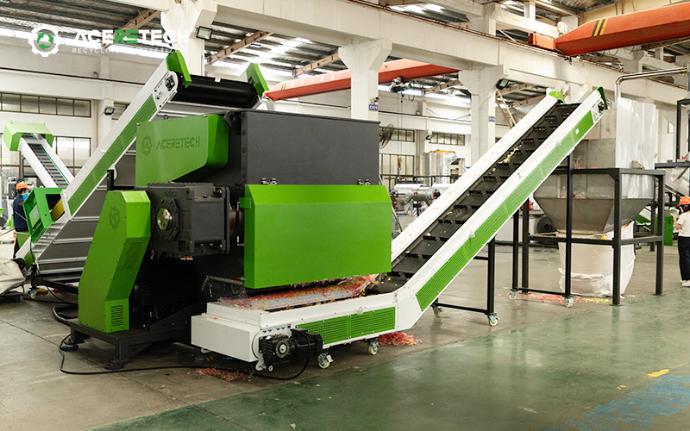
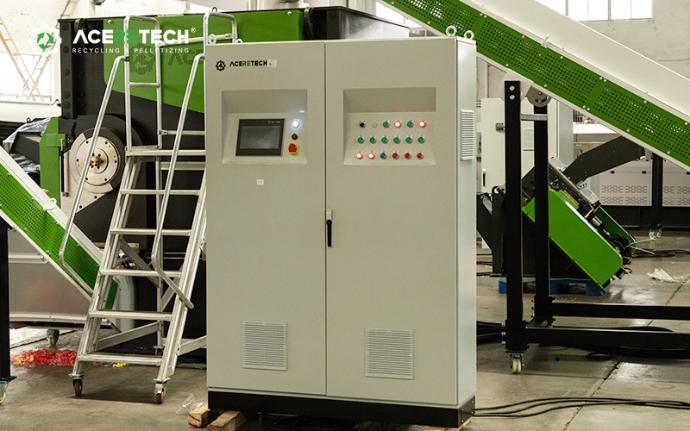
For this project, ACERETECH supplied an HS Series Single-Shaft Shredder equipped with an integrated feeding and control system.
The complete shredding system includes:
• Belt conveyor feeding system
• Metal detector
• Hydraulic ram pusher
• HS single-shaft shredding rotor
• L-shaped discharge conveyor
• Storage hopper
• Gearbox and motor
• Intelligent PLC control cabinet
The complete process can be summarized as:
Post-Industrial Plastic Film → Belt Conveyor → Metal Detection → Hydraulic Feeding → HS Single-Shaft Shredding → Discharge Conveyor → Storage Hopper → Subsequent Pelletizing
The system is designed to provide continuous size reduction while maintaining stable material feeding and protecting critical equipment components.
Step 1: Belt Conveyor Feeding
The post-industrial film scrap is first transferred into the recycling system through the belt conveyor.
The conveyor provides controlled material transportation toward the metal detection and shredding stages.
This helps reduce manual material handling and provides a continuous material flow.
Step 2: Metal Detection
Before the film enters the shredding chamber, it passes through the metal detection system.
The metal detector is designed to identify metallic contaminants and help protect the downstream shredding equipment.
This protection feature can help reduce the risk of unexpected equipment damage and unplanned downtime.
Step 3: Hydraulic Ram Feeding
After passing through the detection system, the film enters the shredding chamber.
Because plastic film is lightweight and flexible, stable feeding is one of the key requirements of this application.
The hydraulic ram continuously pushes the material toward the rotor.
This feeding system helps:
• Improve feeding stability
• Reduce material bridging
• Maintain continuous material flow
• Improve shredding efficiency
• Reduce manual intervention
The hydraulic feeding system is particularly useful when processing lightweight and bulky film scrap.
Step 4: HS Single-Shaft Shredding
The HS single-shaft shredder performs the main size-reduction process.
Main Technical Specifications
Model: HS Single-Shaft Shredder
Processing Capacity: 1000–1200 kg/h
Rotor Diameter: 560 mm
Rotor Length: 1600 mm
The rotor is designed for continuous industrial shredding applications and provides stable cutting performance during the processing of post-industrial film.
Heavy-Duty Rotor with Laser Cladding Technology
One of the key features of the HS shredder is its rotor manufactured using laser cladding technology.
Laser cladding creates a wear-resistant surface on the rotor, helping improve its durability during long-term operation.
Key advantages include:
• Enhanced wear resistance
• Durable cutting performance
• Longer service life
• Reduced maintenance frequency
• Lower long-term operating costs
• Reliable continuous operation
For industrial recycling applications involving continuous production, rotor durability is an important factor in maintaining stable equipment performance.
Step 5: Material Discharge and Storage
After shredding, the processed material is discharged through the L-shaped discharge conveyor.
The shredded film is then transferred to the storage hopper for temporary collection and subsequent feeding into the next recycling process.
Because post-industrial film is generally clean, the shredded material can, depending on its actual condition and downstream requirements, be directly transferred to a granulation system.
Typical Recycling Process
The complete process for this application can be summarized as:
Post-Industrial Plastic Film → Belt Conveyor → Metal Detector → Hydraulic Ram Feeding → HS Single-Shaft Shredder → L-Shaped Discharge Conveyor → Storage Hopper → Subsequent Granulation
The main purpose of this project is to provide stable and efficient size reduction before the subsequent recycling stage.
VI. Key Advantages of This Shredding Solution
This project combines a heavy-duty single-shaft shredder with controlled feeding and equipment protection systems.
Key features include:
• 1000–1200 kg/h processing capacity
• Designed for post-industrial plastic film
• 560 mm rotor diameter
• 1600 mm rotor length
• Hydraulic ram feeding
• Metal detection for equipment protection
• Laser-clad wear-resistant rotor
• Intelligent PLC control
• Continuous material handling
• L-shaped discharge conveyor
• Storage hopper for downstream processing
The integrated configuration helps manufacturers establish a stable in-plant film recycling process while reducing manual handling requirements.
VII. Why Recycle Post-Industrial Plastic Film?
Post-industrial film scrap represents valuable plastic material that can often be recovered directly within the manufacturing process.
By recycling production waste, manufacturers can:
• Reduce virgin resin consumption
• Lower raw material costs
• Reduce factory plastic waste
• Improve material utilization
• Recover value from production scrap
• Support in-plant circular production
For relatively clean production film, direct recycling can also reduce the need for additional washing processes.
VIII. From Film Scrap to Recycled Material
The shredded post-industrial film produced by the HS shredder can be transferred to a subsequent granulation or recycling system.
A typical downstream process may include:
Shredded Film → Granulation → Melt Filtration → Pelletizing → Recycled Plastic Pellets
The exact downstream configuration depends on the characteristics of the film, the required production capacity, and the quality requirements of the final recycled material.
This means the HS shredder can function not only as an individual size-reduction machine, but also as the front-end equipment of an integrated in-plant recycling system.
IX. Project Summary
This project demonstrates the application of an HS Series Single-Shaft Shredder for the continuous processing of post-industrial plastic film.
The system is designed for a processing capacity of 1000–1200 kg/h and combines:
Belt Conveyor → Metal Detection → Hydraulic Ram Feeding → HS Single-Shaft Shredding → Discharge Conveyor → Storage Hopper
With a 560 mm diameter and 1600 mm long rotor, together with laser cladding technology, the shredder is designed to provide durable and stable performance for continuous industrial film processing.
The project demonstrates how clean post-industrial plastic film can be efficiently prepared for subsequent granulation or other recycling processes.
Rather than treating production film scrap as waste, manufacturers can use an in-plant shredding and recycling system to recover valuable plastic material and improve overall material utilization.
Related Articles
In-house Plastic Film Recycling Solutions
Plastic Film Washing Solutions
Plastic Film Pelletizing Solutions
Looking for a Post-Industrial Film Recycling Solution?
ACERETECH provides shredding and recycling solutions for post-industrial plastic film, including size reduction, conveying, pelletizing, melt filtration, and automated material handling.
The equipment configuration can be designed according to the characteristics of the production scrap, required processing capacity, and downstream recycling requirements.
Contact ACERETECH to discuss your post-industrial plastic film recycling application and find a suitable solution.
FAQ
These terms of service ("Terms", "Agreement") are an agreement between the website ("Website operator", "us", "we" or "our") and you ("User", "you" or "your"). This Agreement sets forth the general terms and conditions of your use of this website and any of its products or services (collectively, "Website" or "Services").
Q1. Why is a hydraulic ram used for plastic film shredding?
A: Plastic film is lightweight and flexible, which can make feeding unstable.
The hydraulic ram continuously pushes the material toward the rotor, helping maintain stable feeding and reducing the risk of material bridging.
These terms of service ("Terms", "Agreement") are an agreement between the website ("Website operator", "us", "we" or "our") and you ("User", "you" or "your"). This Agreement sets forth the general terms and conditions of your use of this website and any of its products or services (collectively, "Website" or "Services").
Q2. What is the function of the metal detector?
A: The metal detector identifies metallic contaminants before they enter the shredding chamber.
This helps protect the shredder and reduce the risk of equipment damage caused by accidental metal contamination.
These terms of service ("Terms", "Agreement") are an agreement between the website ("Website operator", "us", "we" or "our") and you ("User", "you" or "your"). This Agreement sets forth the general terms and conditions of your use of this website and any of its products or services (collectively, "Website" or "Services").
Q3. What is the advantage of laser cladding technology on the rotor?
A: Laser cladding improves the wear resistance of the rotor surface.
This helps maintain cutting performance during long-term operation, extend rotor service life, and reduce maintenance requirements.
These terms of service ("Terms", "Agreement") are an agreement between the website ("Website operator", "us", "we" or "our") and you ("User", "you" or "your"). This Agreement sets forth the general terms and conditions of your use of this website and any of its products or services (collectively, "Website" or "Services").
Q4. Can shredded post-industrial film be directly pelletized?
A: For relatively clean post-industrial film, the shredded material can typically be transferred directly to a granulation system.
Whether additional washing or other treatment is required depends on the actual cleanliness, material composition, and final recycled material requirements.
These terms of service ("Terms", "Agreement") are an agreement between the website ("Website operator", "us", "we" or "our") and you ("User", "you" or "your"). This Agreement sets forth the general terms and conditions of your use of this website and any of its products or services (collectively, "Website" or "Services").
Q5. Can the HS shredder be integrated into a complete recycling line?
A: Yes. The HS shredder can be used as the front-end size-reduction equipment in an integrated plastic film recycling system.
Depending on the material and final application, downstream equipment may include granulation, melt filtration, pelletizing, and automated material handling systems.