A plastic pelletizing machine converts plastic waste into uniform pellets for re-manufacturing. For difficult waste streams like 500kg/h printed PE/PP packaging film with high moisture and surface ink, a standard shredder-melter fails. Aceretech ACSS-H Double-Stage Cutter-Compactor Pelletizing System is purpose-built for this scenario. It combines an 800L compactor with pre-drying, two double-zone vacuum degassing systems for moisture and ink VOC removal, and double large-area piston-type melt filters for non-stop filtration. Output range 150-1200kg/h, with final pellets suitable for direct blown film extrusion.
What is a Plastic Pelletizing Machine?
A plastic pelletizing machine is a complete system that converts plastic scrap – film, raffia, woven bags, rigid flakes – into small, uniform, dense pellets that can be directly reused in extrusion or injection molding.
Modern systems are not just an extruder. For flexible films, the system must integrate compacting, plasticizing, degassing, filtration, and pelletizing into one continuous line to ensure stable feeding and clean pellets.
Real Film Recycling Process: 5-Step Flow
Many generic articles describe pelletizing as Shredding -> Melting -> Cutting. For PE/PP film, that process causes bridging, bubbles, and black specks. Aceretech uses a film-specific 5-step flow:
- . Compacting & Pre-Drying: Lightweight film (bulk density 30-60 g/L) is fed via belt conveyor with metal detector into an 800L (300-1600L optional) cutter-compactor. Frictional heat and auxiliary heater pre-crush, mix, and pre-dry surface moisture, increasing bulk density for stable extrusion.
- Single or Double-Stage Extrusion: First-stage extruder (Ø120-180mm, L/D 42) melts and plasticizes. In double-stage ACSS-H, second-stage extruder (Ø150-200mm, L/D 12) stabilizes melt pressure.
- Double Vacuum Degassing: High-efficiency vacuum system removes moisture, air, low-molecular-weight volatiles and printing ink residues and odors. For heavy printed film, double vacuum + Roots vacuum is required.
- Dual-Piston Melt Filtration: Unlike hydraulic single-plate filters that stop production, continuous large-area piston-type filter enables uninterrupted production, stable pressure, and high-efficiency contaminant removal. For high impurity content, double filtration (one after first extruder, one after second) is critical.
- Pelletizing & Drying: Water-ring or strand pelletizing + vibrating dewatering produces uniform pellets with low moisture.
This is the core flow adopted in our PE Film Compacting Pelletizing Solution: ACSS Two-Stage for High-Quality PE Pellets.
Types Compared: ACS vs ACSS vs ASE vs ADS
Function and classification of plastic pelletizing machines must be based on application, not cutting method. Choosing the wrong type leads to unstable output and low pellet value. Below is Aceretech's 2026 portfolio classification based on application, moisture tolerance and filtration.
| Model |
Technology |
Best For | Moisture Tolerance | Ink Handling | Filtration System | Degassing System | Typical Capacity |
| ACS-H | Cutter-Compactor Single-Stage |
Clean PE/PP film, BOPP, edge trim, relatively clean industrial scrap | <3% | Light printing | Single large-area piston filter | Single vacuum degassing (double-zone optional) | 100-1000 kg/h |
| ACSS-H [For Printed Film] | Cutter-Compactor Double-Stage | Printed PE/PP packaging film, LDPE shopping bags, washed agricultural film with high moisture, PP woven bags, heavy printed bags | 5-8% after compactor pre-drying | Heavy printing & surface ink | Double large-area piston filters, double filtration, non-stop operation | Double vacuum degassing + triple degassing process, Roots vacuum for VOC & odor removal | 150-1200 kg/h (500kg/h optimal, 1000kg/h proven) |
| ASE | Single-Screw Single-Stage | Rigid flakes/regrinds: PE, PP, ABS, PS, HIPS, PC | <1% | None | Single piston | Single vent | 100-800 kg/h |
| ADS | Cutter-Compactor + Single-Screw Two-Stage (for rigid) | PP sheet, HDPE, rigid with higher impurity | 3-5% | Medium | Double piston | Double vacuum | 200-1000 kg/h |
| ATE | Parallel Twin-Screw | Modification & compounding with 30% CaCO3 filling | Low | None | Customizable | Multi-vent | 200-1500 kg/h |
| ASP / ASP-ECO | Shredder + Single-Screw (In-Plant) | In-plant trim, purge, hollow parts | Low | None | Single | Single | 50-500 kg/h |
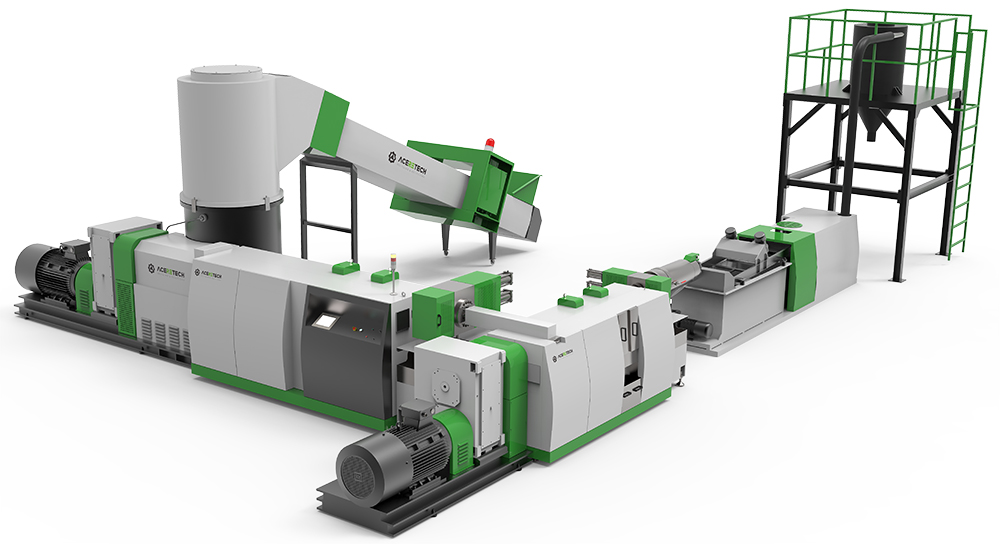
Detailed ACSS Spec Example (from 512 & 497 proven projects):
- Compactor: 800L standard (200L for compact version), cutting-compacting-homogenizing-drying in one
- Extruders: First Ø180mm L/D 42, Second Ø200mm L/D 12
- Filtration: Continuous piston-type, 2X large filtration area, low frequency screen changing
- Pelletizing: Water-ring (for PE) / Strand (for LDPE bags) + vibrating dewatering
- Control: PLC intelligent control, Siemens/Schneider electrical
How to Choose for 500kg/h Printed Film?
If you generate around 500kg/h of printed PE/PP packaging film waste with high moisture (5-10%) and surface ink / printing ink residues, standard single-stage pelletizer cannot remove volatile compounds and moisture.
This is the exact scenario many recyclers face, and why single-stage machines fail.
The 3 Challenges:
- Low Bulk Density & Tangling: Printed packaging film wraps around screws, causing unstable feeding. Solution: Belt conveyor + 800L compactor for volume reduction.
- High Moisture (Often 5-10% after washing): Water turns into steam in extruder, causing bubbles and porous pellets. Solution: Compactor frictional pre-drying + double vacuum degassing to remove moisture and volatile compounds.
- Surface Ink & Volatile Residues: Ink evaporates at 180-220°C, causing odor, black specks and poor film blowing. Solution: As proven in our 1000 kg/h LDPE Films and Packaging Bags ACSS Double-Stage Solution, the system needs dedusting + Roots vacuum degassing to remove printing ink residues, odors and entrapped gases.
Why ACSS-H is the Answer for 500kg/h:
Compared to ACS-H (single-stage for clean film), ACSS-H double-stage provides:
- Second Extruder = Second Chance for Devolatilization: Moisture and ink VOCs that escape first extruder are removed between first and second stage.
- Double Filtration = Cleaner Pellets for Blown Film: The first filter removes paper/labels, the second ensures final pellets <150 microns impurity-free, suitable for direct blown film line.
- Continuous Piston Filter = No Stop Production: Critical for 500kg/h continuous commercial operation.
For a detailed process on achieving stable, continuous production, see: PE Film Pelletizing Solutions: How to Achieve Efficient Recycling, High-Quality Pelletizing, and Stable Continuous Production
Benefits & ROI Analysis
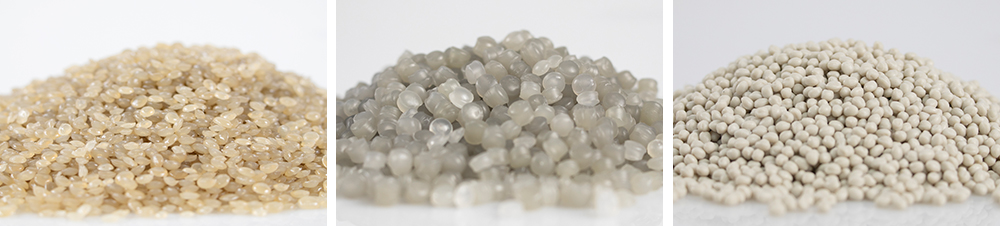
- Consistent Output: Automatic feeding + compactor ensures 500kg/h stable output vs 30% fluctuation on non-compactor machines.
- Reduction of Waste & Higher Pellet Value: Converts Difficult-to-Recycle printed film into high-density, clean pellets for film blowing, not just low-grade injection. Recycled LDPE pellets market price $900-1200/T vs waste film $100/T.
- Cost-Effective & ROI: Using Aceretech ACSS-H at 500kg/h, ~4000 tons/year output. Saving on virgin material (30-50% lower cost than virgin PP/PE) typically leads to payback within 12-18 months for in-house recyclers. Ceramic/far-infrared heaters + intelligent PLC reduce energy per kg.
- Environmentally Friendly & Compliant: Enables circular economy for packaging producers facing EPR regulations.
FAQ
Q1: What is plastic pelletizer machine?
A plastic pelletizer machine is a system that converts plastic waste into uniform pellets via compacting, extrusion, filtration and pelletizing. For PE/PP film, cutter-compactor pelletizers like ACS-H and ACSS-H are standard.
Q2: What is the difference between single-stage and double-stage pelletizing machine?
Single-stage (ACS-H) has one extruder and one filtration, suitable for clean film with <3% moisture. Double-stage (ACSS-H) has two extruders with double filtration and double/triple degassing, designed for materials with high impurity, high moisture (5-8%) and heavy printing, ensuring denser, cleaner pellets.
Q3: Can ACSS-H handle heavily printed film or materials with 5% or more moisture?
Yes. ACSS-H excels at heavily printed LDPE/PP films. The cutter-compactor pre-dries material, and double-stage extrusion provides multiple venting points for superior degassing, effectively removing ink volatiles and moisture for film blowing quality. This is proven in our 1000kg/h LDPE packaging bag project.
Q4: What is dual-piston filtration system?
Dual-piston filtration uses two large-area piston-type screen changers (one after each extruder) that allow non-stop screen changing without stopping production, maintaining stable melt pressure and high filtration efficiency, critical for continuous 500-1000kg/h operation.
Q5: What output can ACSS-H achieve?
Official range 150kg/h-1200kg/h. For printed PE/PP packaging film waste, 500kg/h is optimal mid-range, 1000kg/h proven in LDPE bag recycling.
Q6: Why choose Aceretech as pelletizing machine manufacturer?
Aceretech Machinery (Suzhou) is a ISO9001:2015 certified manufacturer specializing in film/soft plastic recycling washing and pelletizing. Portfolio includes ACS-H, ACSS double-stage, ASP in-plant, and complete washing + pelletizing lines, with 300+ installations worldwide and 13 months warranty.
Related Proven Solutions
Explore deeper technical guides from the same Plastic Pelletizing Machine tag cluster:
- For PE Film Specifics: PE Film Compacting Pelletizing Solution: ACSS Two-Stage for High-Quality PE Pellets (800L compactor detailed config)
- For 1000kg/h Real Test Video: LDPE Films and Packaging Bags | ACSS 1000 kg/h Double-Stage Compacting and Pelletizing System
- For Stable Continuous Production Know-How: PE Film Pelletizing Solutions: How to Achieve Efficient Recycling and Stable Production
- Product Center: Aceretech ACSS-H Double-Stage Cutter-Compactor Line - Get Specs & Quote
Conclusion
Plastic pelletizing machine classification is not about strand vs underwater cutting method, but about matching your waste stream. For clean film, ACS-H is enough. For 500kg/h printed PE/PP packaging film with high moisture and surface ink, Aceretech ACSS-H Double-Stage with Double Vacuum Degassing & Dual-Piston Filtration is the industrial standard.
Still generating 500kg/h printed film waste?
[View 1000kg/h LDPE Case Study Video]
[Get ACSS-H Specs for High Moisture & Ink - Contact Aceretech Engineering]