I. From PE Film Waste to High-Quality Recycled PE Pellets
PE film is widely used in packaging, agriculture, logistics, construction, and industrial applications.
During manufacturing, distribution, and post-consumer use, large quantities of PE film waste are generated. Typical examples include LDPE packaging film, LLDPE stretch film, agricultural film, industrial film scrap, and factory production waste.
However, recycling PE film presents several challenges compared with rigid plastic materials.
The material has a low bulk density, tends to bridge or tangle during feeding, and may contain moisture, printing ink, dust, and other contaminants. These characteristics can affect feeding stability, extrusion performance, filtration, and final pellet quality.
For PE film recycling applications requiring stable feeding, effective degassing, continuous melt filtration, and reliable pelletizing, ACERETECH provides the ACSS Two-Stage Compacting & Pelletizing System.
The system integrates:
Compacting → Plasticizing → Two-Stage Extrusion → Vacuum Degassing → Melt Filtration → Pelletizing → Dewatering
to convert PE film waste into recycled PE pellets for subsequent processing.
II. Application Background
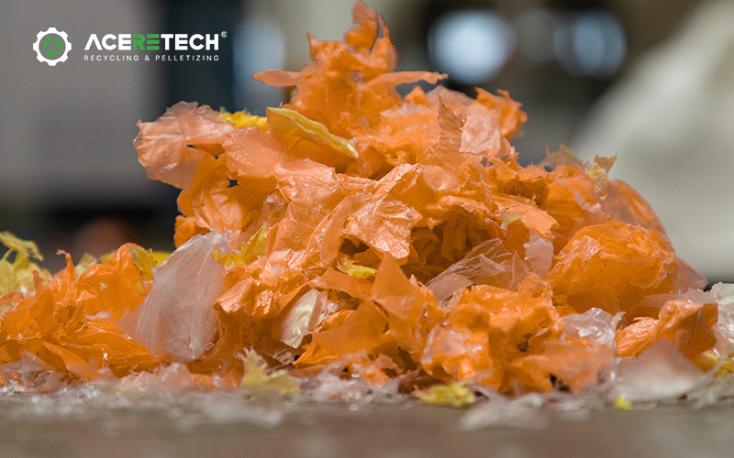
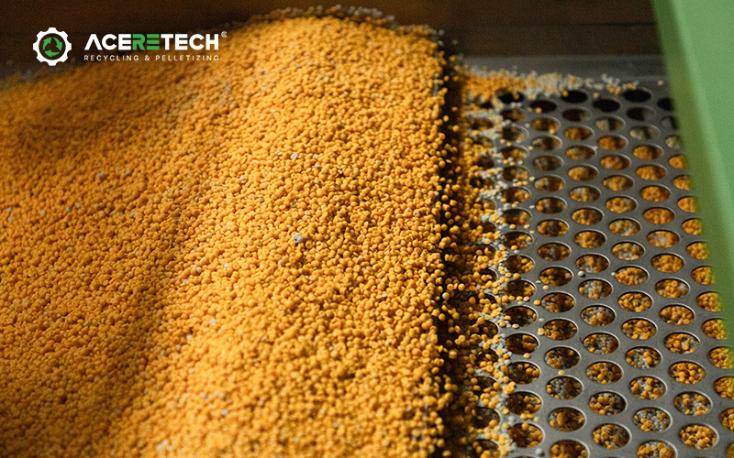
PE film recycling is different from the recycling of rigid plastics.
The low bulk density of film makes it difficult to feed directly into a conventional extrusion system.
During recycling, PE film may also contain:
• Moisture
• Printing ink
• Dust
• Paper residues
• Organic contamination
• Other foreign materials
If these factors are not properly controlled, they can lead to:
• Unstable feeding
• Fluctuating extrusion pressure
• Gas and bubble formation
• Melt contamination
• Increased filter loading
• Reduced pellet quality
The ACSS system addresses these challenges through a combination of cutter compaction, two-stage extrusion, vacuum degassing, and continuous melt filtration.
III. Suitable PE Film Materials
The ACSS two-stage compacting and pelletizing system can be applied to various PE film materials, including:
• LDPE film
• LLDPE stretch film
• HDPE film
• Packaging film
• Agricultural film
• Industrial PE film
• In-house factory film scrap
• Printed PE film
• PE bags
• Flexible PE plastic waste
The actual configuration should be selected according to the material condition, contamination level, moisture content, required throughput, and final pellet application.
For washed PE film, an appropriate dewatering and drying process should be completed before the pelletizing stage.
IV. Why PE Film Requires Specialized Pelletizing Equipment
1. Low Bulk Density
PE film is lightweight and occupies a large volume compared with its weight.
Feeding loose film directly into an extruder can therefore result in unstable feeding and low feeding efficiency.
Film Tends to Bridge and Tangle
Flexible film can bridge inside the feeding system or wrap around rotating components.
A suitable compaction and feeding system is therefore important for continuous operation.
2. Moisture and Volatiles
Washed film can retain moisture, while printed and post-consumer film may contain volatile substances.
These materials can generate gas during extrusion if they are not effectively removed.
3. Contamination
PE film may contain dust, ink, paper residues, and other contaminants.
Continuous melt filtration is therefore important when processing materials with a certain level of contamination.
V. ACSS Two-Stage Compacting & Pelletizing System
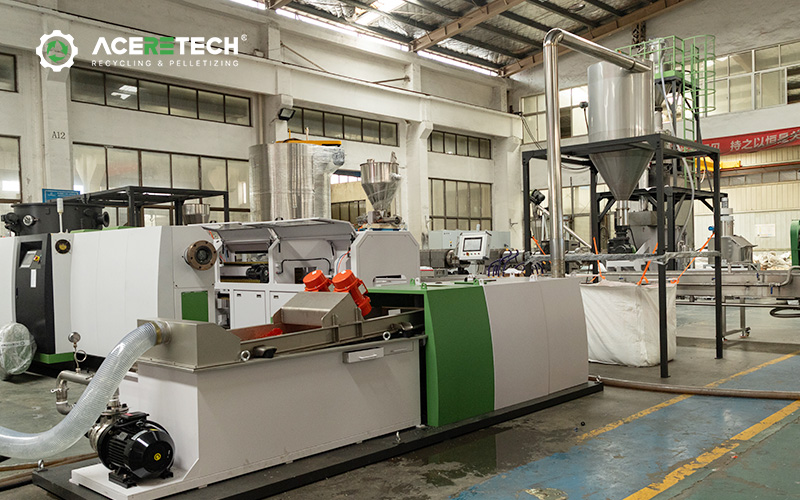
The ACSS system integrates the major stages required for PE film pelletizing into one continuous production line.
The main configuration for this application includes:
| Section |
Main Configuration |
| Material |
PE Film |
| Feeding | Belt conveyor with metal detector |
| Compactor | 800 L |
| First-Stage Extruder | Ø120 mm, L/D 42 |
| Second-Stage Extruder | Ø150 mm, L/D 12 |
| Degassing | Vacuum degassing system |
| Melt Filtration | Continuous piston-type melt filter |
| Pelletizing | Water-ring pelletizing |
| Dewatering | Vibrating dewatering screen |
| Control | PLC intelligent control |
The combination of a large-volume compactor and two-stage extrusion is designed to provide stable feeding and controlled melt processing of PE film.
VI. Complete PE Film Pelletizing Process
The complete process is:
PE Film → Belt Conveyor + Metal Detection → 800 L Compactor → First-Stage Ø120 Extruder → Vacuum Degassing → Continuous Piston-Type Melt Filtration → Second-Stage Ø150 Extruder → Melt Filtration → Water-Ring Pelletizing → Vibrating Dewatering → Recycled PE Pellets
Each section performs a specific function in the recycling process.
Related Articles
In-house PE film recycling and pelletizing solutions
PE film washing solutions
PE film shredding solutions
VII. ACSS Double-Stage Compacting and Pelletizing Machine Workflow



Step 1: Feeding and Metal Detection
The PE film is transferred to the pelletizing system through a belt conveyor.
A metal detector is integrated into the feeding system to help identify metallic contaminants before they enter the extrusion equipment.
Stable and controlled feeding is important because loose PE film has a low bulk density and can otherwise cause fluctuations in material flow.
The automatic feeding system reduces the need for manual feeding and supports continuous operation.
Step 2: 800 L Compaction
The PE film enters the 800 L compactor before extrusion.
The compactor reduces the apparent volume of the loose film and increases the bulk density of the material.
This provides several benefits:
• Improved feeding stability
• Higher material density
• Better continuous feeding into the extruder
• Reduced bridging and feeding interruptions
• More stable extrusion
The compactor is particularly important for lightweight film materials that are difficult to feed directly into an extruder.
Step 3: First-Stage Extrusion
After compaction, the material enters the first-stage extruder.
Main Specifications
• Screw diameter: 120 mm
• L/D ratio: 42
The relatively long first-stage screw provides sufficient processing length for:
• Melting
• Plasticizing
• Mixing
• Homogenization
• Initial degassing
The material is progressively heated and plasticized as it moves through the screw.
The screw design is configured to provide stable plasticization while minimizing unnecessary thermal degradation.
Step 4: Vacuum Degassing
A vacuum degassing system is installed during the extrusion process.
The vacuum system helps remove:
• Moisture
• Entrained air
• Low-molecular-weight volatiles
• Residual gases
This is particularly useful when processing PE film containing printing ink, residual moisture, or other volatile substances.
Effective degassing helps reduce:
• Bubbles
• Voids
• Pellet surface defects
• Melt instability
and supports more stable downstream pelletizing.
Step 5: Continuous Melt Filtration
After initial plasticization and degassing, the polymer melt passes through a continuous piston-type melt filter.
The filtration system removes solid contaminants from the molten PE.
Typical contaminants may include:
• Paper
• Fine dirt
• Aluminum or other foreign particles
• Unmelted polymer
• Other solid impurities
The continuous piston-type design helps maintain production while the filter is serviced or regenerated.
Key benefits include:
• Continuous operation
• Stable melt pressure
• Effective contaminant removal
• Reduced production interruptions
• Improved filtration efficiency
This is particularly valuable when recycling PE film with a certain level of contamination.
Step 6: Second-Stage Extrusion
After the first filtration stage, the material enters the second-stage extruder.
Main Specifications
• Screw diameter: 150 mm
• L/D ratio: 12
The second-stage extrusion section is mainly responsible for melt homogenization and pressure stabilization before pelletizing.
The two-stage extrusion configuration separates the main plasticizing and degassing functions from the final melt stabilization stage.
This provides greater flexibility for processing PE film containing moisture, volatile substances, and impurities.
Step 7: Final Melt Filtration
The melt is filtered again before entering the pelletizing system.
The final filtration stage provides additional removal of remaining solid contaminants.
This helps protect the pelletizing section and improve the consistency of the recycled PE pellets.
The actual filtration configuration should be selected according to:
• Raw material contamination
• Required filtration fineness
• Production capacity
• Final pellet application
Step 8: Water-Ring Pelletizing
After melt filtration and pressure stabilization, the molten PE is transferred to the water-ring pelletizing system.
The water-ring pelletizer cuts the molten polymer into pellets and simultaneously provides initial cooling.
The pelletizing system is designed to produce:
• Stable pellet formation
• Consistent pellet shape
• Efficient cooling
• Continuous production
The actual pellet dimensions depend on the pelletizer configuration and operating conditions.
Step 9: Vibrating Dewatering
After pelletizing and cooling, the pellets are separated from the process water through the vibrating dewatering screen.
The dewatering system removes surface water from the recycled PE pellets and prepares the pellets for collection or further handling.
The final pellets can then be conveyed to a storage or packaging system.
VIII. Key Technical Advantages of the ACSS System
1. Stable Feeding of Lightweight PE Film
The 800 L compactor increases the bulk density of loose PE film before extrusion.
This helps overcome one of the most common feeding problems associated with flexible film recycling.
2. Two-Stage Extrusion
The ACSS system uses two independent extrusion stages:
Ø120 × L/D 42 First Stage
Ø150 × L/D 12 Second Stage
The first stage focuses on melting, plasticizing, mixing, and initial degassing, while the second stage provides melt stabilization before pelletizing.
3. Effective Vacuum Degassing
Vacuum degassing helps remove moisture, air, and volatile substances from the polymer melt.
This can be particularly important when processing printed PE film or washed film with residual moisture.
4. Continuous Melt Filtration
The continuous piston-type melt filter helps remove solid contaminants while maintaining continuous production.
This reduces the need for frequent production shutdowns caused by conventional screen replacement.
5. Stable Pelletizing
The water-ring pelletizing system provides continuous cutting and cooling of the molten PE.
The combination of stable extrusion pressure and controlled pelletizing supports consistent pellet production.
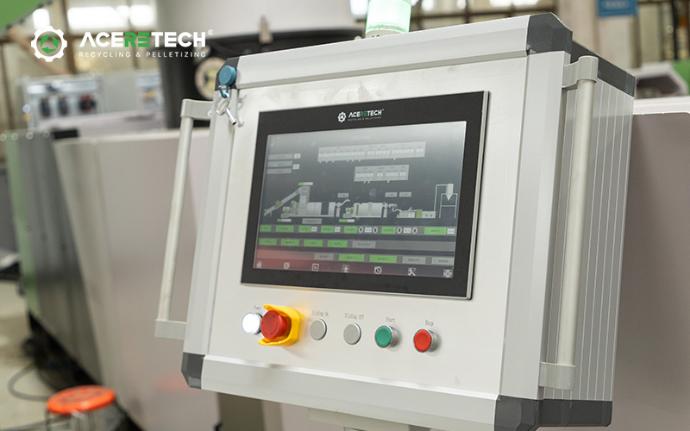
6. Integrated PLC Control
The complete system is controlled through an intelligent PLC system.
The control system monitors and manages key operating parameters such as:
• Temperature
• Pressure
• Feeding
• Extrusion
• Pelletizing
• Equipment status
• Fault conditions
The touchscreen interface also allows operators to monitor the production process and adjust operating parameters.
IX. PE Film Recycling with or without Washing
The ACSS pelletizing system can be used for different PE film recycling applications.
1. Clean Industrial PE Film
For relatively clean in-house production scrap, a washing process may not be necessary.
The material can potentially be processed through:
PE Film → Compaction → Pelletizing → Recycled PE Pellets
The actual process depends on the cleanliness and condition of the material.
2. Washed PE Film
For post-consumer or contaminated PE film, washing and drying should normally be completed before pelletizing.
The process becomes:
Waste PE Film → Shredding / Washing → Dewatering & Drying → Compaction → Pelletizing → Recycled PE Pellets
The pelletizing system then handles the final conversion of clean PE film into pellets.
3. Important Note on Moisture
For washed PE film, the moisture content entering the pelletizing system is an important design parameter.
The required dewatering and drying equipment should therefore be selected according to the material condition and the requirements of the pelletizing system.
X. Typical Applications of Recycled PE Pellets
The recycled PE pellets produced from this type of system can potentially be used in a range of downstream applications, depending on the raw material quality and pellet properties.
Typical applications include:
• Garbage bags
• Packaging films
• Agricultural films
• Plastic bags
• Pipes
• Injection-molded products
• Blow-molded products
• Construction products
• Plastic composite products
The final application should be selected according to the recycled pellet's properties, including contamination level, color, melt flow characteristics, and mechanical performance.
XI. From PE Film Waste to Recycled Pellets
The overall recycling route can be summarized as:
PE Film Waste → Feeding + Metal Detection → Compacting → Plasticizing → Vacuum Degassing → Melt Filtration → Second-Stage Extrusion → Final Melt Filtration → Water-Ring Pelletizing → Dewatering → Recycled PE Pellets
The ACSS system integrates these stages into one continuous pelletizing line.
The combination of compaction, two-stage extrusion, vacuum degassing, filtration, and water-ring pelletizing is designed specifically to address the feeding and processing characteristics of PE film.
XII. Application Summary
This PE film recycling application demonstrates the use of the ACSS Two-Stage Compacting & Pelletizing System for converting PE film waste into recycled PE pellets.
The system is configured with an 800 L compactor, Ø120 × L/D 42 first-stage extruder, Ø150 × L/D 12 second-stage extruder, vacuum degassing, continuous piston-type melt filtration, water-ring pelletizing, and vibrating dewatering.
The process is designed to address several typical challenges associated with PE film recycling:
• Low bulk density
• Unstable feeding
• Moisture
• Volatile substances
• Printing ink
• Solid contamination
The complete process is:
PE Film → Compaction → Two-Stage Extrusion → Degassing → Melt Filtration → Pelletizing → Dewatering → Recycled PE Pellets
For relatively clean industrial film, the pelletizing system can be used as the main recycling stage.
For washed post-consumer or contaminated PE film, the appropriate washing, dewatering, and drying system can be installed before pelletizing.
This provides a flexible approach for producing recycled PE pellets according to different raw material conditions and downstream requirements.
Looking for a PE Film Pelletizing Solution?
ACERETECH provides PE film recycling and pelletizing solutions based on the characteristics of the incoming material and the requirements of the finished recycled pellets.
The ACSS Two-Stage Compacting & Pelletizing System integrates:
Compacting → Two-Stage Extrusion → Vacuum Degassing → Melt Filtration → Pelletizing → Dewatering
It is suitable for a wide range of PE film recycling applications, from relatively clean industrial production scrap to washed PE film requiring enhanced degassing and filtration.
Contact ACERETECH to discuss your PE film recycling project and determine the appropriate pelletizing configuration.
FAQ
These terms of service ("Terms", "Agreement") are an agreement between the website ("Website operator", "us", "we" or "our") and you ("User", "you" or "your"). This Agreement sets forth the general terms and conditions of your use of this website and any of its products or services (collectively, "Website" or "Services").
A: The system can process various PE film materials, including LDPE film, LLDPE stretch film, HDPE film, packaging film, agricultural film, industrial film scrap, factory production waste, printed PE film, and PE bags.
The actual suitability depends on the material composition, contamination level, moisture content, and final pellet requirements.
These terms of service ("Terms", "Agreement") are an agreement between the website ("Website operator", "us", "we" or "our") and you ("User", "you" or "your"). This Agreement sets forth the general terms and conditions of your use of this website and any of its products or services (collectively, "Website" or "Services").
A: PE film has a low bulk density and can be difficult to feed continuously.
The compactor reduces the apparent volume of the film and increases its bulk density, providing more stable feeding into the extruder.
These terms of service ("Terms", "Agreement") are an agreement between the website ("Website operator", "us", "we" or "our") and you ("User", "you" or "your"). This Agreement sets forth the general terms and conditions of your use of this website and any of its products or services (collectively, "Website" or "Services").
A: The two-stage configuration allows the main plasticizing, melting, mixing, and degassing functions to be separated from the final melt stabilization stage.
This is particularly useful for PE film containing moisture, volatiles, printing ink, or other contaminants.
These terms of service ("Terms", "Agreement") are an agreement between the website ("Website operator", "us", "we" or "our") and you ("User", "you" or "your"). This Agreement sets forth the general terms and conditions of your use of this website and any of its products or services (collectively, "Website" or "Services").
A: Yes. The system is suitable for printed PE film, particularly when combined with effective vacuum degassing and melt filtration.
However, the actual processing performance depends on the type and amount of ink and other contamination in the feedstock.
These terms of service ("Terms", "Agreement") are an agreement between the website ("Website operator", "us", "we" or "our") and you ("User", "you" or "your"). This Agreement sets forth the general terms and conditions of your use of this website and any of its products or services (collectively, "Website" or "Services").
A: Washed PE film should be appropriately dewatered and dried before pelletizing.
The required drying system depends on the residual moisture content of the material and the requirements of the extrusion process.
These terms of service ("Terms", "Agreement") are an agreement between the website ("Website operator", "us", "we" or "our") and you ("User", "you" or "your"). This Agreement sets forth the general terms and conditions of your use of this website and any of its products or services (collectively, "Website" or "Services").
A: Depending on the quality of the input material and the properties of the finished pellets, recycled PE can be used for applications such as garbage bags, packaging films, agricultural films, pipes, injection-molded products, blow-molded products, and other plastic products.