Abstract
In the field of plastic recycling and reprocessing, odor removal from plastic particles is a core step in improving the quality of recycled materials and expanding their application scenarios. Whether virgin or recycled plastic particles, residual odors from their production or recycling process (such as the grease smell from food packaging or the pungent odor of chemical raw materials) not only affect the user experience of the final product but may also limit its application in high-end sectors.
I. Necessity Analysis of Odor Removal from Plastic Particles
1. Meeting Core Requirements of Product Applications
The odor of plastic particles directly affects the performance and safety of downstream products:
Food and Medical Fields: If recycled PP/PE particles are used in food packaging, medical devices, etc., residual odors may migrate into the products, leading to food spoilage and contamination of medical supplies, violating food safety and medical regulations;
Daily Necessities and Electronics Fields: Odors affect consumer acceptance of products (e.g., the pungent smell of plastic toys and appliance casings), reducing product competitiveness;
High-End Manufacturing Fields: In industries with extremely high requirements for material purity, such as automotive and aerospace, odor-laden particles cannot meet stringent quality standards, limiting the application of recycled materials.
2. Compliance with Environmental Regulations and Sustainable Development Requirements
Volatile organic compounds (VOCs) generated during plastic production and recycling are a significant source of air pollution. Odor removal equipment removes odor molecules through physical or chemical methods, reducing VOC emissions and complying with environmental regulations such as the "Air Pollution Prevention and Control Law," helping enterprises achieve green production and responding to "dual carbon" goals.
3. Enhance the Market Competitiveness of Recycled Materials
High-quality recycled particles (odorless and stable in performance) have higher added value in the market: Odorless particles can replace some virgin plastics, reducing raw material costs for enterprises; Recycled materials that meet high-end application standards can enter a wider range of industrial chains (such as high-end packaging and automotive parts), improving enterprise profitability.
4. Improve the Production Environment and Protect Employee Health
Odors in plastic particles (such as harmful gases like benzene and formaldehyde) can pollute the workshop environment, and long-term exposure may affect employee health. Odor removal equipment can seal off and treat odors, reducing the concentration of harmful gases in the workshop and improving the safety of the working environment.
5. Solve the "Quality Bottleneck" of Recycled Plastics
Recycled plastics often carry strong odors due to their complex origins (such as mixed waste plastics and contaminated packaging materials), which are difficult to completely remove using traditional treatment methods (such as simple washing). Professional odor removal equipment, through technologies such as high temperature, airflow, and vacuum, can effectively solve this "quality bottleneck" and promote the high-value utilization of recycled plastics.
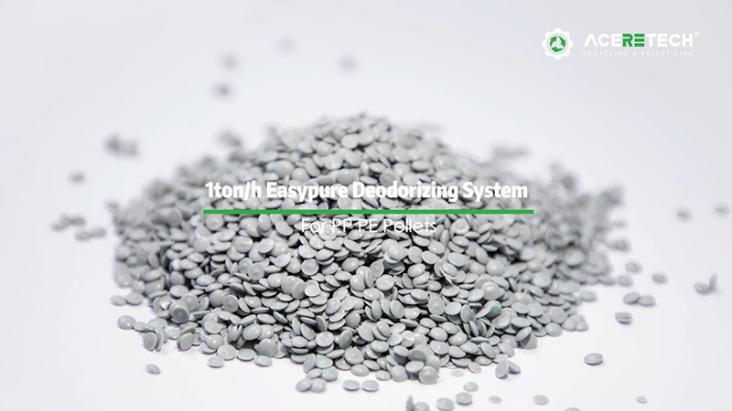
To address the above needs, ACERETECH has launched the 1-ton/hour Easypure Intelligent Odor Removal System. Through modular design and automated control, it achieves precise odor removal from PP/PE particles, providing a high-quality solution for the recycled plastics industry.
1. Core Configuration: Modular Design, Covering the Entire Process
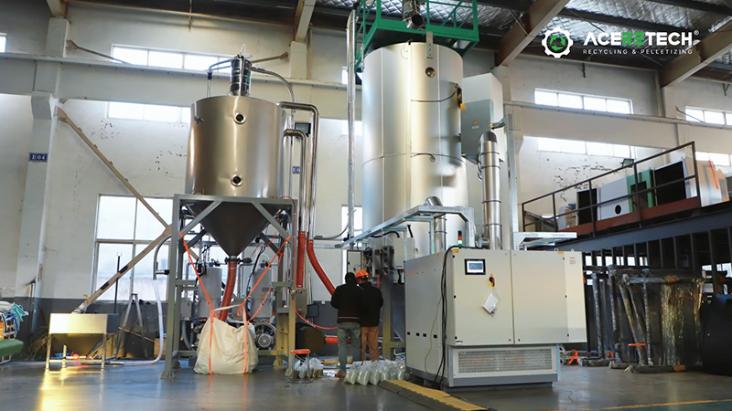
The system adopts a modular layout, integrating six core components to ensure a complete processing chain from feeding to discharging:
* Particle Buffer Bin
As a material pretreatment unit, the buffer bin temporarily stores PP/PE particles in large bags (the video shows workers using hoisting equipment to pour the ton bags of particles into the bin). The buffer design prevents feeding fluctuations, providing a stable material flow for subsequent processing.
* Deodorizing Hopper
The core processing unit of the system, made of stainless steel, with an internal heating and airflow circulation structure. Within the hopper, particles are subjected to high temperature and airflow, causing volatile odor molecules to detach, achieving initial odor removal.
* Material Receiver Equalization Kit (Forced Flip-Type)
Located at the top of the deodorizing hopper, it features a forced flip-type structure to ensure particles enter the hopper evenly, preventing uneven processing caused by localized accumulation and improving deodorization efficiency.
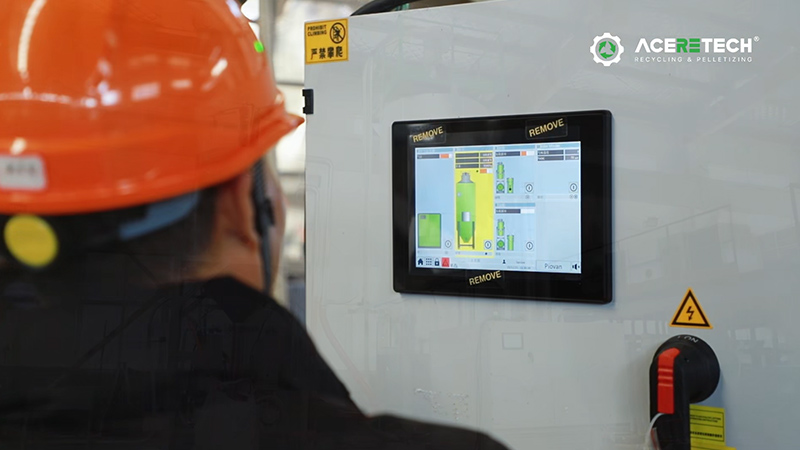
* Air Generator with PLC Control
Precisely controlling airflow and temperature via a PLC (Programmable Logic Controller) provides a stable airflow environment for the deodorization process. A video display allows operators to set parameters via a touchscreen, enabling automated control and reducing manual intervention costs.
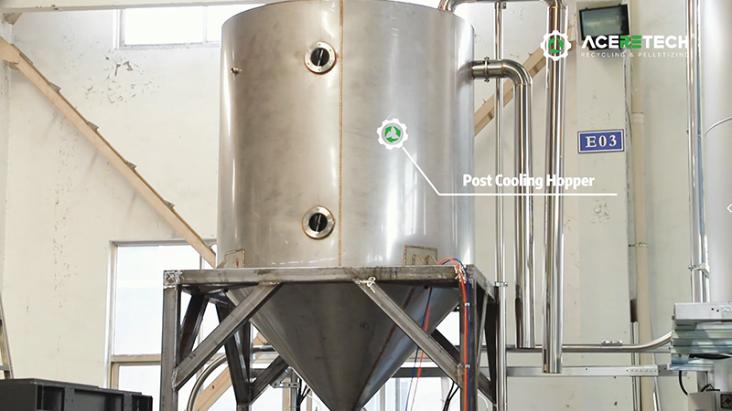
* Post-Cooling Hopper
Deodorized particles require rapid cooling to stabilize performance. The post-cooling hopper uses circulating airflow to lower particle temperature, preventing secondary contamination or performance degradation.
* Vacuum Unit
In conjunction with the deodorization process, the vacuum unit removes volatile gases from the hopper, accelerating the removal of odor molecules while preventing harmful gas leakage and ensuring a safe production environment.
2. Working Principle: Automated Process, High-Efficiency Odor Removal
The system operation process is clear:
Feeding: PP/PE particles enter the conveying pipeline through a buffer tank;
Deodorization: The particles are fed into the deodorization hopper, where odor molecules evaporate under high temperature and airflow and are removed by a vacuum device;
Cooling: The deodorized particles enter the cooling hopper, are rapidly cooled, and then output;
Control: The PLC system monitors parameters such as temperature and airflow in real time, automatically adjusting the equipment's operating status to ensure stable treatment results.
III. Technical Advantages: Precise Control, Strong Applicability
High Capacity: A processing capacity of 1 ton/hour meets the large-scale production needs of small and medium-sized recycled plastic enterprises;
Precise Control: The PLC system achieves automated parameter adjustment, reducing human error and improving deodorization consistency;
Modular Design: Each component operates independently yet works collaboratively, facilitating maintenance and upgrades;
Environmentally Friendly and Safe: The vacuum device and closed structure prevent odor diffusion, meeting industrial environmental protection requirements.
IV. Application Scenarios
This system is suitable for deodorizing PP and PE recycled particles, especially in odor-sensitive fields such as food packaging and daily necessities. It can effectively remove residual odors from recycled particles, increasing product added value.
ACERETECH's Easypure deodorization system, through technological integration and automated control, provides the plastic recycling industry with an efficient and reliable odor solution, helping companies achieve high-quality recycled particle production and driving the industry towards green and high-value development.