I. ACS+ATE Compacting, Compounding, and Pelletizing Machine
In plastic recycling and processing, a key challenge for pelletizing equipment is how to achieve stable plasticization, thorough compounding, efficient filtration, and high-quality pellet production while simultaneously increasing output.
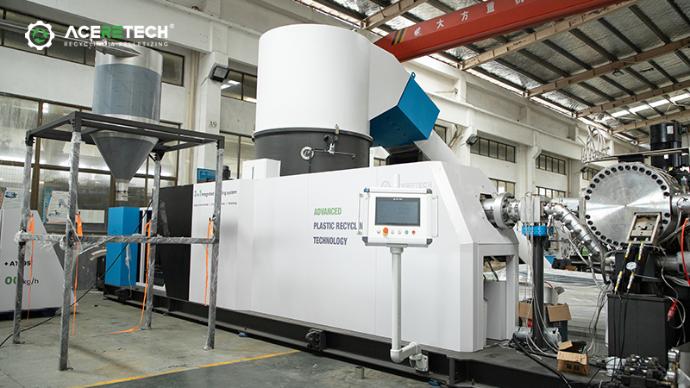
To meet demanding requirements regarding production efficiency, melt purity, and recycled pellet quality, ACERETECH has introduced the ACS+ATE compacting, compounding, and pelletizing machine. It utilizes an advanced two-stage process that logically separates the stages of compacting, plasticization, filtration, compounding, and pelletizing.
Designed for an output of 1,200–1,500 kg/h, the system employs an ACS single-screw compacting and extrusion system for the first stage and an ATE twin-screw compounding and extrusion system for the second stage. It integrates an SCF self-cleaning filter and a continuous piston-type filter to ensure continuous, efficient plastic recycling and pelletizing.
II. What is the ACS+ATE Two-Stage Compacting, Compounding, and Pelletizing Machine?
The ACS+ATE is a two-stage plastic recycling and pelletizing system designed specifically for recycled plastic processing.
Compared to traditional single-stage extrusion pelletizing processes, this system distributes different functions across two independent stages:
Stage 1: Compacting + Plasticization + Extrusion + Primary Filtration
Material undergoes pre-treatment in a compacting chamber before entering the single-screw extrusion system for plasticization and extrusion; impurities are removed from the melt via an SCF self-cleaning filter.
Stage 2: Compounding + Fine Filtration + Extrusion
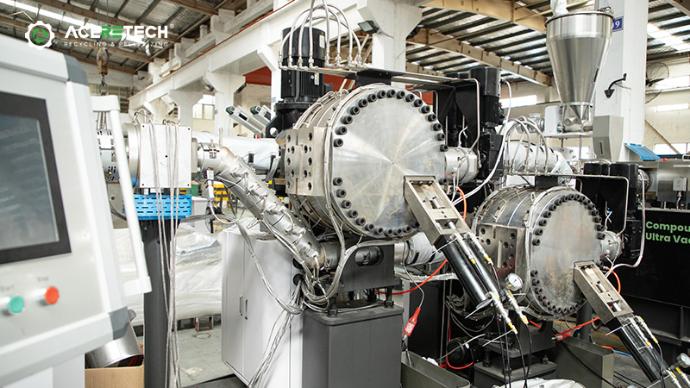
The melt from the first stage enters the twin-screw compounding system. Additives—such as masterbatch pellets—can be introduced via a dedicated feeder to achieve further mixing, dispersion, and homogenization, followed by secondary filtration through a continuous piston-type filter.
Finally, the melt enters a water-ring pelletizing system to form recycled plastic pellets. Therefore, the system's core process can be summarized as follows:
Feeding → Compacting → Single-screw plasticizing & extrusion → SCF filtration → Twin-screw compounding → Continuous filtration → Water-ring pelletizing → Vibratory screening
III. ACS+ATE Compacting, Compounding, and Pelletizing System: Technical Specifications
| ItemConfiguration | Configuration |
| System Output |
1,200–1,500 kg/h |
| Compacting Chamber | 3,800 L |
| Stage 1 | Compacting + Single-screw extrusion |
| Stage 1 Screw | Ø180 mm |
| Screw L/D Ratio | 28:1 |
| Stage 2 | Twin-screw compounding & extrusion |
| Twin-screw Diameter | Ø95 mm |
IV. ACS+ATE Pelletizer: Main Configuration and Working Principle
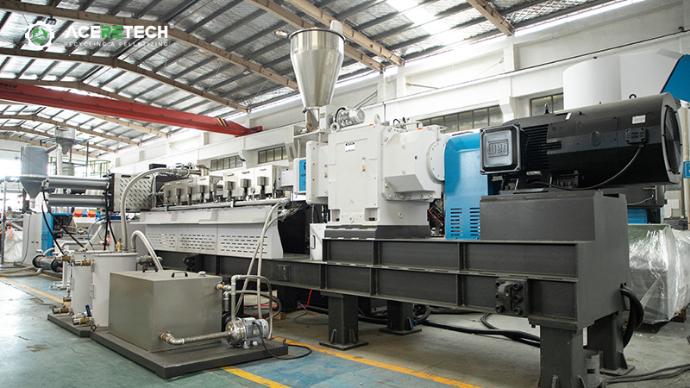
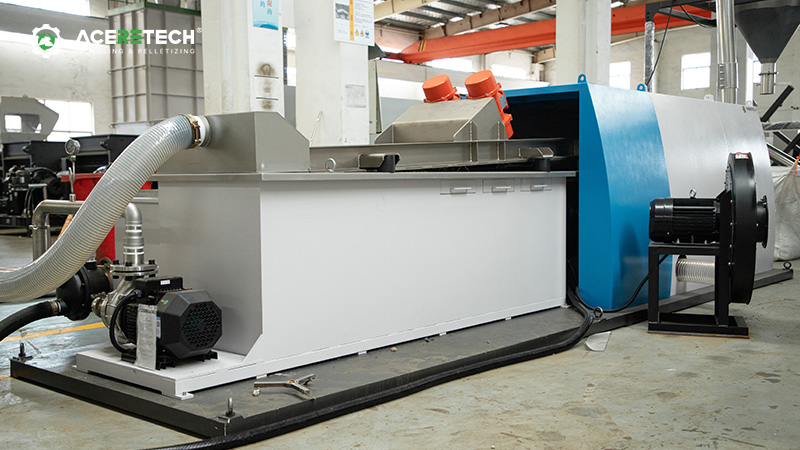
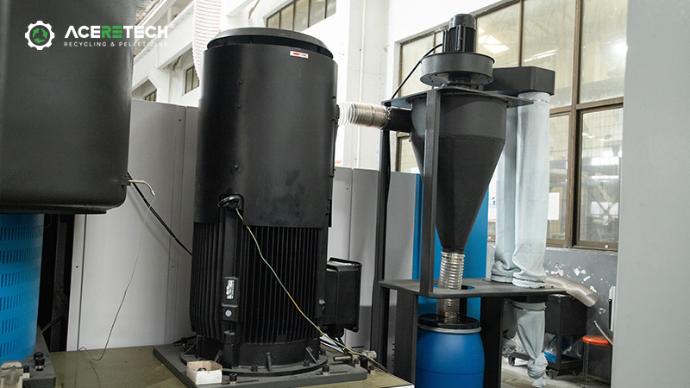
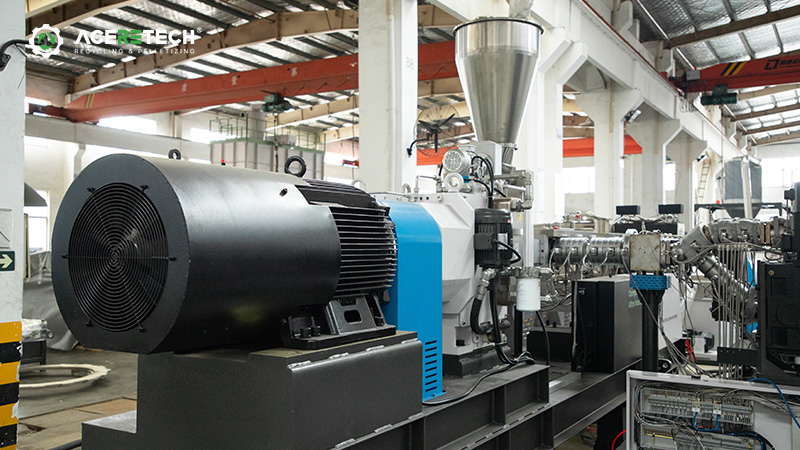
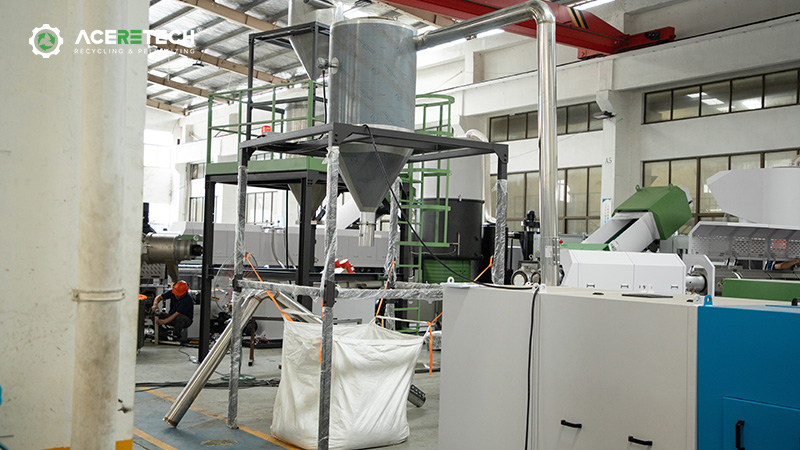
Stage 1: ACS Single-screw Extrusion
1. Belt Conveyor System with Metal Detection
Waste plastic first enters the compacting chamber via a belt conveyor.
The conveying system is equipped with a metal detector to screen incoming material for foreign metal objects, thereby minimizing the risk of metal impurities entering downstream equipment at the source.
This stable, automatic feeding method also ensures the continuous operation of the subsequent compacting and extrusion processes.
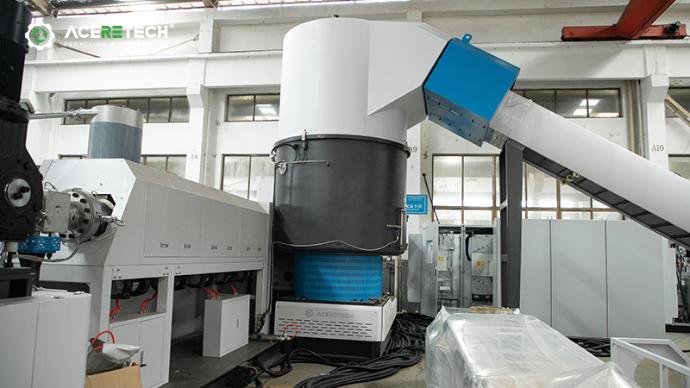
2. 3,800 L Compacting Chamber: Optimizing Material Feed Conditions
The first stage utilizes a 3,800 L compacting chamber equipped with:
Variable frequency control
Sliding gate
Dust removal system
Dehumidification function
For bulky materials such as films and lightweight plastics, direct feeding into an extruder can lead to issues like bridging, unstable feeding, and inefficient material transport.
The compacting system pre-compacts, pre-heats, and continuously conveys the material, enhancing feed stability into the extruder while improving the processing environment through integrated dust removal and dehumidification systems.
3. Ø180 mm Single-screw Extruder: Stage 1 Plasticization
After undergoing the compacting process, the material enters the first-stage single-screw extruder.
Key Specifications:
Screw Diameter: 180 mm
Screw L/D Ratio: 28:1
This stage is primarily responsible for material conveying, compression, melting/plasticization, and extrusion.
Separating the compaction and initial plasticization stages ensures a more stable material feed into the extruder, creating optimal conditions for the subsequent melt filtration and twin-screw compounding processes.
4. SCF Self-Cleaning Filter: Minimizing Downtime for Screen Changes
Melt filtration is a critical step in the plastic recycling and pelletizing process.
Recycled plastics often contain contaminants such as paper scraps, wood chips, aluminum fragments, and other unmelted impurities. If these impurities enter the downstream extrusion and pelletizing systems, they can compromise pellet quality and increase equipment maintenance demands.
The ACS+ATE system incorporates an SCF self-cleaning filter in the first stage.
Unlike traditional filtration methods that require frequent screen disassembly and replacement, the SCF self-cleaning system performs continuous filtration and impurity discharge during production, thereby reducing downtime associated with screen changes.
Under appropriate material and operating conditions, the filtration element has a service life of approximately 1–2 months; the actual lifespan varies based on the level of material contamination, impurity types, filtration precision, and production load.
Thus, the primary value of the SCF self-cleaning filter lies in:
Continuous filtration + Reduced manual screen changes + Lower maintenance downtime + Enhanced production continuity
Second Stage: ATE Twin-Screw Compounding and Extrusion System
The melt, having undergone plasticization and filtration in the first stage, enters the ATE compounding system in the second stage. This system features:
1. Ø95 mm Twin-Screw Extruder
The second stage does not merely repeat the plasticization process of the first stage; instead, it focuses on compounding, dispersion, and homogenization.
Additionally, the system is equipped with a specialized feeder, allowing for the incorporation of additives—such as color masterbatch pellets—based on production requirements.
The twin-screw extruder offers superior mixing and dispersion capabilities, facilitating thorough blending of various components and ensuring greater uniformity in the color and composition of the recycled material.
Consequently, the ACS+ATE two-stage configuration is particularly well-suited for recycled plastic pelletizing applications that require enhanced material uniformity.
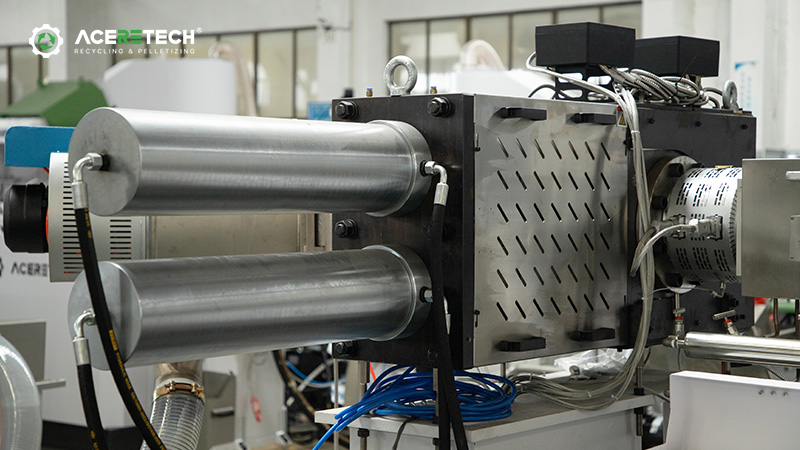
2. Non-stop Piston Type Filter: Further enhancing melt cleanliness
A non-stop piston type filter is installed in the second stage of the system.
This filtration system enables continuous melt filtration during production, minimizing the downtime typically associated with screen changes in conventional filtration equipment.
Combining the first-stage SCF self-cleaning filter with the second-stage non-stop piston type filter creates a two-stage melt filtration process.
This design further reduces impurity levels in the melt, ensuring high-quality recycled plastic pellets.
Water-ring pelletizing system: Stable production of recycled plastic pellets
After undergoing two stages of plasticization, filtration, and compounding, the melt enters the water-ring pelletizing system.
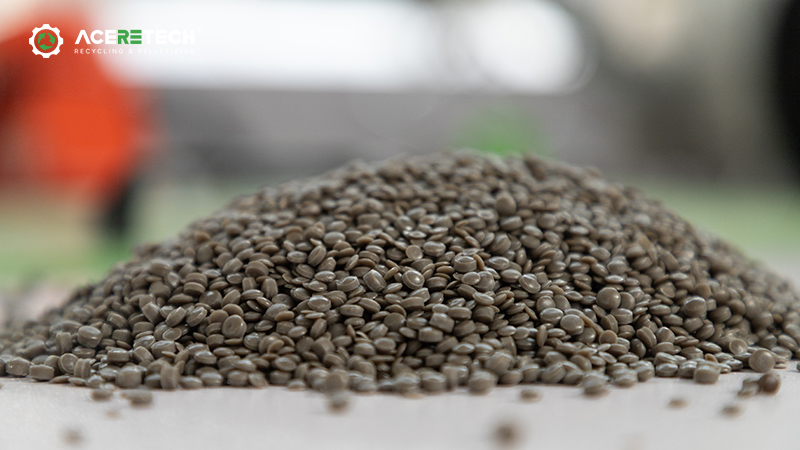
Characterized by high automation and stable continuous production, the water-ring pelletizing method cuts the extruded melt into uniform recycled plastic pellets.
The pellets then pass through a vibrating screen to remove any that do not meet specifications, preventing them from entering the final product.
The complete downstream process flow is:
Melt → Water-ring pelletizing → Vibrating screening → Dewatering → Recycled plastic pellets
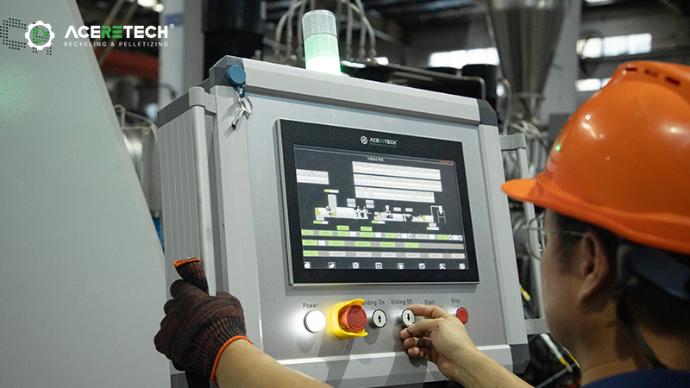
Intelligent control system and branded electrical components
The ACS+ATE pelletizing system utilizes an intelligent control system to centrally manage processes such as feeding, compacting, extruding, filtering, compounding, and pelletizing.
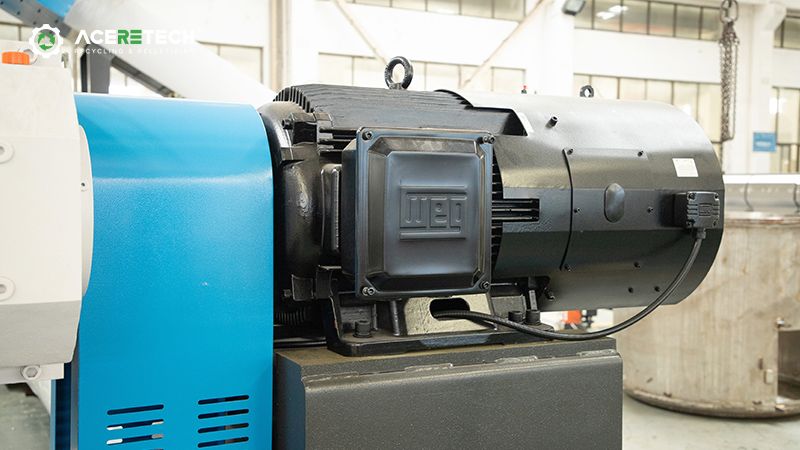
It is equipped with branded electrical components to enhance control stability and operational convenience.
Centralized control facilitates the monitoring of production parameters and equipment management, helping to raise the automation level of the entire line.
V. Core advantages of the ACS+ATE two-stage plastic pelletizing machine
Compared to single-stage extrusion pelletizing, the core advantage of the ACS+ATE two-stage design lies in the clear division of functions.
1. Two-stage process
The first stage focuses on:
Compacting + Plasticization + Extrusion + Primary filtration
The second stage focuses on:
Compounding + Dispersion + Fine filtration + Extrusion
This allows different processing tasks to be carried out under the most suitable equipment and process conditions.
2. Dual melt filtration
Configuration:
SCF self-cleaning filter + Non-stop piston type filter
Two-stage filtration further enhances melt cleanliness.
3. High-Output Design
The designed output for the entire line reaches:
1,200–1,500 kg/h
Actual output is influenced by factors such as material type, moisture content, impurity levels, bulk density, and final product specifications.
4. Thorough Compounding
The ATE twin-screw extruder enables further compounding and dispersion of the recycled melt and supports the addition of components such as masterbatch pellets.
5. Continuous Production
Self-cleaning and continuous piston filtration systems reduce the need for frequent shutdowns to change screens, thereby enhancing production continuity.
VI. Why Choose a Two-Stage Plastic Recycling and Pelletizing Process?
For plastic recycling applications requiring material compaction, melting/plasticization, impurity filtration, and compounding/modification, a single-stage extrusion system may struggle to meet all process requirements simultaneously.
A two-stage pelletizing system allows for a division of labor between the machines based on specific processing tasks:
The first stage addresses stable material plasticization and filtration;
The second stage handles further melt compounding, dispersion, and purification.
Therefore, the ACS+ATE system is not merely a piece of extrusion and pelletizing equipment; it is a comprehensive two-stage recycling solution designed for high-output recycled plastic production.
FAQ
Q1. Why does the ACS+ATE system utilize both single-screw and twin-screw extruders?
A: Each extruder performs a specific function: the first-stage single-screw extruder is primarily responsible for material conveying, melting, and plasticization, while the second-stage twin-screw extruder handles further mixing, dispersion, and homogenization.
Q2. Can masterbatch be added to the ACS+ATE system?
A: Yes. The system's second stage is equipped with a dedicated masterbatch feeder, allowing for the addition of coloring agents during the twin-screw mixing process.
Q3. What are the advantages of the water-ring pelletizing system?
A: The water-ring pelletizing system continuously cuts the extruded melt into recycled plastic pellets, making it ideal for automated, high-output plastic recycling applications.
Q4. How does the two-stage process improve the quality of recycled pellets?
A: The first stage achieves stable compaction, melting, and primary filtration, while the second stage performs further mixing and filtration. This process helps improve melt cleanliness, material uniformity, and the quality stability of the final recycled pellets.
Q5. What are the advantages of the ACS+ATE pelletizer’s 3,800-liter compaction chamber?
A: The 3,800-liter compaction chamber provides ample buffering and pre-compaction capacity for lightweight or low-bulk-density plastic materials. By compacting the material before it enters the 180mm-diameter single-screw extruder, the system improves feed stability and material conveying efficiency. Additionally, the chamber integrates variable frequency control, a slide gate, and dust and moisture removal functions; these features optimize the feeding and pre-treatment processes, thereby ensuring the stability of extrusion and pelletizing operations.