Abstract
Due to their exceptional corrosion resistance, pressure resistance, and longevity, PE pipes are widely utilized in water supply and drainage systems, gas transmission, agricultural irrigation, and industrial piping applications. With the generation of substantial quantities of PE pipe offcuts, discarded pipes, and production waste, achieving efficient size reduction and stable material recovery has emerged as a critical challenge within the plastics recycling industry.
To address the difficulties associated with processing large-diameter, thick-walled PE pipes, ACERETECH has developed a specialized "Shredding + Crushing" integrated solution. By employing a sequential process of initial shredding followed by crushing, this system achieves highly efficient size reduction and uniform output, thereby providing a reliable foundation for subsequent washing, pelletizing, and material regeneration processes.
I. Key Challenges in PE Pipe Recycling
PE pipes—particularly thick-walled HDPE pipes—typically present the following challenges during the recycling process:
* High Material Toughness: The material is highly resilient and difficult to crush directly in a single step.
* Large Diameter: The substantial diameter of the pipes covers significant storage space.
* Thick Walls: The thick pipe wall thickness require high torque demands on processing equipment.
* Difficult Feeding: Feeding long-length pipes into the machinery can be a challenging.
* Risk of Overload: Direct crushing often results in excessive load on the processing equipment.
Consequently, relying only a single crushing machine often fails to achieve optimal recycling results.
To solve this issue, ACERETECH recommends MS Shredder + GF Crusher combination system. Through this two-stage size reduction process, the system significantly enhances both operational stability and production efficiency.
II. Customer Case Study: PE Pipe Shredding & Crushing System
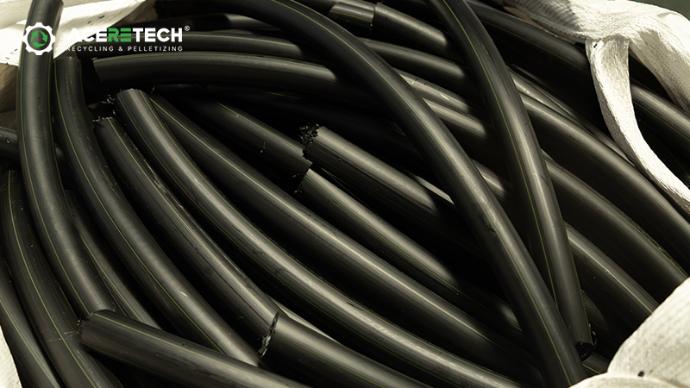
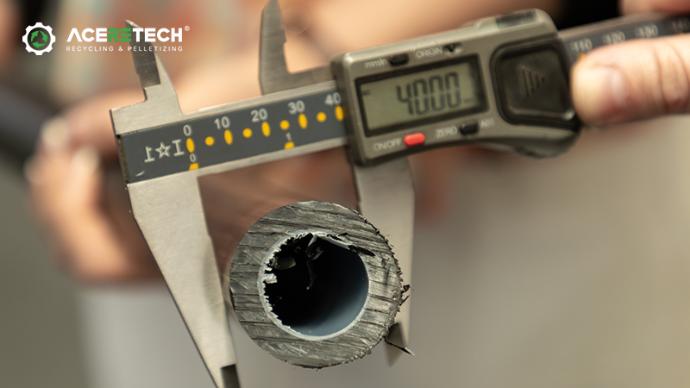
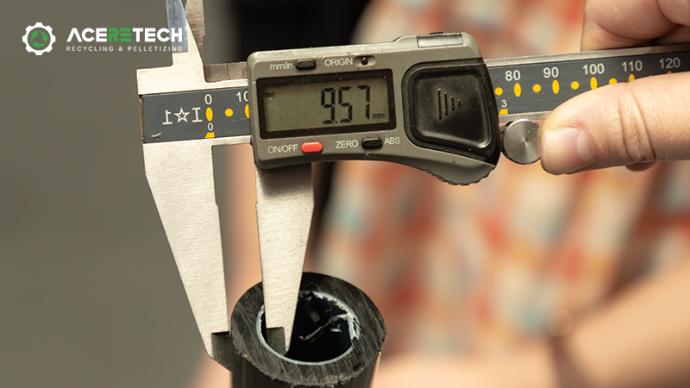
Raw Material Information
Raw Material: PE Pipes
Pipe Diameter: 40 mm
Wall Thickness: 9.57 mm
This type of pipe material is classified as a typical thick-walled rigid plastic; it has high tensile strength and toughness, making it ideally suited for a customized processing workflow involving shredding and crushing system.
III. Customized Processing Workflow
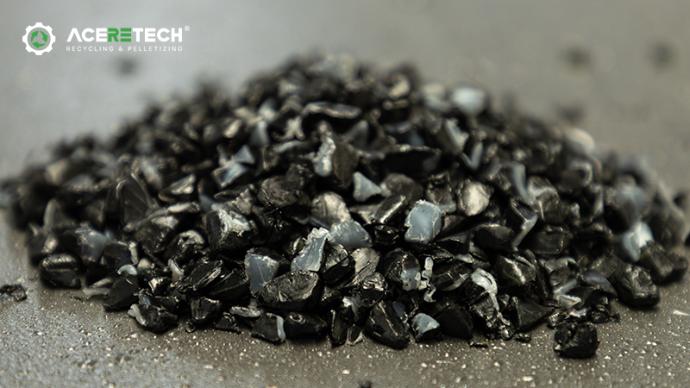
PE Pipe → Shredding → Crushing → Uniform Flakes
This workflow achieves the following objectives:
* Efficient size reduction for large-sized materials
* Reduced load capacity on the crusher unit
* Improved operational stability of the entire processing line
* Production of plastic flakes with uniform dimensions
* Improved efficiency in subsequent washing and pelletizing stage
This represents one of the most stable and mature solutions currently available for the recycling of PE pipes.
IV. Core Equipment
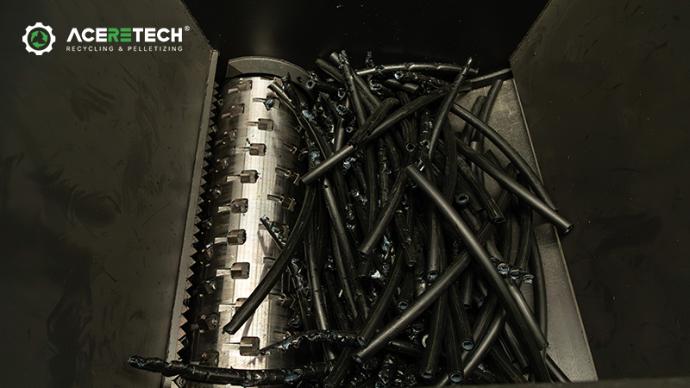
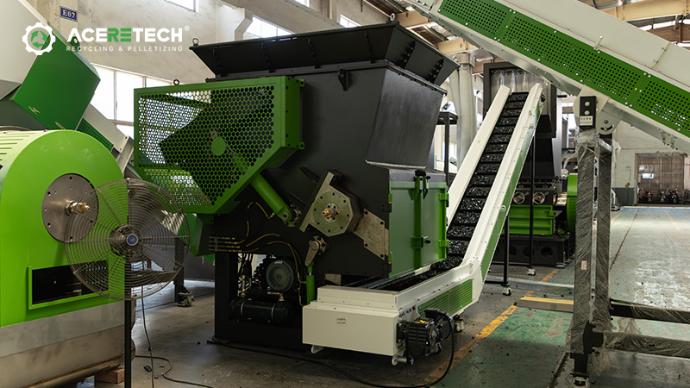

Equipment Specifications
Model: MS Shredder
Rotor width: 1500mm
Configuration Highlights
Belt conveyor system for stable and continuous feeding
Top brand motor ensuring long-term, stable operation
Anti-splash hopper design to enhance safety
High torque and low speed, suitable for heavy-duty rigid plastics
Powerful shearing structure enable easily processing thick-walled pipes
The MS Shredder is primarily responsible for the preliminary size reduction for large-diameter PE pipes, shredding long and bulky materials into sizes suitable for subsequent processing by a crusher.
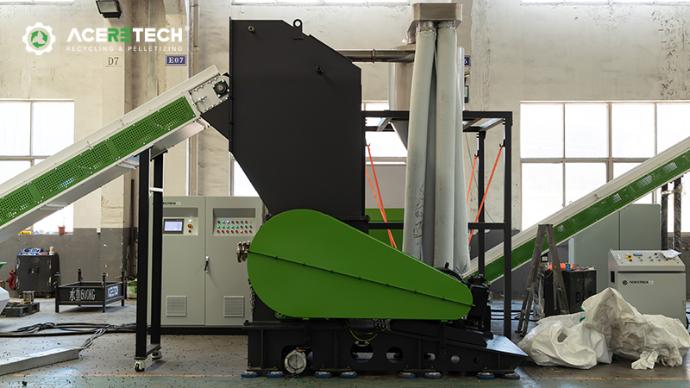
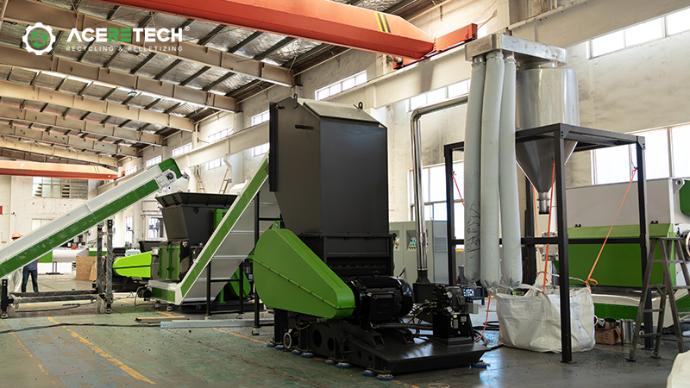
Equipment Parameters
Model: GF Crusher
Rotor Length: 1000mm
Rotor Diameter: 700mm
Configuration Highlights
Branded motor for stable and reliable operation
High-strength gearbox with robust load-bearing capacity
Pneumatic feeding bin system to enhance automation
High-efficiency cutting structure ensuring uniform and stable discharge
Effectively improves the quality of subsequent granulation
The GF Crusher is responsible for the secondary refinement of the shredded materials, reducing them to a more ideal flake size.
V. Applicable Materials
This system is widely applicable to:
PE pipe recycling
HDPE pipe recycling
Rigid PVC pipes
Thick-walled PP products
Large plastic blocks
Injection molding lump waste
Extrusion scrap recycling
It is particularly well-suited for the size reduction of high-strength, high-toughness, and large-sized plastic waste.
VI. Why Recommend the "Shredding-then-Crushing" Approach?
Compared to direct crushing, the combined "shredding + crushing" system offers significant advantages:
Higher Stability
Reduces instantaneous impact loads on the crusher, thereby minimizing equipment wear and tear.
Higher Processing Efficiency
Rigid plastic preliminary size reduction before crusher, which significantly improving overall efficiency.
Lower Maintenance Costs
Reduces blade wear and extends the overall service life of the equipment.
Superior Output Quality
Produces more uniform flake sizes, facilitating subsequent washing and pelletizing processes.
Wider Adaptability
Suitable for the recycling of a wide variety of rigid plastics and complex waste materials.
This is the core reason why an increasing number of plastic recycling enterprises are choosing dual-stage size reduction systems.
VII. ACERETECH Comprehensive Plastic Recycling Solutions
ACERETECH specializes in the manufacturing of plastic recycling equipment, offering a complete suite of solutions:
Plastic Closed-Loop Recycling Systems, including:
Plastic shredding, crushing, washing, pelletizing, intelligent conveying, and automatic control system.
Empowering customers to achieve:
Higher recycling efficiency
More stable production operations
Reduce labor costs
Enhanced value of recycled materials
Truly realizing a closed-loop production cycle for plastic recycling.
If you are seeking professional plastic recycling equipment, we invite you to contact ACERETECH; we will provide you with a customized solution best suited to your specific needs.
Contact us today to receive your personalized recycling solution.
Related Articles
FAQ
Q1. Why is it necessary to shred PE pipes before crushing them?
A: Because PE pipes—especially thick-walled ones—possess high toughness and large dimensions, attempting to crush them directly can easily lead to excessive equipment overload. By first using a shredder for preliminary volume reduction, followed by fine processing in a crusher, the overall stability and production efficiency of the entire line can be significantly enhanced.
Q2. Which plastic materials are suitable for processing by the MS Shredder?
A: The MS Shredder is suitable for processing PE pipes, HDPE pipes, rigid PVC plastics, thick-walled PP products, large plastic blocks, machine head scraps (purge), and various types of high-strength industrial plastic waste.
Q3. What is the role of the GF Crusher in the complete recycling line?
A: The GF Crusher is primarily responsible for the secondary fine-processing of materials that have already been shredded. It reduces the material to a uniform flake size, facilitating subsequent washing, dewatering, and pelletizing processes, thereby improving the quality of the recycled pellets.
Q4. What are the advantages of a combined shredder-and-crusher system compared to a standalone machine?
A: A two-stage system offers higher processing capacity, more stable operation, reduced blade wear, a more uniform output consistency, and lower maintenance costs. It is particularly well-suited for heavy-duty recycling projects involving rigid plastics.
Q5. Can ACERETECH provide a complete plastic recycling production line?
A: Yes. ACERETECH provides a complete closed-loop plastic recycling system—covering everything from shredding, crushing, and washing to dewatering and pelletizing—and offers customized design services tailored to the client's specific raw materials and production capacity requirements.