I. Efficient Recycling and Pelletizing of PP Sheet Waste
PP sheets are widely used in packaging, industrial products, turnover boxes, pallets, and other applications.
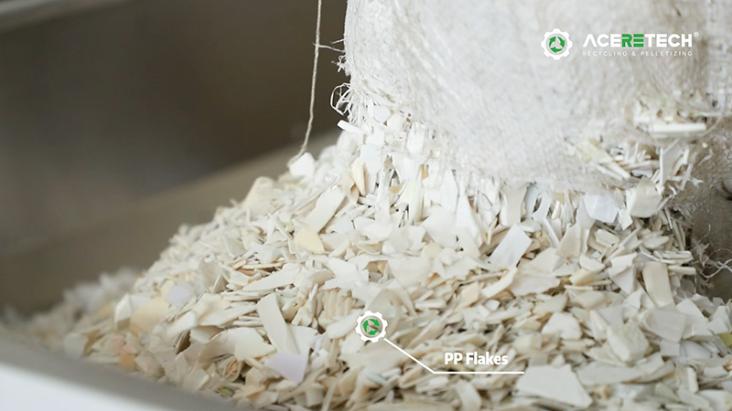
During production and processing, a certain amount of PP sheet scrap is generated. Depending on the source, this material may include production offcuts, rejected sheets, post-industrial scrap, and other rigid PP waste.
Compared with conventional compact plastic scrap, PP sheets can present several challenges during pelletizing because of their relatively large dimensions, low bulk density, and high material volume.
In addition, recycled PP may contain moisture, air, printing residues, and other impurities that can affect the quality of the finished pellets.
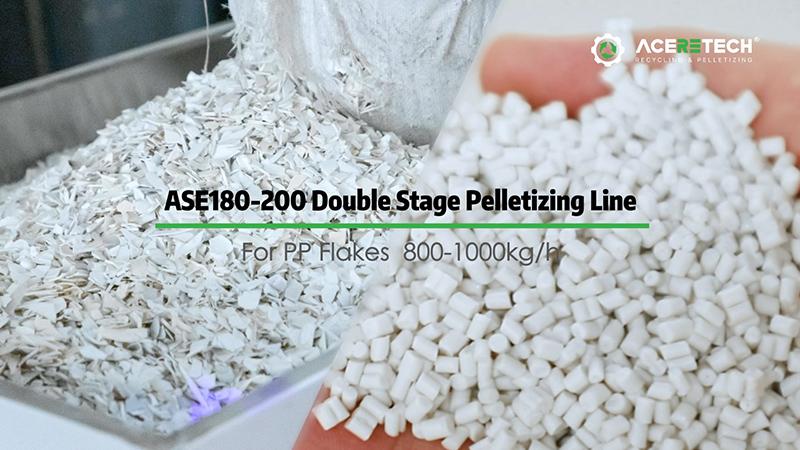
For this type of application, ACERETECH uses the ADS Two-Stage Pelletizing System to process PP sheet waste into recycled PP pellets.
The system combines two-stage plasticizing, vacuum degassing, melt filtration, and automated process control to provide stable pelletizing performance.
II. Application Background
PP sheet waste is generated in different manufacturing processes.
Typical sources include:
• PP sheet production offcuts
• Rejected PP sheets
• Thermoforming scrap
• Industrial PP sheet waste
• Rigid PP production scrap
• Recycled PP sheet materials
The material may enter the recycling process in relatively large and lightweight pieces.
Before extrusion, the material needs to be prepared for stable feeding.
During extrusion, additional challenges may arise from:
• Entrained air
• Moisture
• Printing residues
• Foreign particles
• Thermal and shear history
Therefore, the pelletizing system needs to provide not only melting capacity but also effective homogenization, degassing, and filtration.
III. Main Challenges in PP Sheet Recycling
Large and Lightweight Feedstock
PP sheet waste can occupy a relatively large volume compared with its actual weight.
This can make stable feeding into the extrusion system more difficult.
A suitable feeding system is therefore important for maintaining continuous material flow.
Air and Volatile Removal
PP sheet waste may contain air between pieces or residual gases and volatiles from previous processing.
If these substances are not adequately removed, they may affect melt quality and contribute to bubbles in the final pellets or downstream products.
Impurities
Depending on the source, PP sheet waste may contain:
• Dust
• Paper
• Foreign plastic particles
• Metal contamination
• Other solid impurities
Effective melt filtration is therefore important for recycled PP pelletizing.
Thermal History
Repeated processing can expose polypropylene to additional thermal and shear stress.
Controlling the extrusion conditions is therefore important when the objective is to maintain the quality of recycled PP.
For PP sheet recycling, ACERETECH uses the ADS Two-Stage Pelletizer.
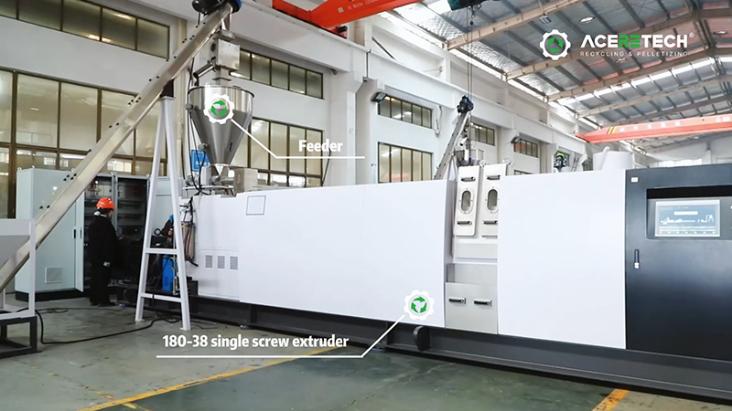
The system uses a long first-stage screw together with a shorter second-stage screw.
The basic process is:
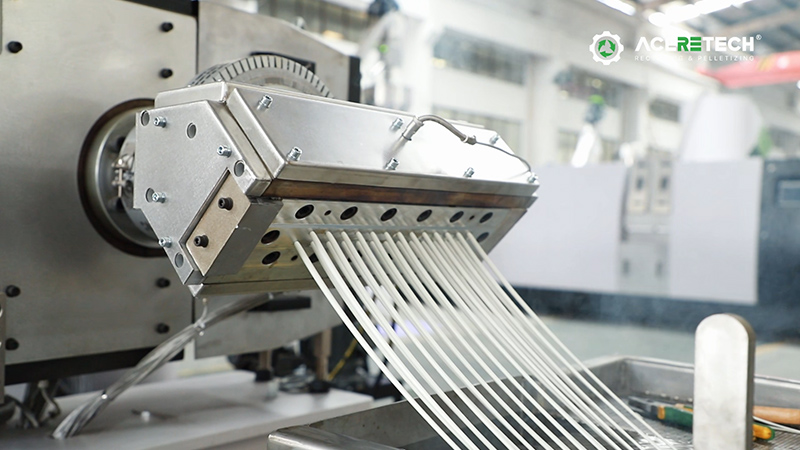
PP Sheet Waste → Feeding → First-Stage Melting & Plasticizing → Vacuum Degassing → Melt Filtration → Second-Stage Homogenization → Pelletizing → Recycled PP Pellets
The two-stage configuration separates the main plasticizing process from the final homogenization and extrusion stage.
This allows the material to be processed under different conditions at different stages of the extrusion process.
1. First Stage: Melting and Plasticizing
The first extrusion stage is responsible for the main melting and plasticizing process.
The first-stage screw has an L/D ratio of 38, providing sufficient screw length for:
• Material conveying
• Melting
• Plasticizing
• Mixing
• Homogenization
• Vacuum degassing
The relatively long plasticizing section allows the PP material to be gradually converted from solid feedstock into a homogeneous polymer melt.
This is particularly important when processing PP sheet waste with different particle sizes and physical conditions.
2. Vacuum Degassing
Vacuum degassing is integrated into the first extrusion stage.
During processing, moisture, trapped air, and volatile substances can be released from the material.
The vacuum system removes these gases from the polymer melt.
This helps reduce the risk of:
• Bubbles
• Voids
• Unstable extrusion
• Gas-related pellet defects
The effectiveness of degassing depends on the actual feedstock condition and operating parameters.
For PP sheet recycling, vacuum degassing provides an additional process step for improving melt quality before the final extrusion stage.
3. Melt Filtration
After plasticization and degassing, the polymer melt passes through the filtration system.
The purpose of filtration is to remove solid contaminants from the melt before pelletizing.
The ADS system uses hydraulic screen-changing technology to support continuous melt filtration.
This is important when processing recycled PP because the feedstock may contain foreign particles that should not enter the final recycled pellets.
The appropriate filtration level should be selected according to:
• Feedstock cleanliness
• Contamination type
• Final pellet requirements
• Downstream application
4. Second Stage: Low-Shear Homogenization
After the first-stage plasticizing and filtration process, the polymer melt enters the second extrusion stage.
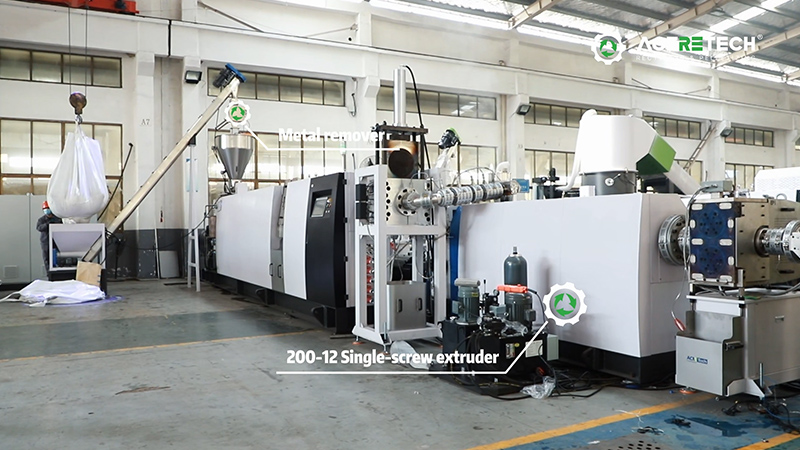
The second-stage screw has an L/D ratio of 12.
Compared with the first stage, the second stage is shorter and is mainly responsible for:
• Melt homogenization
• Pressure stabilization
• Final extrusion
The two-stage arrangement allows the first stage to focus on efficient melting and degassing, while the second stage provides controlled final extrusion.
This separation helps manage the thermal and mechanical load applied to the recycled PP melt.
5. Two-Stage Processing Logic
The main technical logic of the ADS system can be summarized as:
First Stage
Melting + Plasticizing + Mixing + Vacuum Degassing → Filtration
Removal of Solid Impurities → Second Stage
Homogenization + Pressure Stabilization + Final Extrusion → Pelletizing
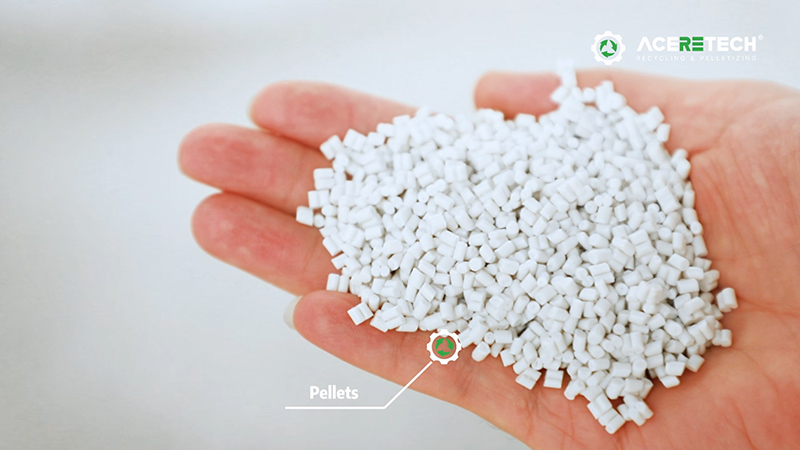
Recycled PP Pellets
The purpose of the two-stage configuration is not simply to add another extruder.
It is to separate different processing functions and provide more controlled conditions for recycled PP.
6. Automated Feeding and Process Control
The ADS pelletizing system integrates PLC-based control.
The feeding system can automatically adjust the material feeding frequency according to the operating condition of the main extruder.
This helps maintain a more stable relationship between:
Material Feeding → Extrusion Load → Pelletizing Output
The control system also monitors key process parameters such as:
• Melt temperature
• Melt pressure
• Main motor condition
• Equipment operating status
The operator can monitor these parameters through the PLC touchscreen interface.
7. Pellet Cooling and Drying
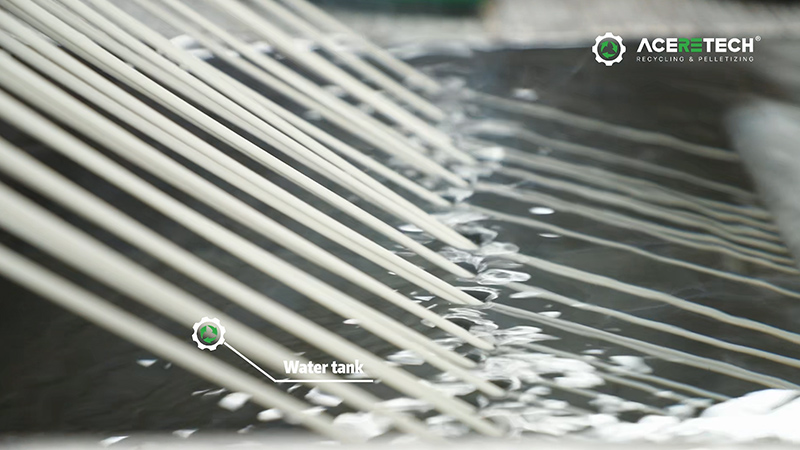
After pelletizing, the recycled PP pellets need to be cooled and separated from the process water or moisture associated with the pelletizing process.
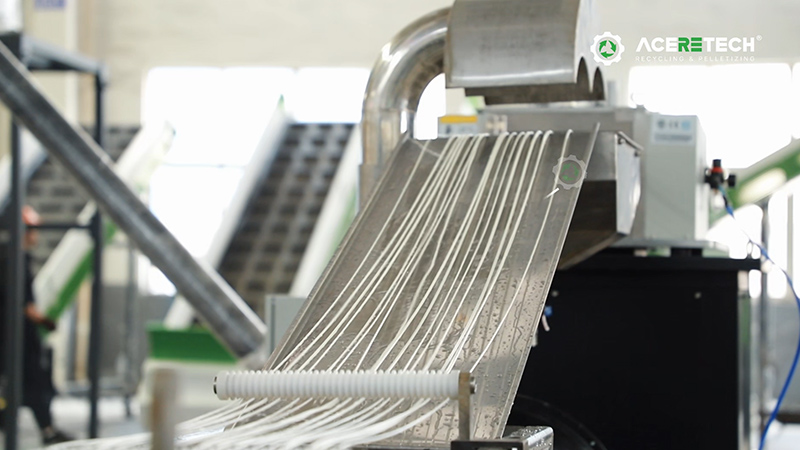
The system incorporates vibration-based dehydration and drying.
This helps reduce residual surface moisture before the recycled pellets are collected.
The final moisture condition depends on the operating conditions and material characteristics.
The purpose of this stage is to provide pellets that are suitable for subsequent storage and downstream processing.
V. Application Performance
According to the data presented for this PP sheet application, the ADS system achieves a stable output of approximately:
800–1000 kg/h
The system configuration includes:
| Parameter |
Application Configuration |
| Material |
PP Sheet |
| Pelletizing System | ADS Two-Stage Pelletizer |
| First Stage L/D | 38 |
| Second Stage L/D | 12 |
| Output | 800–1000 kg/h |
| Degassing | Vacuum Degassing |
| Filtration | Hydraulic Screen Changer |
| Control | PLC Automatic Control |
These figures describe the application presented on the current page.
VI. Why a Two-Stage Pelletizer Is Used for PP Sheet Recycling
A single-stage extrusion system can perform melting and extrusion, but recycled PP applications may require additional control of:
• Degassing
• Melt homogenization
• Filtration
• Thermal history
• Final extrusion pressure
The ADS two-stage configuration separates the processing functions.
The first stage provides the main melting and degassing process.
The second stage performs final homogenization and extrusion under controlled conditions.
This configuration is therefore particularly suitable for applications where both throughput and recycled pellet quality are important.
VII. Application Value
The main value of the ADS system in this application is its ability to combine several important recycling functions into one continuous pelletizing process.
The application addresses:
1. Stable Processing
Automated feeding and PLC control help maintain stable extrusion conditions.
2. Effective Degassing
Vacuum degassing helps remove trapped air, moisture, and volatile substances released during processing.
3. Melt Filtration
Hydraulic screen changing provides continuous filtration of the recycled polymer melt.
4. Controlled Two-Stage Extrusion
The first and second stages perform different processing functions.
5. Recycled PP Pellet Production
The final result is recycled PP pellets that can be transferred to subsequent plastic processing applications according to their material quality and end-use requirements.
VIII. Typical PP Sheet Recycling Process
The application can be summarized as:
PP Sheet Waste → Material Feeding → First-Stage Extrusion → Melting & Plasticizing → Vacuum Degassing → Melt Filtration → Second-Stage Homogenization → Pelletizing → Cooling & Dehydration → Recycled PP Pellets
The exact upstream size-reduction and feeding equipment can be selected according to the incoming PP sheet dimensions and material condition.
IX. Application Summary
This application demonstrates the use of the ACERETECH ADS Two-Stage Pelletizing System for PP sheet recycling.
The main challenges of PP sheet recycling include:
• Large and lightweight feedstock
• Air and volatile substances
• Solid impurities
• Thermal and shear history
• The need for stable pelletizing
The ADS system addresses these requirements through:
First-Stage Melting & Plasticizing
• Vacuum Degassing
• Melt Filtration
• Second-Stage Homogenization
• Automated Process Control
• Pelletizing & Dehydration
For the application presented, the system achieves a stable output of approximately 800–1000 kg/h.
The overall process can be summarized as:
PP Sheet Waste → Two-Stage Extrusion → Degassing → Filtration → Pelletizing → Recycled PP Pellets
Looking for a PP Sheet Recycling Pelletizing Solution?
PP sheet waste can be challenging to recycle because of its large volume, low bulk density, potential contamination, and the need to control the quality of the recycled polymer.
The ACERETECH ADS Two-Stage Pelletizing System combines:
Melting & Plasticizing → Vacuum Degassing → Melt Filtration → Two-Stage Homogenization → Pelletizing
For the application presented, the system achieves approximately 800–1000 kg/h output.
Contact ACERETECH to discuss your PP sheet recycling and pelletizing requirements.
PP Sheet Recycling Pelletizing Machine Line FAQ
Q1: What is the purpose of the first-stage L/D 38 screw?
A: The long first-stage screw provides sufficient processing length for conveying, melting, plasticizing, mixing, homogenization, and vacuum degassing.
Q2: What is the purpose of the second-stage L/D 12 screw?
A: The second-stage screw is mainly used for final melt homogenization, pressure stabilization, and extrusion before pelletizing.
Q3: How are impurities removed?
A: The system uses hydraulic screen-changing technology to filter solid impurities from the polymer melt before final pelletizing.
Q4: Can PP sheet pellets be used directly for injection molding?
A: Recycled PP pellets may be suitable for injection molding or other downstream applications depending on their final material properties, contamination level, moisture, and the requirements of the specific product.
The recycling process itself does not automatically guarantee suitability for a particular end-use application.
Q5: What happens to the PP material after pelletizing?
A: After pelletizing and dehydration, the recycled PP pellets can be collected and transferred to subsequent processing according to the customer's requirements.