I. Project Overview
This project utilizes an advanced LSP online IV reinforcement system to create a 1000 kg/h PET fiber and fabric waste recycling system. This system aims to improve the intrinsic viscosity of the fibers, ensuring the stability of spinning performance.
🔹 Raw Materials: PET fiber waste, PET fabric scraps, polyester yarn waste
🔹
Input Intrinsic Viscosity: 0.63–0.64
🔹
Output Intrinsic Viscosity: 0.65–0.68
🔹
Capacity: 1000 kg/h
The customer has long been engaged in the production and recycling of polyester (PET) fibers. As market demands for recycled plastic quality increase, the focus has shifted from simple recycling efficiency to:
🔹
Stable intrinsic viscosity (IV)
🔹
High particle transparency and appearance quality
🔹
Excellent downstream spinning performance
🔹
Stable melt filtration and degassing performance
II. ACERETECH's Turnkey Recycling Solution for PET Fiber
ACERETECH offers a complete turnkey solution for PET fiber and textile waste recycling.
System Configuration:
→ Belt Conveyor
→ DTS Disc Crusher
→ Buffer Silo
→ ACS Compactor Single Screw Extruder
→ LSP System
→ Automated Strip Granulation System
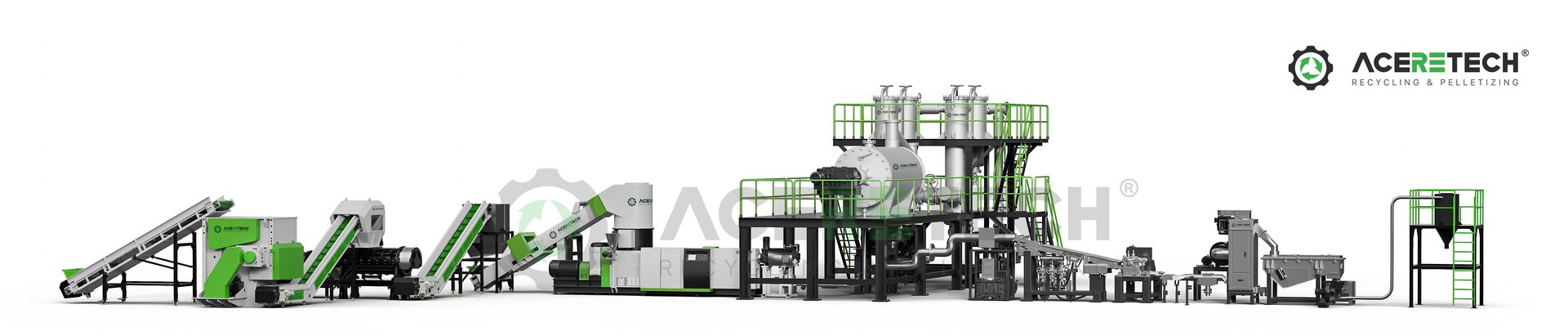
This integrated system is designed specifically for soft, flexible PET fibers and fabric materials, ensuring stable feed, efficient melting, and high-quality pellet output.
III. Why the LSP System is Crucial for PET Fiber Recycling
During PET recycling, intrinsic viscosity (IV) typically decreases due to thermal degradation and moisture absorption.
LSP Online Viscosity Index (IV) Enhancement System:
🔹
Increases IV value from 0.63-0.64 to 0.65-0.68
🔹
Enhances molecular chain reconstruction
🔹
Improves melt strength
🔹
Ensures better spinning and fiber production performance
🔹
Stabilizes final pellet quality for high-end applications
This makes recycled PET suitable not only for downgraded products but also for fiber and textile applications.
IV. Key Advantages of this PET Recycling Project
1. Optimized Crushing for Flexible Materials
The DTS disc crusher ensures uniform reduction in the size of long fiber and fabric scraps, avoiding material entanglement issues.
2. Stable Compaction and Extrusion
The ACS compacting extruder increases bulk density, ensuring a continuous and stable feed of lightweight fiber materials.
3. Online Viscosity Index (IV) Enhancement
The LSP system enables controlled viscosity enhancement, making recycled pellets suitable for direct spinning applications.
4. High Output and High Energy Efficiency
A capacity of 1000 kg/h ensures industrial-scale production while maintaining stable pellet quality.
V. Final Results
Through systematic engineering design and precise configuration, this project successfully transformed PET fiber and fabric waste into:
🔹
High-quality recycled PET pellets
🔹
Stable intrinsic viscosity (0.65–0.68)
🔹
Excellent spinning performance
🔹
Consistent pellet appearance
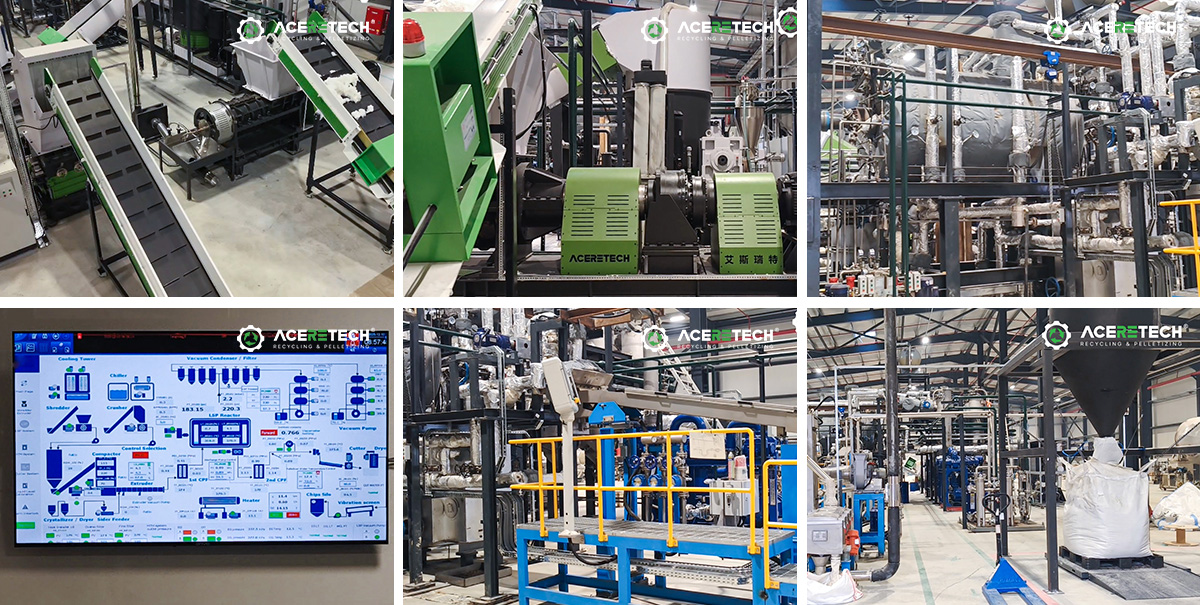
This case demonstrates the maturity and reliability of ACERETECH's PET fiber recycling technology in high-end textile applications.
FAQ
A: Yes. Through intrinsic viscosity enhancement systems such as LSP, recycled PET can achieve fiber-grade viscosity suitable for spinning applications.
A: Thermal degradation and moisture cause molecular chain breakage, thus reducing intrinsic viscosity.
A: Typically, the ionic viscosity (IV) of fiber-grade PET is approximately 0.64–0.70, with specific values depending on the application.
A: Yes. The DTS crushing and compaction system is designed specifically for flexible, lightweight PET materials.
A: Online systems reduce processing time, lower energy consumption, and can be directly integrated into extrusion lines.