Summary: Choosing between a single-stage and a double-stage plastic pelletizer isn't just a technical choice—it directly dictates your factory's profit margins and operational headaches. As a general rule, single-stage systems are highly cost-effective for clean, dry factory scraps, while double-stage systems are essential for heavily printed or washed post-consumer waste. Before committing your capital, you must evaluate three core variables: your feedstock contamination level, your moisture content, and the quality expectations of your target pellet buyers.
I. What Are Single-Stage and Double-Stage Pelletizers?
💡 The Strategic Difference: When investing in a plastic recycling line, the quickest way to protect your ROI is understanding how your machinery handles stress. While both systems melt and pelletize waste, they manage the physical breakdown of contaminants in fundamentally different ways.
A single-stage pelletizing system relies on a single extruder to complete the entire recycling process—from melting and mixing to venting, filtering, and final pelletizing. It features a continuous, single-screw design optimized for streamlined workflows.
In contrast, a double-stage pelletizing system (often called a cascade system) links two separate extruders in series. The primary extruder handles the initial heavy lifting of melting and rough filtering, while the secondary, sub-extruder focuses entirely on deep degassing and ultra-fine final filtration.
II. Structural Comparison
💡 Inside the Engineering: A machine's physical footprint directly dictates its maintenance overhead and floor space requirements. Seeing how these systems differ mechanically helps your production team plan for long-term operational efficiency.
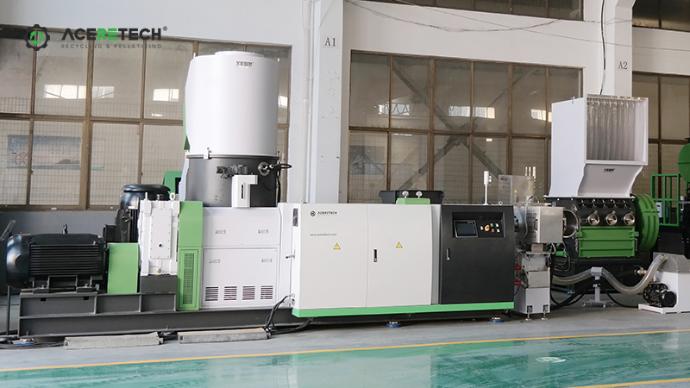
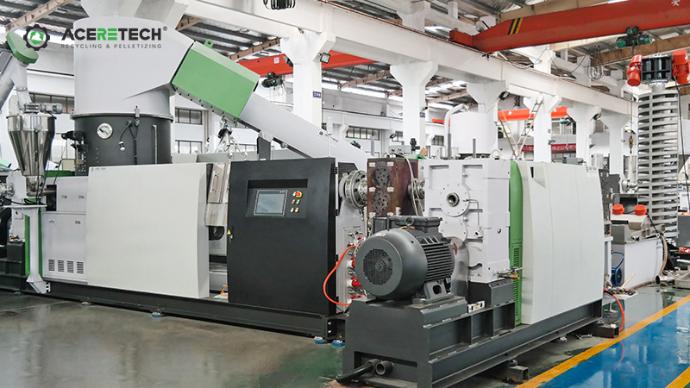
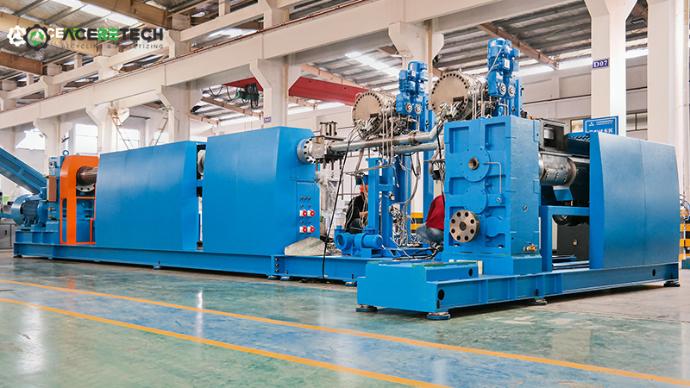
The mechanical layouts of Aceretech's two flagship configurations highlight this structural evolution:
- Single-Stage Configuration (e.g., ACS-H/ASE Series): This setup integrates a compact single-shaft shredder or cutter compactor directly with a single extruder. The material moves natively along one barrel, keeping the machinery compact, straightforward to operate, and highly energy-efficient.
- Double-Stage Configuration (e.g., ACSS/ADS Series): This advanced layout pairs a heavy-duty cutter compactor or shredder with a primary extruder, which then feeds gravity-assisted or force-fed melt directly into a secondary extruder. While it occupies a larger workshop footprint, it multiplies your processing control.
🔗 [Complete Process Guide] The built-in compactor/shredder system (such as our ACS-H series) is just one critical piece of a successful plant. To see how this single-stage technology integrates into the overarching workflow—from sorting and shredding to final compounding—read our [How to Recycle Plastic Film Efficiently: Complete Film Recycling Process Guide].
III. Comparison of Core Differences
💡 The Bottom-Line Comparison: To help you balance your initial capital investment against long-term daily operating costs, we have mapped out exactly how these two technologies stack up across your most critical manufacturing metrics.
The following matrix contrasts the single-stage and double-stage systems to help you pinpoint the exact threshold where upgrading to a two-stage system becomes financially justifiable:
| Comparison Item |
Single-Stage Pelletizer (ACS-H/ASE) |
Double-Stage Pelletizer (ACSS/ADS) |
| Structure |
Simple |
Relatively Complex |
| Investment Cost |
Low |
Higher |
| Plasticization Capacity |
Moderate |
⭐ Stronger |
| Degassing Capacity |
Moderate |
⭐⭐ Extremely Strong |
| Applicable Materials |
Clean Materials |
Highly Contaminated Materials |
| Pellet Quality |
Moderate |
⭐ Higher |
IV. Why Does the Double-Stage System Offer Superior Performance?
💡 Core Takeaway for Buyers: Why do double-stage pelletizers command a higher price point? It’s because they introduce a crucial "buffer and treatment zone." Think of it as a secondary high-efficiency digestive system that effortlessly processes volatile contaminants and moisture that a single-stage machine simply cannot handle.
1. Optimization of the Plasticization Process
In a single-stage system, melting, venting, and filtering must all happen within one continuous screw, putting immense stress on the material.
- The Double-Stage Advantage: It splits the workload perfectly. The first extruder focuses purely on melting and initial compounding, and then transfers the semi-molten material into the second extruder for fine plasticization and uniform extrusion.
- Why It Matters to You: Because the screws aren't overloaded, shearing heat is drastically reduced. This prevents thermal degradation, preserving the physical properties and market value of your recycled plastic.
2. Enhanced Degassing Efficiency
When plastics melt, residual moisture, inks, and additives turn into massive amounts of gas. If not fully vented, your final pellets will suffer from severe porosity (air bubbles).
- The Double-Stage Advantage: The three vacuum degassing zones mentioned earlier are highly strategic. As material drops from the first stage into the second, it undergoes a sudden pressure release. This acts like popping the cap off a soda bottle, forcing deep-seated gases to erupt and escape.
- Why It Matters to You: Whether you are processing high-moisture washed materials or heavily printed packaging films, this feature guarantees dense, solid pellets with zero air pockets.
3. Double Filtration for Ultimate Purity
- The Double-Stage Advantage: It places a melt filter at the end of both the first and second stages (Double Melt Filtration).
- Why It Matters to You: The first filter rough-screens large contaminants, protecting the system. The second filter fine-screens micro-impurities and black spots. This not only delivers top-tier pellet purity but also extends the lifespan of your high-mesh filters, cutting down on costly downtime for filter changes.
V. Which Plastic Materials Require a Single-Stage or Double-Stage System?
💡 Core Takeaway for Buyers: Choosing the wrong machine setup is the most expensive mistake you can make. To help you invest smartly, we break down exactly which machine fits your specific material condition and final product goals:
🌟 When is a "Single-Stage System" More Than Enough?
If your material stream is clean and consistent, there is no need to overspend. A single-stage system offers the fastest ROI for:
- Clean Industrial Scrap (Post-Industrial Waste): Such as factory edge trims from bag making, unprinted film scraps, or injection molding rejects.
- Low-Moisture, Unprinted Rigid Flakes: Materials that are already dry and free of surface contamination.
- Budget-Conscious Projects with Standard Quality Requirements: If your downstream buyers do not require optical-grade pellets, a single-stage machine keeps your operational and initial capital costs incredibly low.
If your downstream buyers do not require optical-grade pellets, a single-stage machine keeps your operational and initial capital costs incredibly low.
🔗 [Real-World Application] Discover how we tailored a high-efficiency layout specifically for flexible packaging waste by exploring our [PE Film Shredding And Pelletizing Integrated Solution] case study.
🚀 When Do You "Absolutely Need" a "Double-Stage System"?
If your business strategy revolves around processing unpredictable post-consumer waste, or if you want to command premium prices for your pellets, a double-stage system is non-negotiable:
- Heavily Printed and High-Moisture Materials: Such as post-consumer courier bags, printed packaging films, or washed materials that still retain residual surface moisture.
- Highly Contaminated or Mixed Recyclables: Materials containing paper labels, aluminum foil micro-particles, or dust that require two stages of filtration to prevent frequent clogging.
- Targeting High-End Applications: If you sell your pellets to film blowing or yarn drawing plants where quality standards are brutal, only the "bubble-free, black-spot-free" output of a double-stage system will secure those lucrative contracts.
VI. Common Misconceptions
💡 Core Takeaway for Buyers: In our consultations with global plastics recyclers, we find that nearly 80% of buyers fall into two classic traps. Misunderstanding these realities can lead to wasted capital or buying a machine that drains your monthly profits.
❌ Misconception 1: A double-stage system automatically means double the output.
- The Reality: Output is determined by screw diameter and motor power, not by how many stages the machine has.
- Many buyers assume that linking two extruders together will double their hourly production. This is technically incorrect. The second stage exists entirely to refine quality through superior venting and filtration; it acts as a secondary treatment and pressurization station. At identical screw sizes, a single-stage and a double-stage system will yield roughly the same hourly output.
❌ Misconception 2: If budget permits, it’s always safer to buy a double-stage system just in case.
- The Reality: If your input materials are clean, running a double-stage system is actually wasting electricity and labor.
- Because a double-stage system features an extra screw, additional heating bands, and a second screen changer, its energy consumption and daily maintenance costs are significantly higher than a single-stage alternative. If your factory only processes clean, in-house factory scraps, buying a double-stage machine means paying extra on your electric bill every single day for capability you don't use. The best machine is always the one that matches your specific feedstock.
VII. Conclusion: Making Your Investment Count
💡 The Expert's Final Verdict: Machinery is a long-term capital investment. The most expensive pelletizer is not the one with the highest price tag, but the one that stands idle in your factory because it cannot handle your real-world material.
To wrap up, your choice locks in your factory's operational DNA for the next decade:
- Choose the Single-Stage System if you possess a stable, closed-loop source of clean industrial scrap. It will reward you with low energy bills, simple maintenance, and a lightning-fast return on investment.
- Choose the Double-Stage System if you are diving into the post-consumer recycling market, managing unpredictable waste, or targeting premium buyers who demand flawless, zero-porosity pellets.
Choose the Double-Stage System if you are diving into the post-consumer recycling market, managing unpredictable waste, or targeting premium buyers who demand flawless, zero-porosity pellets.
🔗 [System Integration] Keep in mind that high-quality pelletizing requires flawless pre-washing for contaminated post-consumer waste. Learn how our turn-key frontline processing works in our comprehensive showcase of the [Waste Plastic Film Recycling Washing Line].
Still Undecided on Which System Fits Your Production Line? Don't guess with your capital. Contact Aceretech's engineering team today. Send us a sample of your feedstock, and we will run a custom analysis to design the exact extrusion setup that guarantees your profitability.
FAQ
Q1. What is the main difference between single and double stage pelletizing machines?
A: The main difference between a single stage pelletizing machine and a double stage pelletizing machine lies in the number of extrusion and degassing processes.
A single stage system completes melting and pelletizing in one step, while a double stage system performs two-step plasticizing and double degassing, making it more suitable for contaminated or high-moisture plastic materials.
👉 This directly affects pellet quality, density, and stability.
Q2. When should I choose a double stage pelletizing machine?
A: You should choose a double stage pelletizing machine when processing:
High moisture plastic films
Printed films with ink
Materials with oil, glue, or contaminants
Post-consumer plastic waste
👉 The double stage system provides stronger degassing and better melt homogenization, ensuring higher quality pellets.
Q3. Can a single stage pelletizing machine handle wet or contaminated plastic?
A: A single stage pelletizing machine can handle slightly contaminated or low-moisture materials, but it is not ideal for heavily contaminated or wet plastics.
👉 If moisture or impurities are too high, it may lead to:
Air bubbles in pellets
Unstable extrusion
Lower pellet quality
In such cases, a double stage pelletizing system is recommended.
Q4. Does a double stage pelletizing machine always produce better pellets?
A: Not necessarily.
A double stage pelletizing machine performs better for complex materials, but for clean and dry plastic, a single stage system can already produce high-quality pellets.
👉 Choosing a double stage system for clean material may:
Increase investment cost
Raise energy consumption
Reduce overall cost efficiency
Q5. How do I choose the right pelletizing machine for my plastic recycling line?
A: To choose the right plastic pelletizing machine, consider three key factors:
1️⃣ Material contamination level
2️⃣ Moisture content
3️⃣ Final pellet quality requirements