Case Study on Nylon Waste Yarn Recycling

2026/02/25

With the increasing production capacity of nylon fibers, manufacturers face growing challenges in recycling waste yarn, substandard filaments, and scraps. A nylon filament producer selected ACERETECH's DTS disc shredder to establish an efficient internal recycling system.
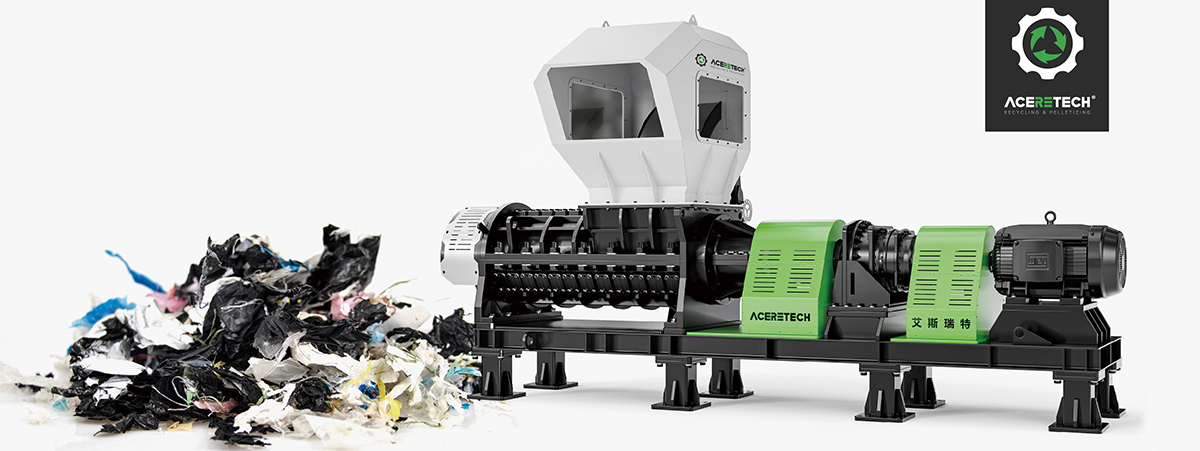
DTS Disc Shredder
This case study outlines the challenges faced, the technical solutions, and the proven operational results.

I. Project Overview

● Materials: Nylon waste yarn and filaments
● Application: Pretreatment before pelleting
● Target Capacity: 500 kg/h
● Objective: Stable shredding, avoiding shaft entanglement or clogging

The customer needed a shredding system capable of handling high-strength, flexible fibers without frequent downtime.

II. Challenges: Why is Nylon Fiber Difficult to Shred?

Nylon waste yarn faces numerous challenges during processing:

● High tensile strength
● Prone to tangling
● Poor cut resistance
● Low bulk density but high elasticity

Traditional shredders often experience the following problems:

● Severe shaft entanglement
● Material blockage
● Unstable output particle size
● Rapid blade wear
● Requires frequent manual intervention

The customer needs a machine specifically designed for processing flexible, long-fiber materials.

III. Solution: DTS Disc Shredder (Integrated Shredding and Crushing)

The DTS disc shredder integrates shredding and particle size reduction into one unit. The output particle size is suitable for direct feeding into a pelletizing extruder, thereby reducing processing steps.

DTS Disc Shredder

Key Technical Features

1. Disc Rotor Design

● Forged alloy steel shredding shaft
● CNC precision machining to meet high-precision manufacturing requirements
● Spline connection for high torque transmission
● Optimized disc arrangement to reduce fiber entanglement; the disc structure effectively reduces the entanglement problem commonly encountered in long fiber processing.

2. High-Efficiency Drive System

The main motor uses a WEG motor, ensuring:

● Stable torque output
● High proportion of input electrical energy converted into mechanical energy; high energy conversion efficiency, cost savings
● Reliable continuous operation

3. Heavy-Duty Gearbox Structure

● High-strength ductile iron housing
● High load-bearing capacity
● Low-noise operation
● Long service life

This configuration supports continuous industrial production.

4. Intelligent Control System

This machine is equipped with a Siemens PLC control system, which can:

● Monitor motor current in real time
● Automatically control conveyor feeding
● Prevent overload
● Reduce manual intervention

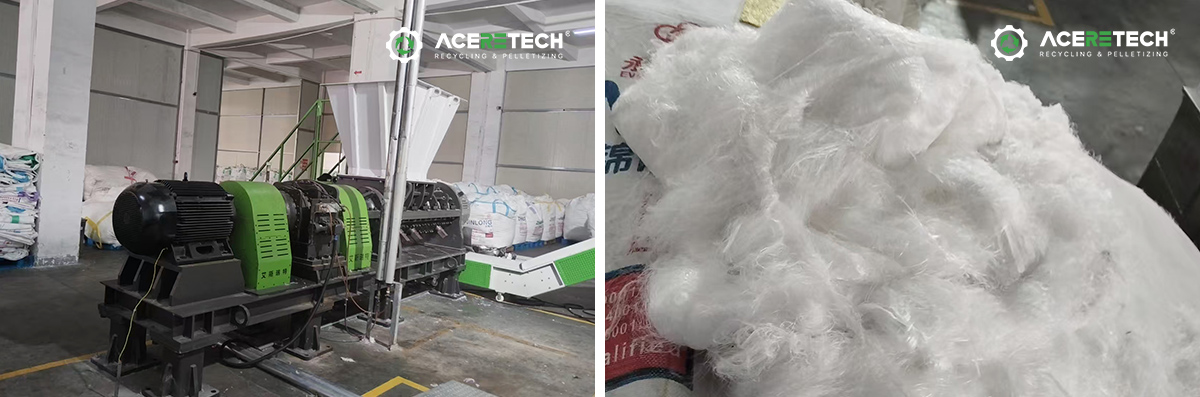
IV. Performance Results (On-site Verification)

After installation and commissioning, the machine's performance is stable:

✅ Capacity: 500 kg/h (continuous operation)
✅ Material flow: Smooth shredding process
✅ Shaft winding: No obvious winding observed
✅ Blockage: No blockage occurred during normal operation
✅ Output particle size: Uniform, suitable for granulation
✅ Noise level: Low
✅ Maintenance frequency: Significantly reduced

The customer successfully implemented an internal nylon recycling system, improving raw material utilization and reducing waste disposal costs.

V. Why is Disc Shredding Technology Suitable for Nylon Fibers?

This project demonstrates that disc rotor technology is particularly effective for the following materials:

● Long fiber materials
● Flexible industrial yarns
● Films and woven bags
● Soft plastic waste

Compared to traditional single-shaft shredders, the disc structure reduces continuous fiber entanglement and improves operational stability.