ACERETECH ATE Parallel Twin-Screw Pelletizing Machine
👉 Ideal for the modification and pelletizing of highly filled (30% CaCO₃) PE flakes
👉 Parallel twin-screw structure with good dispersion and compounding effect
👉 Equipped with screw side feeding and precise temperature control to ensure stable, continuous production
👉 Achieves a stable output capacity of 700–800 kg/h, meeting the demands of industrial-scale applications
I. Industry Challenges: Why PE High-Filling Compounding Difficult?
In the field of plastic compounding, as the filling ratio of calcium carbonate (CaCO₃) rises to 30%, traditional pelletizing equipment will face bottlenecks:
High Filler Ratio → Reduced Melt Flowability
Poor Dispersion → Unstable Pellet Performance
High Wear & Tear → Shorten Equipment Lifetime
Increased Thermal Sensitivity → Easy Degradation and Yellowing
👉 The Core Contradiction: achieve both a high filling ratio and stable, high-quality production.
II. Solution: The ATE Parallel Twin-Screw Pelletizing System
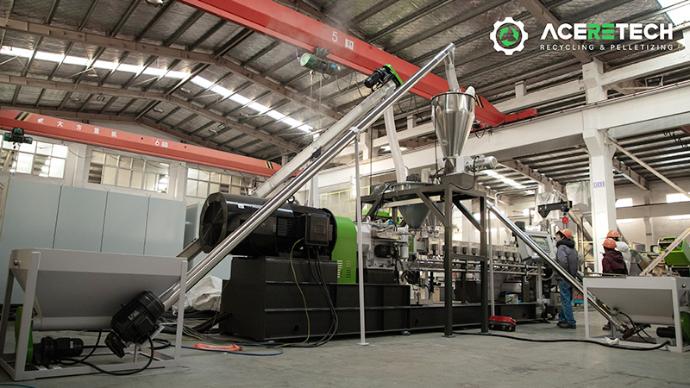
ACERETECH ATE series of parallel twin-screw pelletizing machines is specifically optimized for high filler masterbatch compounding and pelletizing applications. It is able to stably processing PE flakes with 30% CaCO₃, enabling efficient, continuous, and controllable industrial-scale production. By optimizing the screw structure, feeding system, and temperature control system, the ATE system achieves the following under high-filler conditions:
✔ Efficient Dispersion: Ensures uniform distribution of calcium carbonate within the PE flakes
✔ Stable Feeding: Prevents bridging and feeding fluctuations.
✔ Continuous Production: Reduces downtime and boosts production efficiency.
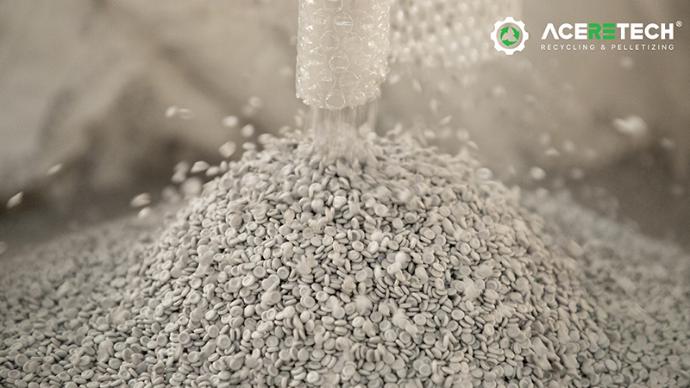
✔ High-Quality Pellet Output: Produces uniform pellets with stable performance.
III. Core Technological Advantages of the ATE Twin-Screw Pelletizing Machine

1️⃣ Side-Feeding System (Enhancing Feeding Stability)
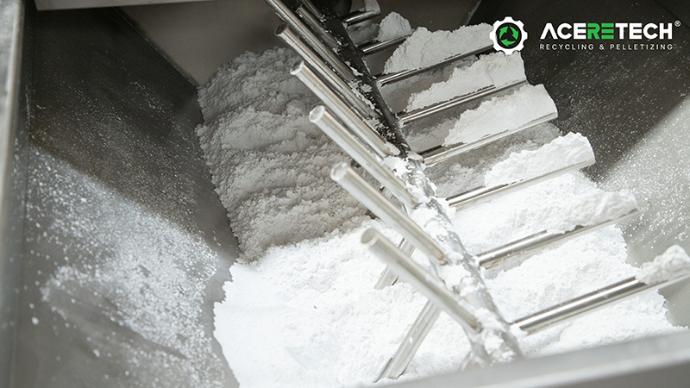
Designed specifically for high-filler systems involving PE flakes + CaCO₃:
Characterized by significant density differences
Characterized by poor flowability
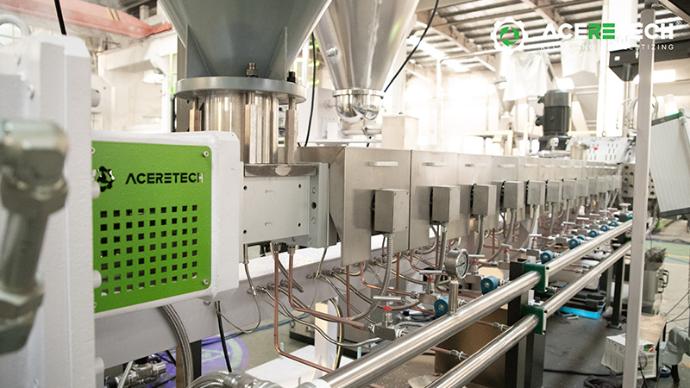
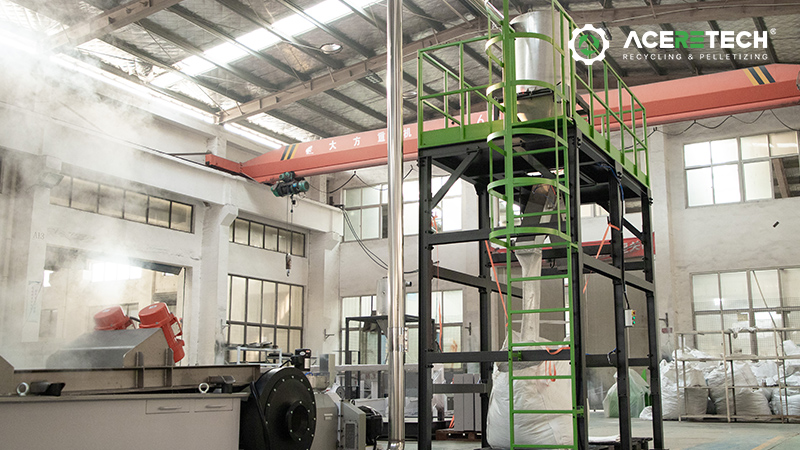
ATE adopts a side-feeding design:
Enables uniform and continuous conveyance of resin and filler.
Effectively prevents bridging and material clogging.
Significantly enhances feeding stability and continuity.
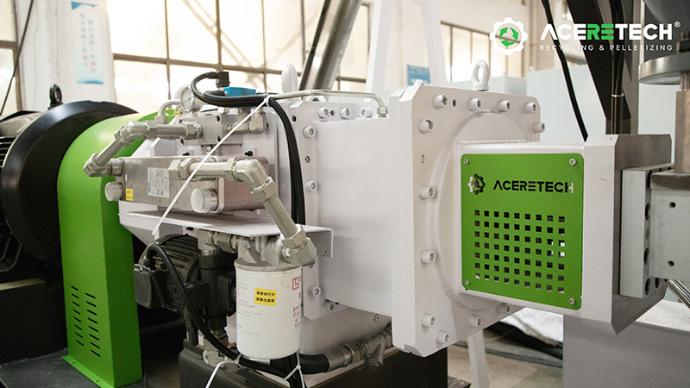
2️⃣ ATE75mm Parallel Twin-Screw Structure (Core Dispersion & Compounding Capability)
Optimized screw configuration (Shearing elements + Dispersion modules).
Intensifies compounding and plasticization effects.
Maintains stable melt pressure under conditions with 30% CaCO₃ filler content.
👉 Achieves uniform dispersion and stable extrusion with high-filler application
3️⃣ Intelligent Control System (Ensuring Continuous & Stable Operation)
Real-time monitoring: Screw speed / Temperature.
Automatic adjustment of key process parameters.
Prevents equipment overload and melt pressure fluctuations.
👉 Enhances complete line stability and reduces reliance on manual operation.
4️⃣ Precision Temperature Control System (Preventing Material Degradation)
Cast-copper / Cast-aluminum heaters + Water cooling system.
Rapid response to temperature fluctuations.
Multi-zone independent precision temperature control.
High-efficiency heat dissipation capability.
👉 Effectively prevents:
Thermal degradation of PE.
Pellet discoloration (yellowing).
Deterioration of mechanical properties.
5️⃣ High-Efficiency Filtration System (Enabling Continuous Production)
SCF Self-Cleaning Filtration System.
Automatic removal of impurities online.
Reduces the frequency of screen changing.
Significantly minimizes downtime.
👉 Enables truly continuous production (Continuous Operation).
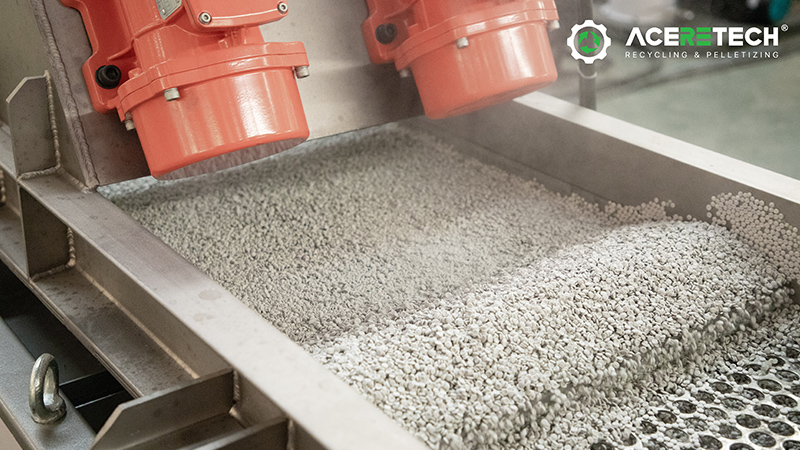
6️⃣ High-Quality Pelletizing & Dewatering System
Water-Ring Pelletizing System.
Stable and continuous pelletizing process.
Produces round, uniform size pellets.
👉 Particularly suitable for high-filler pelletizing applications.
Multi-Stage High-Efficiency Dewatering System.
Vibrating screen + Centrifugal Dewatering Unit
Efficient Moisture Removal
👉 Product Advantages:
Low moisture content
Excellent flowability
Easy storage and downstream processing
7️⃣ Whole-Line Capacity and Automatic System
Finished Product Silo + Automatic Conveying System
Automatically collects, stores, and conveys granules
Optimizes production cycle times
👉 Stable Capacity:
700–800 kg/h
👉 Meet the Demands of:
Large-scale industrial production
Long-duration continuous operation
IV. Application Fields for ATE Plastic compounding, Recycling, and Pelletizing
ATE parallel twin-screw pelletizing system is widely applicable in the fields of high-filler compounding and recycling pelletizing. It is particularly well-suited for systems containing inorganic fillers:
PE + CaCO₃ High-Filler compounds Materials (30% and above)
Production of Filler Masterbatches
Recycling and Repelletizing of rigid flakes
Construction Materials (pipes,boards, profiles)
Daily-Use Plastic Products (injection-molded / blow-molded products)
👉 Helping Customers Achieve: Reduced raw material costs + Enhanced product consistency + Improved production efficiency.
V. Why Choose ACERETECH?
In the field of high-filler compounding and pelletizing, equipment stability and process compatibility are equally critical. ACERETECH provides not just equipment, but complete solutions.
Core Advantages:
🔹 Focus on Plastic Recycling and compounding Pelletizing Technology
Years of deep industry expertise, covering the entire process line from crushing and washing to pelletizing
🔹 Extensive Experience in High-Filler Projects
Successfully applied to various high-filler systems (CaCO₃, talc powder, etc.)
🔹 Customized Screw Design Capabilities
Optimizing screw configurations and process parameters based on varying filler ratios and material characteristics
🔹 Globally Proven, Stable Equipment
Equipment has operated stably over the long term in numerous countries, demonstrating reliable performance
👉 ACERETECH offers not only equipment, but practical, implementable process solutions for compounding and pelletizing. Contact us to receive a professional quotation and service consultation.
FAQ
Q1. What are the biggest challenges involved in materials adding 30% calcium carbonate filler content?
A: The primary challenges are reduced flowability and increased difficulty in dispersion; additionally, it tends to cause equipment wear and melt instability.
Q2. Why use a twin-screw extruder rather than a single-screw extruder?
A: Twin-screw extruders present superior shearing and kneading capabilities, enabling the uniform dispersion of high-filler systems— that is difficult to achieve with single-screw extruders.
Q3. How does the ATE system ensure effective dispersion?
A: By optimizing the screw configuration (specifically, the combination of kneading blocks and dispersion elements) and precisely controlling shear intensity, the system ensures the uniform distribution of fillers.
Q4. Will high-filler materials reduce the equipment's service life?
A: Yes, they can; however, the ATE system utilizes wear-resistant materials and an optimized structural design to significantly extend the equipment's service life.
Q5. Does this system support even higher filler ratios?
A: Yes, it does. Based on the specific material properties and processing requirements, the screw configuration can be customized to accommodate even higher filler ratios.