I. Project Background
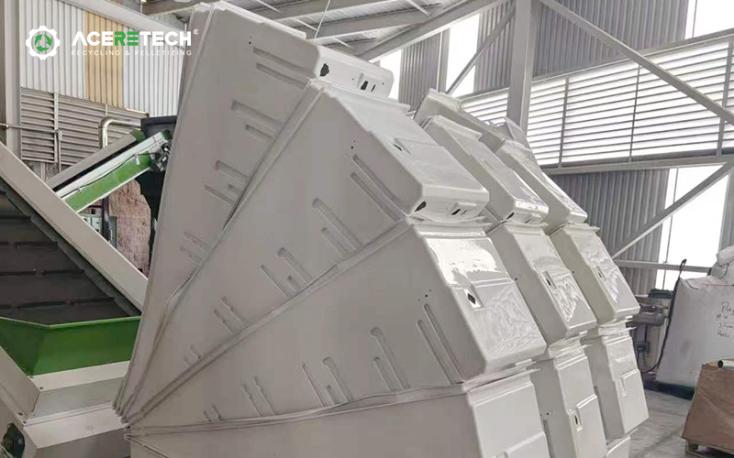
Large and rigid plastic scrap is commonly generated in injection molding, automotive parts manufacturing, home appliance production, plastic product manufacturing, and other industrial applications.
Typical waste can include ABS blocks, PS scrap, PP blocks, thick-walled PE products, large plastic housings, injection molding rejects, sheets, profiles, pipes, and other bulky plastic lumps.
Compared with conventional plastic scrap, these materials can be difficult to process directly because of their large dimensions, high mechanical strength, and relatively high weight.
For this application, ACERETECH developed a two-stage size-reduction solution combining a dual-shaft shredder with a GH700/1400 Heavy-Duty Crusher.
The system is designed for a processing capacity of approximately 1,500 kg/h.
The first stage reduces large and bulky plastic waste into smaller pieces, while the second stage further reduces the pre-shredded material to a suitable size for subsequent washing, pelletizing, modification, or other recycling processes.
II. Project Overview
Equipment Specifications
| Item |
Specification |
| Materials |
ABS, PS, PP, PE and other bulky rigid plastics |
| Main Application | Industrial rigid plastic size reduction |
| Processing Capacity | Approx. 1,500 kg/h |
| First Stage | Dual-Shaft Shredder |
| Second Stage | GH700/1400 Heavy-Duty Crusher |
| Dual-Shaft Motor | 37 kW × 2 |
| Dual-Shaft Rotor Diameter | 500 mm |
| Dual-Shaft Rotor Length | 1530 mm |
| Dual-Shaft Inlet | 1530 × 940 mm |
| GH Rotor Diameter | 700 mm |
| GH Rotor Width | 1400 mm |
| GH Cutting Chamber | 1150 × 815 mm |
| Screen Aperture | 12 mm |
| Control Intelligent | PLC Control |
Material Characteristics
The system is designed for bulky, rigid plastic waste generated from industrial production and recycling operations.
Typical materials include:
• ABS blocks
• ABS injection molding rejects
• PS plastic waste
• PP blocks
• Thick-walled PE products
• Large plastic containers and housings
• Industrial plastic offcuts
• Plastic sheets and boards
• Plastic profiles
• Plastic pipes
• Large rigid plastic lumps
These materials are widely found in:
• Injection molding plants
• Automotive parts manufacturing
• Home appliance manufacturing
• Plastic product factories
• Plastic recycling companies
• Industrial solid-waste recovery facilities
III. Why Is Two-Stage Size Reduction Used?
Large rigid plastic waste can place considerable mechanical load on a size-reduction machine when fed directly into a high-speed crusher.
For large blocks and bulky products, the first stage therefore focuses on volume reduction, while the second stage performs further size reduction and particle classification.
The process is:
Large Rigid Plastic Waste → Dual-Shaft Shredding → GH Heavy-Duty Crushing → 12 mm Screened Material
This two-stage configuration provides several practical benefits:
• Large material can enter the system without extensive manual pre-cutting
• The first-stage shredder reduces the size and bulk of the feedstock
• The second-stage crusher receives pre-shredded material
• The mechanical load is distributed between two machines
• The final material is prepared for downstream processing
IV. Complete Process Flow of Bulky Rigid Plastics Shredding & Crushing
The processing flow for this application is:
Feeding → Metal Detection → Dual-Shaft Shredding → Material Conveying → GH700/1400 Heavy-Duty Crushing → Roots Blower Conveying → Downstream Washing or Pelletizing
The system performs two consecutive size-reduction stages.
The first stage handles the large and bulky material, while the second stage further processes the pre-shredded material through the heavy-duty crusher.
Step 1: Feeding and Metal Detection
The rigid plastic scrap is transferred into the system through the feeding conveyor.
Before entering the shredding stage, the material passes through a metal-detecting conveyor.
This provides an additional layer of protection against accidental metallic contaminants entering the cutting system.
The system also includes emergency-stop protection for safe operation.
Step 2: Dual-Shaft Shredding
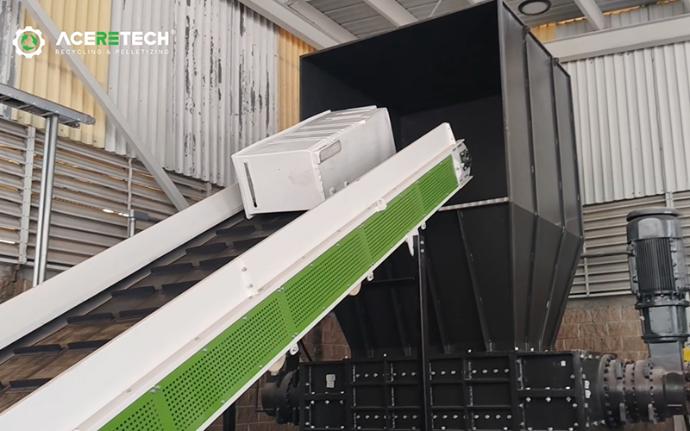
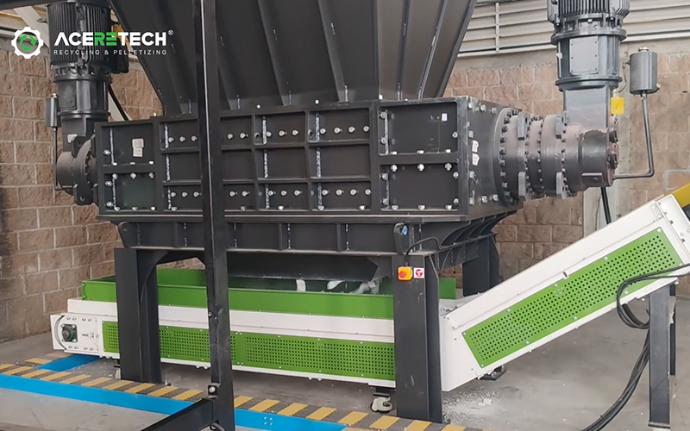
The dual-shaft shredder is the first major size-reduction stage.
It is designed to process large, hard, and bulky plastic materials that would be difficult to feed directly into a conventional crusher.
Main Specifications
| Item |
Specification |
| Processing Capacity |
Approx. 1,500 kg/h |
| Motor Power | 37 kW × 2 |
| Power Supply | AC 440 V, 3-phase, 60 Hz |
| Rotor Diameter | 500 mm |
| Rotor Length | 1530 mm |
| Rotor Speed | 11.6–12.9 rpm |
| Inlet Dimensions | 1530 × 940 mm |
Large-Size Inlet
The shredder features a large 1530 × 940 mm inlet.
This allows bulky plastic materials to enter the shredding chamber with less manual size reduction before feeding.
For large injection-molded rejects, plastic blocks, housings, and other oversized scrap, this can simplify material handling.
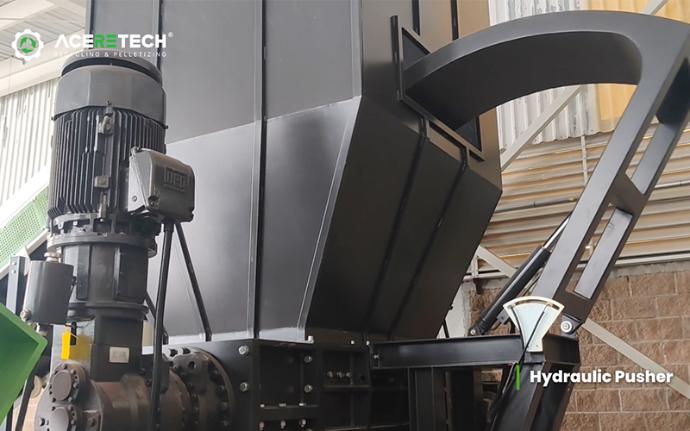
Hydraulic Ram Feeding
The hydraulic ram system assists material feeding into the shredding zone.
It pushes bulky plastic waste toward the cutting area and helps maintain stable material entry during continuous operation.
This is particularly useful when processing large or irregularly shaped rigid plastics.
High-Torque Drive System
The dual-shaft shredder uses 37 kW × 2 motors together with heavy-duty gearboxes.
The low-speed, high-torque configuration provides the mechanical force required for processing large rigid plastic waste.
Step 3: Material Conveying
After the first-stage shredding process, the reduced-size material is transferred toward the GH700/1400 Heavy-Duty Crusher.
The conveying system provides continuous material transfer between the two size-reduction stages.
This allows the shredder and crusher to operate as an integrated front-end processing system.
Step 4: GH700/1400 Heavy-Duty Crushing
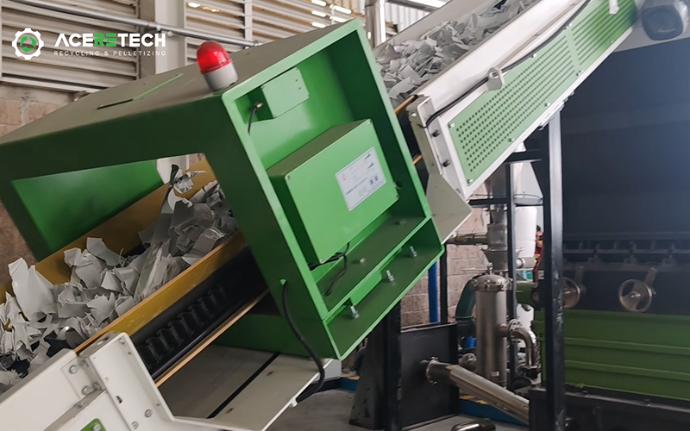
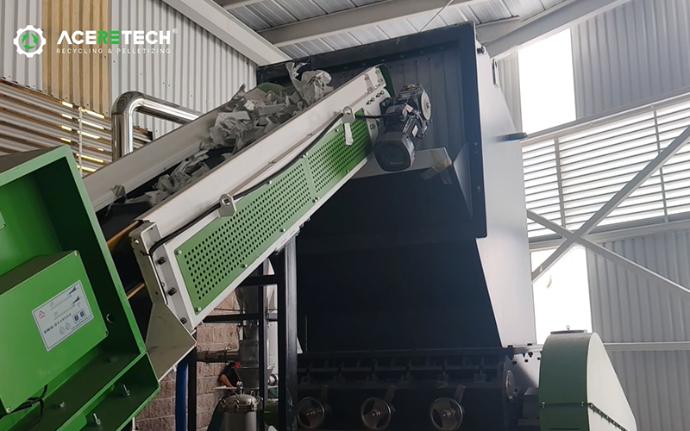
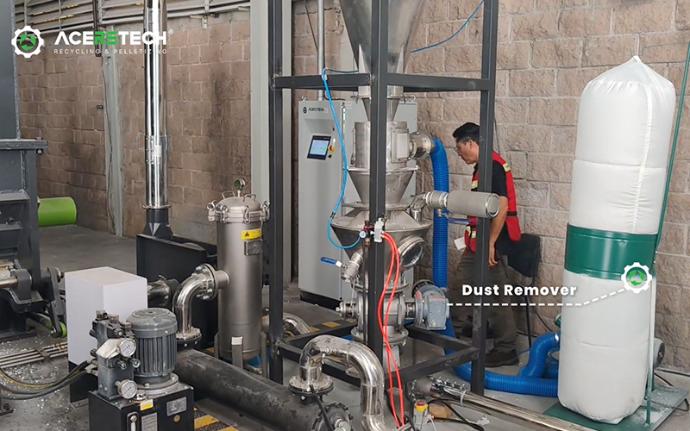
After pre-shredding, the material enters the GH700/1400 Heavy-Duty Crusher for secondary size reduction.
Main Specifications
| Item |
Specification |
| Model |
GH700/1400 |
| Rotor Diameter | 700 mm |
| Rotor Width | 1400 mm |
| Cutting Chamber | 1150 × 815 mm |
| Screen Aperture | 12 mm |
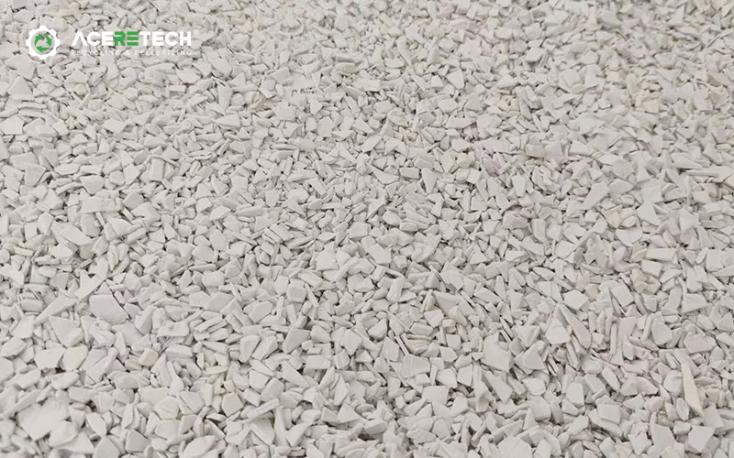
The second stage further reduces the pre-shredded rigid plastic and produces material that can be transferred to subsequent recycling processes.
V-Rotor Cutting Design
The GH Series uses a V-shaped rotor configuration.
The cutting tools are arranged to improve the interaction between the rotor and the material during processing.
The design is intended to provide:
• Efficient cutting
• Stable material processing
• Reduced energy consumption
• Controlled cutting clearance
• Consistent size-reduction performance
The rotor and cutting chamber geometry are optimized for heavy-duty plastic recycling applications.
Heavy-Duty Machine Construction
The GH700/1400 uses an all-steel welded machine structure designed for continuous heavy-load operation.
The heavy-duty construction helps the machine withstand the mechanical loads associated with processing bulky rigid plastics.
The system also incorporates:
• Large-sized rotor bearings
• Wear-resistant chamber liners
• External bearing structure
• Heavy-duty hydraulic feeding
• Intelligent control system
External Bearing Structure
The bearings are positioned outside the cutting chamber.
This design helps reduce the exposure of the bearings to plastic dust and other contaminants generated during size reduction.
It also supports easier maintenance and contributes to the long-term reliability of the machine.
Wear-Resistant Chamber Design
Wear-resistant liners are installed inside the cutting chamber.
These liners help protect the main machine structure from material abrasion during continuous operation.
This is particularly relevant for applications involving heavy and rigid plastic scrap.
Step 5: Screening and Material Transfer
The GH700/1400 crusher is equipped with a 12 mm screen aperture.
Material is reduced through the cutting chamber and screened according to the installed screen configuration.
The processed material is then transferred through the conveying system.
A Roots blower conveying system is used for material transportation after the crushing stage.
Step 6: Downstream Processing
After the two-stage size-reduction process, the processed plastic material can be transferred to the customer's subsequent recycling process.
Depending on the material and final application, possible downstream processes include:
• Plastic washing
• Pelletizing
• Compounding
• Modification extrusion
• Injection molding recycling
• Other plastic reprocessing applications
The actual downstream configuration depends on the material condition and the customer's final requirements.
V. Complete Processing Flow
The complete front-end process can be summarized as:
Bulky Rigid Plastic Waste → Feeding Conveyor → Metal Detection → Dual-Shaft Shredding → Material Conveying → GH700/1400 Heavy-Duty Crushing → 12 mm Screening → Roots Blower Conveying → Downstream Washing / Pelletizing / Modification
This two-stage size-reduction system converts large and bulky rigid plastic waste into a more manageable feedstock for subsequent recycling.
VI. Key Advantages of This Two-Stage Solution
1. Handles Large and Bulky Plastic Waste
The large inlet of the dual-shaft shredder allows large rigid plastic scrap to be processed with reduced manual pre-cutting requirements.
2. Two-Stage Volume and Size Reduction
The dual-shaft shredder performs the initial volume reduction, while the GH700/1400 provides secondary size reduction.
This distributes the processing load between the two machines.
3. 1,500 kg/h Processing Capacity
The system is designed for a processing capacity of approximately 1,500 kg/h for the application described in this case.
4. Hydraulic Feeding
Hydraulic ram feeding supports stable processing of large and irregular rigid plastic materials.
5. Equipment Protection
The metal-detecting conveyor and emergency-stop system provide additional protection during operation.
6. Heavy-Duty Crusher Construction
The GH700/1400 features an all-steel welded structure, large rotor bearings, wear-resistant liners, and an external bearing configuration for demanding recycling applications.
7. Suitable for Multiple Rigid Plastics
The system can be applied to a variety of rigid plastic materials, including ABS, PS, PP, and PE.
VII. Applications of the Processed Material
The processed material from the two-stage size-reduction system can be used as feedstock for various downstream recycling processes.
Depending on the material type and final application, the material can be further processed through:
• Washing and drying
• Plastic pelletizing
• Compounding
• Modification extrusion
• Injection molding
• Other recycling processes
For contaminated post-consumer rigid plastics, a washing process may be required before pelletizing.
For clean post-industrial production scrap, the shredded and crushed material may be transferred directly to a subsequent granulation or processing stage, depending on the customer's requirements.
Related Articles
Rigid Plastic Pelletizing Solutions
Rigid Plastic Washing Solutions
VIII. Project Summary
This application demonstrates a 1,500 kg/h two-stage size-reduction solution for bulky rigid plastic waste.
The system combines:
Feeding → Metal Detection → Dual-Shaft Shredding → Material Conveying → GH700/1400 Heavy-Duty Crushing → Roots Blower Conveying
The dual-shaft shredder is responsible for the initial processing of large and bulky plastic materials, while the GH700/1400 Heavy-Duty Crusher performs the subsequent size reduction.
With a 1530 × 940 mm shredder inlet, 500 mm rotor diameter, 700 mm crusher rotor diameter, 1400 mm crusher rotor width, and 12 mm screen aperture, the system is configured for continuous processing of large rigid plastic scrap.
The solution provides a practical front-end size-reduction system for ABS, PS, PP, PE, and other bulky rigid plastic waste before subsequent washing, pelletizing, modification, or other recycling processes.
Looking for a Rigid Plastic Size-Reduction Solution?
ACERETECH provides industrial size-reduction solutions for bulky rigid plastics, including dual-shaft shredders, heavy-duty crushers, conveying systems, metal detection, and integrated front-end recycling equipment.
The equipment configuration can be designed according to the characteristics of your plastic waste and the requirements of your downstream recycling process.
Contact ACERETECH to discuss your rigid plastic shredding and crushing application.
FAQ
Q1. What materials can be processed by this system?
A: The system is designed for bulky rigid plastic materials such as ABS, PS, PP, and PE.
Typical feedstock includes injection molding rejects, thick-walled plastic products, plastic blocks, sheets, profiles, pipes, housings, and industrial offcuts.
Q2. Why are a dual-shaft shredder and heavy-duty crusher used together?
A: The dual-shaft shredder performs the initial size and volume reduction of large rigid plastic waste.
The pre-shredded material is then processed by the GH700/1400 Heavy-Duty Crusher for further size reduction.
This two-stage process is suitable for large and bulky materials that are difficult to process efficiently with a crusher alone.
Q3. Does the system require manual pre-cutting of large plastic pieces?
A: The large 1530 × 940 mm inlet of the dual-shaft shredder is designed to accommodate large rigid plastic waste and reduce the need for extensive manual pre-cutting.
However, the actual feed size should still be evaluated according to the material dimensions and operating requirements of the specific project.
Q4. What is the screen size of the GH700/1400 crusher?
A: The GH700/1400 crusher in this application is equipped with a 12 mm screen aperture.
The final output characteristics depend on the material and operating conditions as well as the installed screen configuration.
Q5. Can the processed material go directly to pelletizing?
A: Yes, depending on the material condition and the requirements of the downstream process.
Clean post-industrial rigid plastic scrap can potentially proceed directly to pelletizing or modification after size reduction.
If the material contains significant contamination, a washing and drying process may be required before pelletizing.